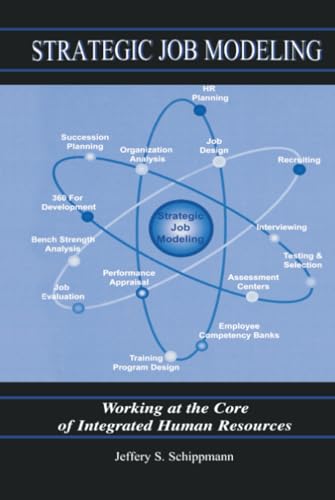

Strategic job modeling working at the core of integrated human resources Jeffery S. Schippmann.
Detalles de publicación: Mahwah, N.J. L. Erlbaum c1999.Descripción: xvi, 302 p. ill. 24 cmISBN:- 0805830529 (cloth : alk. paper)
- 0805830537 (pbk. : alk. paper)
- 658.306 S3369s 21
- HF5549.5.J6 S35 1999
| Imagen de cubierta | Tipo de ítem | Biblioteca actual | Biblioteca de origen | Colección | Ubicación en estantería | Signatura topográfica | Materiales especificados | Info Vol | URL | Copia número | Estado | Notas | Fecha de vencimiento | Código de barras | Reserva de ítems | Prioridad de la cola de reserva de ejemplar | Reservas para cursos | |
|---|---|---|---|---|---|---|---|---|---|---|---|---|---|---|---|---|---|---|
| Libro | Biblioteca Mons. Iñaki Mallona (Arecibo) Colección General ab | 658.306 S3369s (Navegar estantería(Abre debajo)) | Disponible | 60000001986683 |
Descripciones mejoradas de Syndetics:
(USE FOR PRACTITIONER/BUSINESS PIECES)
In an increasingly knowledge-based economy, a company's success hinges on the quality of its people. People set strategy, make decisions, build relationships, and drive change. Businesses possess a powerful advantage if their people do their jobs better and faster than the competition. The need for more sophisticated, integrated, and strategically linked human resource applications (e.g., selection systems, training programs, and performance management interventions) is recasting the very role of HR. One of the critical tools in the HR professionals' toolkit that has been used to create these applications is job analysis. However, much of today's job analysis practice has failed to keep up with the evolutionary pace.
This book is about a "next generation" job analysis method that involves translating business strategies into work performance and competency requirements, and using this information and data to create an architecture that can be used to support the sophisticated HR applications and enterprise resource planning systems that will be a part of high-performance third millennium organizations. Numerous case studies, applied examples, and project management tips contribute to the practice-oriented design of the book to illustrate a personnel research activity that is essentially an ongoing organizational development intervention.
(USE THIS COPY FOR TEXTBOOK PIECES) The business landscape is changing and becoming more complex. Furthermore, human resources is at the vortex of much of what is changing. The need for more sophisticated, integrated, and strategically linked human resource applications (e.g., selection systems, training programs, and performance management interventions) is recasting the very role of HR. One of the critical tools in the HR professionals' toolkit that has been used to create these applications is job analysis. However, much of today's job analysis practice has failed to keep up with the evolutionary pace.
This book is about a "next generation" job analysis method that involves translating business strategies into work performance and competency requirements, and using this information and data to create an architecture that can be used to support the sophisticated HR applications and enterprise resource planning systems that will be a part of high-performance third millennium organizations. Numerous case studies, applied examples, and project management tips contribute to the practice-oriented design of the book to illustrate a personnel research activity that is essentially an ongoing organizational development intervention.
Includes bibliographical references and indexes.
Tabla de contenidos provista por Syndetics
- Preface(p. ix)
- Author's Note(p. xv)
- References(p. xv)
- I The Basics Of Strategic Job Modeling(p. 1)
- Chapter 1 Introduction to Strategic Job Modeling(p. 3)
- References(p. 16)
- II The Practice Of Strategic Job Modeling(p. 33)
- Chapter 3 What Is the Organization's Vision and Competitive Strategy?(p. 35)
- Chapter 4 What Applications Are Required to Achieve Desired Outcomes?(p. 69)
- Chapter 5 Who is the Target Population?(p. 117)
- Chapter 7 How is the Information Analyzed and Displayed?(p. 190)
- III The Future Of Strategic Job Modeling(p. 231)
- Chapter 8 Final Comments and Prognostications(p. 233)
- Appendix A Work Activity and Competency Taxonomies for Management(p. 238)
- Rference(p. 259)
- Appendix B Data-Reduction Techniques in Job Modeling(p. 260)
- References(p. 272)
- References(p. 275)
- Author Index(p. 289)
- Subject Index(p. 294)