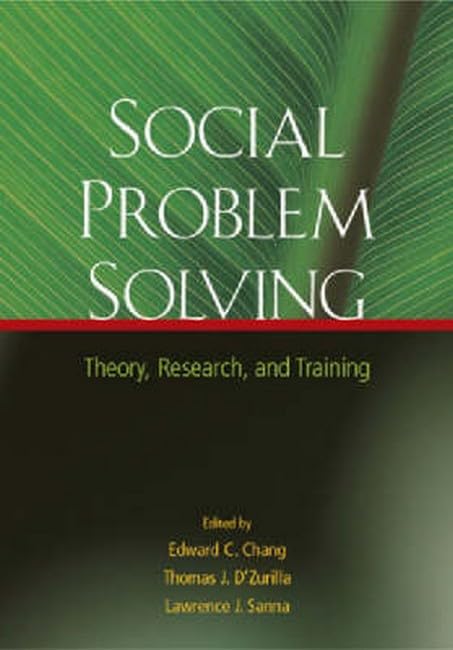

Social problem solving theory, research, and training edited by Edward C. Chang, Thomas J. D'Zurilla, Lawrence J. Sanna.
Detalles de publicación: Washington, DC American Psychological Association c2004.Edición: 1st edDescripción: xvi, 276 p. ill. 27 cmISBN:- 1591471478
- 153.4/3 22
- BF449 .S67 2004
| Imagen de cubierta | Tipo de ítem | Biblioteca actual | Biblioteca de origen | Colección | Ubicación en estantería | Signatura topográfica | Materiales especificados | Info Vol | URL | Copia número | Estado | Notas | Fecha de vencimiento | Código de barras | Reserva de ítems | Prioridad de la cola de reserva de ejemplar | Reservas para cursos | |
|---|---|---|---|---|---|---|---|---|---|---|---|---|---|---|---|---|---|---|
| Libro | Biblioteca de Mayagüez Colección General mb | BF449 .S67 2004 (Navegar estantería(Abre debajo)) | Disponible | 50000003179206 |
Descripciones mejoradas de Syndetics:
Throughout history, philosophers have argued that the capacity to solve problems successfully in the real world is a crucial component for one's well-being. Psychologists have since been looking to understand the nuances of problem solving specifically as it applies to the self-directed cognitive-behavioral process by which an individual, couple, or group attempts to identify or discover effective solutions for problems encountered in everyday living. From this researchers are developing training methods in which people can learn to solve problems effectively and positively thereby leading to generalized and durable behavior changes. In Social Problem Solving: Theory, Research, and Training, readers will find a nice balance of theory and research in social problem solving and well as practical methods and training approaches. Because of the widespread relevance of social problem solving, this book is not only for researchers and mental health practitioners, but also for students and other readers who would like to maximize their effectiveness and success in dealing with real and complex problems in everyday living.
Includes bibliographical references and indexes.
gccoct2007
Tabla de contenidos provista por Syndetics
- Contributors(p. ix)
- Foreword(p. xi)
- Preface(p. xv)
- Introduction: Social Problem Solving for the Real World(p. 3)
- I. What Is Social Problem Solving?(p. 9)
- Chapter 1. Social Problem Solving: Theory and Assessment(p. 11)
- Chapter 2. Mediators and Moderators of Social Problem Solving(p. 29)
- II. Social Problem Solving and Adjustment(p. 47)
- Chapter 3. Social Problem Solving, Stress, and Negative Affect(p. 49)
- Chapter 4. Social Problem Solving and Suicide Risk(p. 67)
- Chapter 5. Social Problem Solving and Schizophrenia(p. 83)
- Chapter 6. Social Problem Solving and Positive Psychological Functioning: Looking at the Positive Side of Problem Solving(p. 99)
- Chapter 7. Social Problem-Solving Abilities and Behavioral Health(p. 117)
- Chapter 8. Social Problem Solving and Mental Simulation: Heuristics and Biases on the Route to Effective Decision Making(p. 135)
- III. Problem-Solving Training and Therapy(p. 151)
- Chapter 9. Problem-Solving Training for Children and Adolescents(p. 153)
- Chapter 10. Problem-Solving Therapy for Adults(p. 171)
- Chapter 11. Problem-Solving Training for Couples(p. 193)
- Chapter 12. Problem-Solving Training for Families(p. 209)
- Chapter 13. Problem-Solving Therapy for Caregivers(p. 223)
- IV. Conclusion(p. 239)
- Chapter 14. Social Problem Solving: Current Status and Future Directions(p. 241)
- Author Index(p. 255)
- Subject Index(p. 267)
- About the Editors(p. 275)