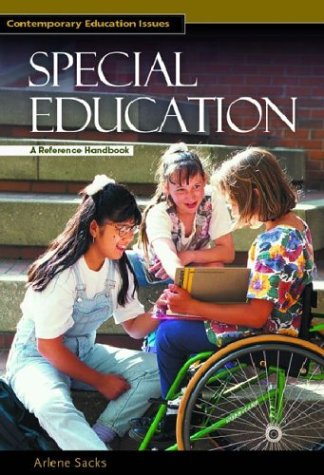

Special education a reference handbook Arlene Sacks.
Series Contemporary education issuesDetalles de publicación: California ABC-CLIO 2001.Descripción: xii, 235 p. 24 cmISBN:- 1576072746
- LC3981 .S33 2001
| Imagen de cubierta | Tipo de ítem | Biblioteca actual | Biblioteca de origen | Colección | Ubicación en estantería | Signatura topográfica | Materiales especificados | Info Vol | URL | Copia número | Estado | Notas | Fecha de vencimiento | Código de barras | Reserva de ítems | Prioridad de la cola de reserva de ejemplar | Reservas para cursos | |
|---|---|---|---|---|---|---|---|---|---|---|---|---|---|---|---|---|---|---|
| Libro | Biblioteca de Mayagüez Colección General mb | LC3981 .S33 2001 (Navegar estantería(Abre debajo)) | Disponible | 50000002177417 |
Descripciones mejoradas de Syndetics:
A reference work that presents a chronology focusing on special education, its development, and the important issues that both positively and negatively affect the field.
This fascinating survey provides a comprehensive introduction to special education, the broad number of disciplines that inform it, and how it has evolved. Traditionally schools excluded certain children, especially those with disabilities. However, nationwide compulsory education in l912 meant policymakers had to deal with children who did not fit the mold. What emerged was the concept of "learning disabilities" as an explanation of school failure rather than mental retardation. Among those with learning disabilities: Thomas Edison, Woodrow Wilson, and Beethoven.
In this volume, Arlene Sacks covers the history and laws related to special education, and also discusses contemporary research regarding such issues as cognitive development, multiple intelligences, and different learning styles. The book also includes a chronology, directories, bibliographies, and other reference materials.
* A timeline of key events in the evolution of the concept of special education from the formation of the National Education Association in the 1880s to the Class Size Reduction Act of 2000
* A directory of organizations, associations, and government agencies relating to all aspects of special education from advocacy and legal assistance programs to the Make-a-Wish Foundation
Overview--Chronology--Special education curriculum--Special education programs and law--Special education and advocacy--Politics and special education challege--Organizations, associations and government agencies--Selected print and nonprint resources.
Includes bibliographical references and index.
Tabla de contenidos provista por Syndetics
- Series Editor's Preface(p. ix)
- Preface(p. xi)
- Chapter 1 Overview(p. 1)
- The Development of Regular Education in the United States(p. 1)
- The Development of Special Education(p. 2)
- Special Institutions and Schools(p. 3)
- Growing Awareness of Special Needs(p. 5)
- Legal Implications and Funding(p. 7)
- Assessment and Evaluation(p. 8)
- Formal, Informal, Norm-Referenced, and Criterion-Referenced Assessment(p. 9)
- Functional Behavioral Assessment(p. 9)
- Learning Potential Assessment(p. 10)
- Referrals, Eligibility, and Placement(p. 11)
- Assessment Issues When Providing for Dual Exceptionalities for the Gifted(p. 13)
- Individualized Educational Plan and Assessment(p. 13)
- Types of Assessments for Exceptional Education Students(p. 14)
- Individual Tests of Intellectual Functioning(p. 15)
- Tests of Academic Achievement(p. 15)
- Assessment of Social/Emotional Behavior(p. 15)
- Assessment of Adaptive Behavior(p. 16)
- Assessment of Psychological Processes(p. 16)
- Full-Service Schools(p. 16)
- Mainstreaming(p. 18)
- Inclusion(p. 19)
- Technology's Role in Classroom Inclusion(p. 22)
- Realities of Inclusion for Regular and Special Education Teachers(p. 24)
- Teachers' Experiences with Inclusive Classrooms(p. 24)
- Brain Research(p. 25)
- "At-Risk" Children(p. 26)
- Controversy over Critical Learning Periods(p. 30)
- Early Childhood Special Education(p. 31)
- Head Start(p. 32)
- Why Special Education Teachers?(p. 33)
- Parental Involvement and the Need for Parent Education(p. 36)
- References(p. 39)
- Chapter 2 Chronology(p. 43)
- Chapter 3 Special Education Curriculum(p. 59)
- Curriculum Development Involves a Multidisciplinary Team(p. 60)
- Curriculum-Based Assessment and Evaluation Approach(p. 63)
- Including the Affective Domain(p. 65)
- Encouraging a More Peaceful Environment(p. 66)
- Multiple Intelligence and Its Impact on the Curriculum(p. 69)
- Curriculum for Both General Education and Special Education(p. 72)
- Community-Based Instruction and Curriculum(p. 74)
- Discipline as Part of the Curriculum(p. 76)
- Early Childhood Special Education Curriculum(p. 78)
- Curriculum Accommodates Dual Exceptionalities(p. 81)
- Inclusion in the Curriculum(p. 82)
- References(p. 85)
- Chapter 4 Special Education Programs and the Law(p. 87)
- Section 504 of the Vocational Rehabilitation Act and IDEA Compared(p. 88)
- Funding and Opposition(p. 90)
- Charter Schools and Children with Special Needs(p. 91)
- Technology Programs Based on the Law(p. 92)
- Programs for At-Risk Infants and Toddlers(p. 93)
- Policy versus Program Implementation(p. 94)
- Special Education as It Is Impacted by Goal 1 of Goals 2000(p. 95)
- References(p. 95)
- Chapter 5 Special Education and Advocacy(p. 97)
- The School as Advocate(p. 97)
- Development of Advocacy Groups(p. 98)
- Parent Advocacy(p. 99)
- Popular Culture and Advocacy(p. 100)
- Advocacy and Politics(p. 103)
- References(p. 103)
- Chapter 6 Politics and the Special Education Challenge(p. 105)
- The Development of Teacher Unions and Their Impact on Special Education(p. 105)
- Early Influence of Politics on Special Education Programs for Young Children(p. 109)
- Political Changes Affecting the Education of Disabled Children(p. 110)
- References(p. 112)
- Chapter 7 Organizations, Associations, and Government Agencies(p. 113)
- National Contacts(p. 113)
- Advocacy and Legal Assistance(p. 133)
- Free Medical Services(p. 138)
- Federal Assistance(p. 140)
- Fraternal Organizations(p. 140)
- Wish Organizations(p. 141)
- Free Medical Air Transportation(p. 142)
- Transportation for Cancer Patients and Organ Donors(p. 143)
- Chapter 8 Selected Print and Nonprint Resources(p. 145)
- Books and CD-ROMs(p. 145)
- Guides and Reference Materials(p. 154)
- Journals and Magazines(p. 156)
- Web Directories(p. 161)
- Starting Points for Advocacy of Special Education and Children's Services(p. 165)
- On-line Legislative Resources(p. 166)
- Sites for Community Outreach(p. 166)
- Toys(p. 166)
- Videos(p. 169)
- Educational Software Vendors(p. 172)
- Adaptive Device Vendors(p. 178)
- Enabling Device Vendors(p. 180)
- Selected Internet Resources for Assistive Technology(p. 181)
- Glossary(p. 185)
- Index(p. 215)
- About the Author(p. 235)
Reseñas proporcionadas por Syndetics
CHOICE Review
Sacks's current book, like many on the market, attempts to condense a complex field of study into one volume and does a rather poor job of doing so. Chapters 1 and 2 provide an overview and chronology of special education, while chapters 3 through 6 give general descriptions of special education curriculum, advocacy, and legal issues. The remainder contains information on who to contact if one needs additional information about matters pertaining to special education. Some information is dated, or soon will be, and will not be of much value in two to three years because the field is changing so rapidly. Some of the chapters are rather disjointed, and there are considerable gaps in commonly held knowledge; however, the chronology section is useful to a layperson and contains citations of the more pertinent legal cases that formed the field. The glossary section includes some of the more commonly used terms in the special education field and is acceptable for such a small volume. Students just starting to study the field or those with only cursory knowledge of special education might find this volume useful. J. D. Neal Central Missouri State UniversityBooklist Review
More titles in the ongoing Contemporary Education Issues series, providing background as well as chronologies, directories, bibliographies, and other reference content.Notas de autor provistas por Syndetics
Arlene Sacks is the head of the PhD program for the Union Institute based in Miami, FL.