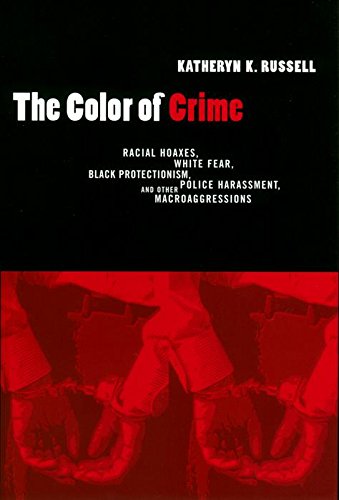

The color of crime racial hoaxes, white fear, black protectionalism, police harassment, and other macroaggressions Katheryn K. Russell.
Series Critical AmericaDetalles de publicación: New York New York University Press,1cc1998.Descripción: xvi, 203 p. 24 cmISBN:- 0814774717
- 305.8
- HV9950 .R87 1998
| Imagen de cubierta | Tipo de ítem | Biblioteca actual | Biblioteca de origen | Colección | Ubicación en estantería | Signatura topográfica | Materiales especificados | Info Vol | URL | Copia número | Estado | Notas | Fecha de vencimiento | Código de barras | Reserva de ítems | Prioridad de la cola de reserva de ejemplar | Reservas para cursos | |
|---|---|---|---|---|---|---|---|---|---|---|---|---|---|---|---|---|---|---|
| Libro | Biblioteca Mons. Iñaki Mallona (Arecibo) Colección General ab | 305.8 R964c (Navegar estantería(Abre debajo)) | Disponible | 60000002015763 |
Descripciones mejoradas de Syndetics:
When Americans are asked what concerns them most about the direction of the country, crime and racial tensions invariably figure prominently in the answer. In the minds of many, these two problems are inextricably linked. Yet opinions and beliefs about race and crime are often informed as much by myth and preconception as by fact and reality.
In this important book, Katheryn K. Russell surveys the landscape of American crime and identifies some of the country's most significant racial pathologies. Why do Black and White Americans perceive police actions so differently? Is White fear of Black crime justified? Do African Americans really "protect their own"? Should they?
Perhaps the most explosive and troublesome phenomenon at the nexus of race and crime is the racial hoax--a contemporary version of The Boy Who Cried Wolf. Examining both White-on-Black hoaxes such as Susan Smith's and Charles Stuart's claims that Black men were responsible for crimes they themselves committed, and Black-on-White hoaxes such as the Tawana Brawley episode, Russell illustrates the formidable and lasting damage that occurs when racial stereotypes are manipulated and exploited for personal advantage. She shows us how such hoaxes have disastrous consequences and compellingly argues for harsher punishments for offenders.
Stressing that journalists, scholars, and policymakers alike have an ethical imperative to disregard and refute inflammatory or wrong-headed work on race, The Color of Crime is a lucid and forceful book, impossible to ignore.
Includes bibliographical references (p. 191-198) and index.
The color of crime : external and internal images -- Measuring racial equity in criminal justice : the historical record -- Racial discrimination or disproportionate offending? -- Are we still taling about O. J.? -- The racial hoax as crime -- Science, scientific racism, and the ethical imperative -- In search of white crime -- Affirmative race law.
Tabla de contenidos provista por Syndetics
- Acknowledgments(p. xi)
- Introduction(p. xiii)
- 1 The Color of Crime: External and Internal Images(p. 1)
- 2 Measuring Racial Equity in Criminal Justice: The Historical Record(p. 14)
- 3 Racial Discrimination or Disproportionate Offending?(p. 26)
- 4 Are We Still Talking about O.J.?(p. 47)
- 5 The Racial Hoax as Crime(p. 69)
- 6 Science, Scientific Racism, and the Ethical Imperative(p. 94)
- 7 In Search of White Crime(p. 110)
- 8 Affirmative Race Law(p. 130)
- Afterword(p. 149)
- Appendix A Police-Public Contact Survey(p. 151)
- Appendix B Racial Hoaxes: Case Summaries (1987-1996)(p. 157)
- Notes(p. 175)
- Selected Bibliography(p. 191)
- Index(p. 199)
- About the Author(p. 203)