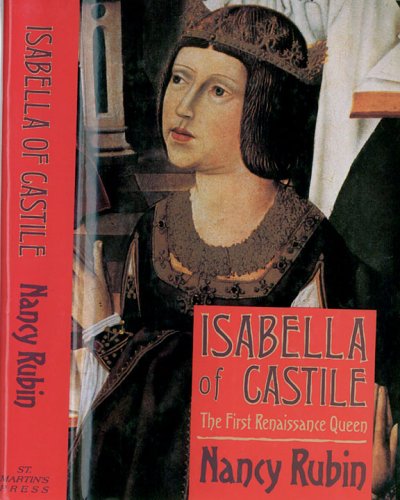
"An artful, sensitive biography... A prerequisite for understanding Isabella is understanding the period and Rubin excels at delineating both." --"Booklist" "Rubin succeeds admirably in recounting the story of Spain's greatest queen and the impact of her reign on her country and the world... a first rate exposition." --"Kirkus" "An excellent, well-developed picture of the complex, often contradictory forces of the European scene from which Columbus sailed." --"Washington Times" "Classic... will make permanent literary history by dispelling many schoolroom myths." --"Tulsa World"
oct/91 28.82
Reseñas proporcionadas por Syndetics
Library Journal Review
The flow of books connected with the quincentenary of Columbus's voyage to the Americas continues. General readers interested in the remarkable woman who pressed the unification of the several kingdoms constituting medieval Spain; pacified a rebellious nobility; made Catholicism a national unifying force by using the Inquisition against Muslims and Jews; supported the new learning of the Renaissance; produced five children around whom the history of 16th-century Europe revolved; and, almost by accident, financed the Genoese sailor who ``discovered'' America believing it was India will find this an enjoyable study. Rubin, however, has a very sketchy knowledge of late medieval-early modern European history, nor is she familiar with the rich recent literature on Muslim Spain, the reconquista , and the direction of current scholarship. The book also suffers from clumsy organization, with 62 short chapters, too many romantic conjectures, contradictions, and a prolix style. The serious student and scholar must look to scholarly monographs. Previewed in ``Rediscovering Columbus,'' LJ 8/91, p. 120-122.-- Bennett D. Hill, Georgetown Univ., Washington, D.C. (c) Copyright 2010. Library Journals LLC, a wholly owned subsidiary of Media Source, Inc. No redistribution permitted.
Publishers Weekly Review
Isabella (1441-1504) was a master strategist, seizing the crown of Castile and, with husband Ferdinand of Aragon, ruling both her kingdom and his and winning a virtually nonstop succession of wars to preserve their strongholds. Freelance journalist Rubin presents the queen also as loving wife and mother, promoter of the arts and sponsor of Columbus, views emphasized to soften the dominant persona: Isabella la Catolica. Her goal to make Spain exclusively and permanently Catholic drove the queen to supporting the tortures of the Inquisition, burning dissenters at the stake and evicting Jews from the country. Packed with information, the book holds the reader's interest, despite pedestrian prose and a clear bias in Isabella's favor. Illustrations not seen by PW. (Oct.) (c) Copyright PWxyz, LLC. All rights reserved
Booklist Review
We remember Queen Isabella as the sponsor of Columbus' watershed 1492 voyage across the forbidding Atlantic, which enabled Spain to claim vast tracks of land to "civilize." But what else does the general reader know about this consequential figure in European history? Not to despair, even as we face the quincentennial of Columbus' enterprise and may feel the need to be more acquainted with his time and milieu, for Rubin provides an artful, sensitive biography of Queen Isabella that captures the woman and the era wonderfully. If it's a complicated piece of history to explain Isabella's heritage, suffice it to say that the Iberian peninsula in the fifteenth century was composed of a handful of kingdoms, and she, as inheritor of the throne of Castile, gave birth to modern Spain by marrying the king of Aragon, Ferdinand. Their partnership was one of the sturdiest marriages of the age, but though their reign put Spain on the international map, it was not a completely glorious time. The two of them instituted the dreadful Inquisition and also expelled all Jews from the land. Rubin does not defend Isabella's less admirable actions but explains them in terms of the queen's determination to make her country pure in the Christian faith. A prerequisite for understanding Isabella is understanding the period, and Rubin excels at delineating both. ~--Brad Hooper
Isabella of Castile
APA
Rubin N., . (1991). Isabella of Castile. New York: St. Martin's Press.
Chicago
Rubin Nancy, . 1991. Isabella of Castile. New York: St. Martin's Press.
Harvard
Rubin N., . (1991). Isabella of Castile. New York: St. Martin's Press.
MLA
Rubin Nancy, . Isabella of Castile. New York: St. Martin's Press. 1991.