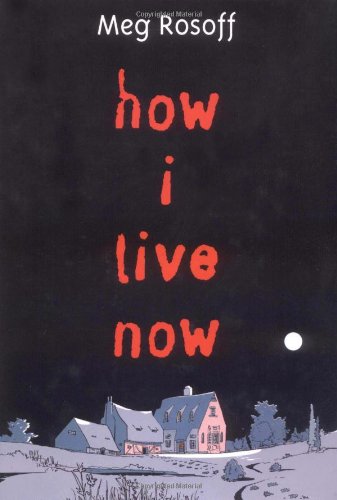

How I live now Meg Rosoff.
Detalles de publicación: New York Wendy Lamb Books 2004.Descripción: 194 p. 21 cmISBN:- 0385746776 (trade)
- 823 R822h 22
- PZ7.R719563 Ho 2004
| Imagen de cubierta | Tipo de ítem | Biblioteca actual | Biblioteca de origen | Colección | Ubicación en estantería | Signatura topográfica | Materiales especificados | Info Vol | URL | Copia número | Estado | Notas | Fecha de vencimiento | Código de barras | Reserva de ítems | Prioridad de la cola de reserva de ejemplar | Reservas para cursos | |
|---|---|---|---|---|---|---|---|---|---|---|---|---|---|---|---|---|---|---|
| Libro | Biblioteca Encarnación Valdés Colección General bev | 823 R822h (Navegar estantería(Abre debajo)) | Disponible | 80000002360520 |
Descripciones mejoradas de Syndetics:
"Every war has turning points and every person too." Fifteen-year-old Daisy is sent from Manhattan to England to visit her aunt and cousins she's never met: three boys near her age, and their little sister. Her aunt goes away on business soon after Daisy arrives. The next day bombs go off as London is attacked and occupied by an unnamed enemy. As power fails, and systems fail, the farm becomes more isolated. Despite the war, it's a kind of Eden, with no adults in charge and no rules, a place where Daisy's uncanny bond with her cousins grows into something rare and extraordinary. But the war is everywhere, and Daisy and her cousins must lead each other into a world that is unknown in the scariest, most elemental way. A riveting and astonishing story.
To get away from her pregnant stepmother in New York City, fifteen-year-old Daisy goes to England to stay with her aunt and cousins, with whom she instantly bonds, but soon war breaks out and rips apart the family while devastating the land.
Extracto provisto por Syndetics
Reseñas proporcionadas por Syndetics
Publishers Weekly Review
This riveting first novel paints a frighteningly realistic picture of a world war breaking out in the 21st century. Told from the point of view of 15-year-old Manhattan native Daisy, the novel follows her arrival and her stay with cousins on a remote farm in England. Soon after Daisy settles into their farmhouse, her Aunt Penn becomes stranded in Oslo and terrorists invade and occupy England. Daisy's candid, intelligent narrative draws readers into her very private world, which appears almost utopian at first with no adult supervision (especially by contrast with her home life with her widowed father and his new wife). The heroine finds herself falling in love with cousin Edmond, and the author credibly creates a world in which social taboos are temporarily erased. When soldiers usurp the farm, they send the girls off separately from the boys, and Daisy becomes determined to keep herself and her youngest cousin, Piper, alive. Like the ripple effects of paranoia and panic in society, the changes within Daisy do not occur all at once, but they have dramatic effects. In the span of a few months, she goes from a self-centered, disgruntled teen to a courageous survivor motivated by love and compassion. How she comes to understand the effects the war has had on others provides the greatest evidence of her growth, as well as her motivation to get through to those who seem lost to war's consequences. Teens may feel that they have experienced a war themselves as they vicariously witness Daisy's worst nightmares. Like the heroine, readers will emerge from the rubble much shaken, a little wiser and with perhaps a greater sense of humanity. Ages 12-up. (Aug.) (c) Copyright PWxyz, LLC. All rights reservedSchool Library Journal Review
Gr 8 Up-Impending war, parental rejection, and anorexia are Daisy's concerns as she steps off the plane in England where she's been sent to stay with her Aunt Pen and her four cousins. The 15-year-old has landed in a chaotic but supportive country household where she is immediately intrigued by her cousin, Edmund. In this novel (Wendy Lamb Books, 2004), Meg Rosoff explores what happens when war leaves these five youngsters to fend for themselves. There are the hardships of finding food and the loss of their mother, but there is also freedom and unexpected tenderness that evolves into an intense physical relationship between Daisy and Edmund. When the two are parted, Daisy takes charge of her youngest cousin, Piper, and the two young women set off to find Edmund and his twin Isaac. What they discover is a brutal massacre but not their kin. Finally returning to the family home, the two girls spend every waking minute trying to survive until Daisy's dad forcibly extricates her from England. It's many years before all of them are reunited. Kim Mai Guest reads with a light, slightly saucy tone which is just right for a New Yorker like Daisy. Though the novel has disturbing elements, Rosoff handles the harshness of war and the taboo of incest with honest introspection. This Printz award winner is a good choice for book discussions as it considers the disruption of war both physically and emotionally and should be on every high school and public library shelf.-Barbara Wysocki, Cora J. Belden Library, Rocky Hill, CT (c) Copyright 2010. Library Journals LLC, a wholly owned subsidiary of Media Source, Inc. No redistribution permitted.Booklist Review
Gr. 8-11. A 15-year-old, contemporary urbanite named Daisy, sent to England to summer with relatives, falls in love with her aunt's oldy worldy farm and her soulful cousins--especially Edmond, with whom she forms the world's most inappropriate case of sexual obsession. Matters veer in a startling direction when terrorists strike while Daisy's aunt is out of the country, war erupts, and soldiers divide the cousins by gender between two guardians. Determined to rejoin Edmond, Daisy and her youngest cousin embark upon a dangerous journey that brings them face to face with horrific violence and undreamt-of deprivation. Just prior to the hopeful conclusion, Rosoff introduces a jolting leap forward in time accompanied by an evocative graphic device that will undoubtedly spark lively discussions. As for the incestuous romance, Daisy and Edmond's separation for most of the novel and the obvious emotional sustenance Daisy draws from their bond sensitively shift the focus away from the relationship's implicit (and potentially discomfiting) physical dimension. More central to the potency of Rosoff's debut, though, is the ominous prognostication of what a third world war might look like, and the opportunity it provides for teens to imagine themselves, like Daisy, exhibiting courage and resilience in roles traditionally occupied by earlier generations. --Jennifer Mattson Copyright 2004 BooklistNotas de autor provistas por Syndetics
Meg Rosoff was born in Boston, Massachusetts on October 16, 1956. She studied at Harvard University, but left for England in 1977 to take classes at Central St. Martin's College of Art and Design. She returned to finish her degree in English and fine arts at Harvard University. She worked in New York City for 10 years in publishing and advertising, before moving to England.Her first novel, How I Live Now, was published in 2004 and won the Guardian Children's Fiction Prize. Her other novels include What I Was, The Bride's Farewell, There Is No Dog, Moose Baby, and Picture Me Gone. Just in Case won the 2007 Carnegie Medal. She won the 2016 Astrid Lindgren Memorial Award. She is also the author of a picture book entitled Meet Wild Boars and co-author of a non-fiction book entitled London Guide: Your Passport to Great Travel.
(Bowker Author Biography)