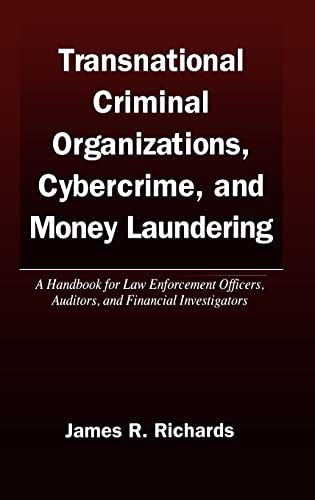

Transnational criminal organizations , cybercrime , and money laundering handbook for law enforcement officers , auditors , and financial investigator James R. Richards .
Detalles de publicación: Boca Raton , FL CRC press c1999 .Descripción: xxii , 318 p . 24 cmISBN:- 0849328063
- HV6768 . R53 1999
| Imagen de cubierta | Tipo de ítem | Biblioteca actual | Biblioteca de origen | Colección | Ubicación en estantería | Signatura topográfica | Materiales especificados | Info Vol | URL | Copia número | Estado | Notas | Fecha de vencimiento | Código de barras | Reserva de ítems | Prioridad de la cola de reserva de ejemplar | Reservas para cursos | |
|---|---|---|---|---|---|---|---|---|---|---|---|---|---|---|---|---|---|---|
| Libro | Biblioteca de Derecho Mons. Fremiot Torres Oliver Colección General biblioteca derecho | HV6768 .R53 1999 (Navegar estantería(Abre debajo)) | Disponible | 70000000693828 |
Descripciones mejoradas de Syndetics:
WRITTEN BY A LAW ENFORCEMENT PROFESSIONAL FOR OTHER LAW ENFORCEMENT PERSONNEL IN THE TRENCHES
This book examines the workings of organized criminals and criminal groups that transcend national boundaries. Discussions include methods used by criminal groups to internationally launder money; law enforcement efforts to counteract such schemes; and new methods and tactics to counteract transnational money laundering.
A PRACTICAL GUIDE TO FACETS OF INTERNATIONAL CRIME AND MEASURES TO COMBAT THEM
Intended for law enforcement personnel, bank compliance officers, financial investigators, criminal defense attorneys, and anyone interested in learning about the basic concepts of international crime and money laundering, this timely text explains:
money laundering terms and phrases
an overview of relevant federal agencies, transnational criminal organizations, and basic investigatory techniques
the intricacies of wire transfers and cyberbanking
the phenomenon of the "World Wide Web"
Includes bibliographical references and index.
Tabla de contenidos provista por Syndetics
- Part I The Bad Guys(p. 1)
- 1 International Criminal Organizations(p. 3)
- I. Introduction(p. 3)
- II. The Big Six International Criminal Organizations(p. 5)
- A. The Italian Criminal Enterprises(p. 5)
- 1. The Mafia(p. 5)
- 2. The Camorra(p. 7)
- 3. 'Ndrangheta(p. 8)
- 4. Sacred Crown (Sacra Corona Unita)(p. 8)
- B. The Russian Mafiya(p. 8)
- C. The Japanese Yakuza(p. 11)
- D. The Chinese Triads(p. 13)
- 1. Background(p. 13)
- 2. Recent Operations Against the Chinese Triads(p. 14)
- E. Colombian Drug Cartels(p. 15)
- 1. The Medellin Cartel(p. 16)
- 2. The Cali Cartel(p. 17)
- a. Introduction(p. 17)
- b. The Leaders of the Cali Cartel(p. 19)
- i. The Rodriguez-Orejuela Family(p. 19)
- ii. Jose Santacruz Londono(p. 20)
- iii. Pacho Herrera Buitrago(p. 20)
- 3. Cartel de la Costa(p. 20)
- 4. Northern Valle del Cauca Traffickers(p. 21)
- 5. Recent Operations Against the Cartels(p. 21)
- F. Mexican Criminal Organizations: The Mexican Federation(p. 21)
- 1. Gulf Cartel(p. 22)
- 2. Juarez Cartel(p. 22)
- 3. Sonora Cartel(p. 23)
- 4. Tijuana Cartel(p. 23)
- 5. Amezqua Organization(p. 24)
- III. Other International Criminal Organizations(p. 25)
- A. Nigerian Criminal Organizations(p. 25)
- B. Khun Sa(p. 26)
- C. Manuel Noriega(p. 27)
- IV. International Terrorist Organizations(p. 28)
- A. Introduction(p. 28)
- B. Terrorist Organizations(p. 29)
- 1. Peru's Shining Path Terrorist Group(p. 29)
- 2. Provisional Irish Republican Army (PIRA, or IRA)(p. 30)
- 3. Colombian Revolutionary Groups(p. 30)
- V. Strategic Alliances Between Transnational Criminal Organizations(p. 30)
- A. International Strategic Alliances Generally(p. 30)
- B. The Colombian Cartels: A Strategic Alliance Case Study(p. 31)
- Appendix 1.1 Specially Designated Narcotics Traffickers(p. 33)
- Part II Money-Laundering Techniques(p. 41)
- 2 An Introduction to Money Laundering(p. 43)
- I. Money Laundering: What Is It?(p. 43)
- II. Money Laundering: Why Fight It?(p. 45)
- III. The Mechanics of Money Laundering(p. 46)
- A. The Three Stages of Money Laundering(p. 47)
- 1. Stage 1: Placement(p. 47)
- 2. Stage 2: Layering(p. 49)
- 3. Stage 3: Integration(p. 49)
- IV. Money-Laundering Techniques and Tools(p. 50)
- A. Smuggling(p. 50)
- B. Structuring(p. 52)
- C. The Use of Front Companies(p. 53)
- 1. Front Companies in General(p. 53)
- 2. Businesses Commonly Used as Front Companies(p. 54)
- a. Jewelry Stores(p. 54)
- b. Money-Service Businesses(p. 54)
- c. Travel Agencies(p. 55)
- d. Import/Export Companies(p. 55)
- D. The Use of Shell or Nominee Corporations(p. 55)
- E. Bank Drafts(p. 56)
- F. Counterbalancing Loan Schemes(p. 57)
- G. Dollar Discounting(p. 57)
- H. Mirror-Image Trading(p. 58)
- I. Reverse Flips(p. 58)
- J. Inflated Prices(p. 58)
- K. The Colombian Black-Market Peso Exchange(p. 59)
- V. United States vs. Saccoccia: The Ultimate Example of La Vuelta(p. 61)
- 3 Cyberbanking and Wire Transfers(p. 65)
- I. Cyberbanking(p. 65)
- A. Introduction to Cyberbanking(p. 65)
- B. Cyberbanking and the Encryption of Data(p. 66)
- C. Smart Cards, or Stored-Value Cards(p. 68)
- D. Electronic Benefits Transfer Cards (EBT Cards)(p. 69)
- II. Cybercrime(p. 69)
- A. What is "Cybercrime"?(p. 69)
- B. Justin Peterson: A Cybercriminal's Case History(p. 70)
- C. Cybercrime Statutes and Laws(p. 71)
- III. Cybersecurity in the Future(p. 72)
- IV. Cyberlaundering: An Example(p. 75)
- 4 Money Laundering in the Banking Industry(p. 77)
- I. What is the "Banking Industry"?(p. 77)
- II. Offshore Banking(p. 78)
- A. Introduction(p. 78)
- B. Attributes of Offshore Banking Havens(p. 79)
- III. Underground or Parallel Banking Systems(p. 80)
- IV. Money-Laundering Techniques Common to the Banking Industry(p. 80)
- A. The Use of Wire Transfers(p. 80)
- 1. How Wire Transfers Work(p. 80)
- 2. The Major Wire Transfer Systems(p. 83)
- B. The Use of Conduit Accounts(p. 85)
- C. The Use of Correspondent Accounts/Due from Accounts(p. 85)
- D. The Use of Payable-Through Accounts(p. 86)
- V. Preventing Money Laundering in the Banking Industry(p. 86)
- A. Detecting and Preventing Money Laundering Generally(p. 86)
- 1. Introduction(p. 86)
- 2. Basic Steps for Any Bank Compliance Program(p. 87)
- 3. "Know your Customer" Policies(p. 88)
- 4. Safe Harbor Provisions(p. 88)
- 5. Tip Off Provisions(p. 90)
- 6. Exempt Businesses/Qualified Business Customers(p. 90)
- B. Cash Reserves(p. 91)
- VI. Money Laundering Through Banks: Case Studies(p. 91)
- A. American Express Bank International(p. 91)
- B. Banque Leu(p. 92)
- C. Bank of Credit and Commerce International (BCCI)(p. 92)
- 1. The Early Years of BCCI(p. 93)
- 2. BCCI's Move to The Cayman Islands(p. 94)
- 3. BCCI's Move to the United States(p. 94)
- a. Takeover of the National Bank of Georgia(p. 94)
- b. Establishing a U.S. Commodities Trading Presence(p. 95)
- 4. The Mid-1980s: Something Appears Wrong(p. 96)
- 5. 1988: Congressional Subcommittees Begin to Look at BCCI(p. 97)
- 6. 1988: BCCI Is Indicted in Federal Court in Tampa, Florida(p. 97)
- 7. The Late 1980s: The Global Problems of BCCI(p. 98)
- 8. 1991: The House of Cards Comes Tumbling Down(p. 98)
- 9. Epitaph(p. 98)
- 5 Money Laundering in Non-Bank Financial Institutions (NBFIs)(p. 101)
- I. Introduction(p. 101)
- II. Money Services Businesses (MSBs)(p. 102)
- A. Proposed Regulations Relating to MSBs(p. 102)
- B. Money Order Transmitters(p. 103)
- C. Casas de Cambio(p. 104)
- III. Casinos(p. 104)
- A. Regulation of Casinos(p. 104)
- B. Laundering Money Through Casinos(p. 105)
- C. Tribal Casinos(p. 106)
- D. On-Line Casinos(p. 106)
- IV. Card Clubs(p. 107)
- V. Race Tracks(p. 108)
- VI. Insurance Companies(p. 108)
- VII. Securities Dealers and Brokers(p. 109)
- Part III The Good Guys(p. 111)
- 6 United States Federal Government Agencies and Task Forces(p. 113)
- I. Introduction(p. 113)
- II. Justice Department(p. 113)
- A. Drug Enforcement Administration (DEA)(p. 113)
- B. Federal Bureau of Investigation (FBI)(p. 114)
- C. Organized Crime Drug Enforcement Task Force (OCDETF)(p. 114)
- III. Department of State(p. 115)
- A. Introduction(p. 115)
- B. Certification of Drug-Producing/Transit Countries(p. 115)
- IV. Department of the Treasury(p. 118)
- A. Office of the Comptroller of the Currency (OCC)(p. 119)
- B. United States Customs Service (USCS)(p. 119)
- 1. Customs Service Currency Interdiction Efforts(p. 120)
- 2. Customs Service Narcotics Interdiction Efforts(p. 120)
- 3. Seizures and Forfeitures by Customs(p. 120)
- C. Internal Revenue Service (IRS)(p. 121)
- D. Office of Thrift Supervision (OTS)(p. 123)
- E. Financial Crimes Enforcement Network (FinCEN)(p. 124)
- 1. Office of Financial Enforcement (OFE)(p. 125)
- 2. FinCEN Artificial Intelligence System (FAIS)(p. 125)
- 3. Project Gateway(p. 125)
- F. Office of Foreign Assets Control (OFAC)(p. 126)
- G. United States Secret Service (USSS)(p. 126)
- H. Federal Law Enforcement Training Center (FLETC)(p. 126)
- V. Federal Deposit Insurance Corporation (FDIC)(p. 127)
- VI. Federal Reserve Board(p. 127)
- VII. Office of National Drug Control Policy (ONDCP)(p. 127)
- VIII. Central Intelligence Agency (CIA)(p. 128)
- Part IV Anti-Money-Laundering Tools(p. 129)
- 7 Domestic Money-Laundering Statutes and Laws(p. 131)
- I. Milestones in American Anti-Money-Laundering Efforts(p. 131)
- II. Evolution of American Money-Laundering Laws(p. 132)
- A. Bank Secrecy Act of 1970 (BSA)(p. 132)
- B. Racketeer Influenced and Corrupt Organizations (RICO) Statute(p. 135)
- C. Money Laundering Control Act of 1986 (MLCA)(p. 136)
- 1. Money Laundering Involving Financial Transactions(p. 137)
- 2. Crossing the Border Without Declaring Monetary Instruments(p. 138)
- 3. Money-Laundering: Sting Operations(p. 139)
- 4. Money-Laundering: Underlying Offenses(p. 140)
- 5. Money-Laundering: Engaging in Transactions with Property Derived from Unlawful Activity(p. 140)
- a. Attorneys' Fees(p. 140)
- b. Forfeiture of Property Involved in Money Laundering(p. 141)
- c. Border Searches for Monetary Instruments(p. 141)
- D. Anti-Drug Abuse Act of 1988(p. 142)
- E. Annunzio-Wylie Anti-Money-Laundering Act of 1992(p. 142)
- F. Money-Laundering Suppression Act of 1994 (MLSA)(p. 143)
- G. International Emergency Economic Powers Act (IEEPA) and PDD(p. 144)
- H. International Crime-Control Act of 1996 (ICCA)(p. 145)
- III. Proposed Money Laundering and Financial-Crimes-Strategy Bill of 1997(p. 146)
- IV. Federal Sentencing Guidelines(p. 147)
- A. Introduction and Basic Concepts(p. 147)
- B. How the Guidelines Work(p. 148)
- C. Sentencing Guidelines for Money-Laundering Offenses(p. 149)
- D. Future of the Sentencing Guidelines(p. 151)
- V. States' Money-Laundering and Reporting Legislation(p. 151)
- VI. Current State of American Money-Laundering Laws(p. 151)
- Appendix 7.1 Bank Secrecy Act, 31 U.S.C. 5311-5324 and Regulations(p. 153)
- 8 Regulatory (Anti-Money-Laundering) Forms(p. 179)
- I. Introduction(p. 179)
- II. The Six Major Regulatory Reporting Forms(p. 179)
- A. Currency Transaction Report: CTR(p. 179)
- B. Currency Transaction Report by Casinos: CTRC(p. 180)
- C. Currency and Monetary Instrument Report: CMIR(p. 181)
- D. Foreign Bank Account Report (FBAR)(p. 182)
- E. Form 8300(p. 182)
- F. Suspicious Activity Report (SAR)(p. 183)
- Appendix 8.1 The Reporting Forms(p. 186)
- 9 Asset Forfeiture(p. 191)
- I. Introduction(p. 191)
- II. Basic Concepts of Forfeiture(p. 192)
- A. Statutory Authority(p. 192)
- B. Property Subject to Forfeiture(p. 192)
- 1. Property Related to Drug Crimes(p. 192)
- 2. Property Related to Money-Laundering Crimes(p. 193)
- 3. Other Types of Property Subject to Forfeiture(p. 193)
- C. Proceeds of Crime or Property Used to Facilitate Crime(p. 193)
- D. Civil or Criminal Forfeiture(p. 194)
- 1. Civil Forfeiture Proceedings Generally(p. 194)
- 2. Civil Forfeiture: Administrative Proceedings(p. 196)
- 3. Criminal Forfeiture Proceedings(p. 197)
- E. Relation Back Doctrine(p. 198)
- F. Innocent Owners(p. 199)
- G. Constitutional and Other Protections(p. 199)
- III. Equitable Sharing and Adoption of State Forfeitures(p. 200)
- IV. Disposition of Seized and Forfeited Property(p. 200)
- V. The Future of Asset Forfeiture(p. 201)
- 10 Law Enforcement Operations(p. 203)
- I. Introduction(p. 203)
- II. Law Enforcement Tools(p. 203)
- A. Geographic Targeting Orders (GTOs)(p. 203)
- B. Mobile Enforcement Teams (METs)(p. 204)
- C. High-Intensity Drug Trafficking Areas (HIDTA)(p. 204)
- III. Multi-Agency Drug-Money-Laundering Operations(p. 205)
- A. Operation Big Ticket(p. 206)
- B. Operation Cat's Eye(p. 206)
- C. Operation C-Chase(p. 206)
- D. Operation Dinero(p. 207)
- E. Operation El Dorado(p. 207)
- F. Operation Gateway(p. 208)
- G. Operation Green Ice(p. 208)
- H. Operation Green Ice II(p. 209)
- I. Operation Greenback(p. 209)
- J. Operation Hard Line(p. 210)
- K. Operation La Mina(p. 210)
- L. Operation Polar Cap(p. 210)
- M. Operation Q-Tip(p. 211)
- N. Operation Zorro II(p. 211)
- O. Pizza Connection Case(p. 212)
- 11 Investigative Techniques(p. 213)
- I. Four Basic Steps of Money-Laundering Investigations(p. 213)
- A. Step 1: Identify the Unlawful Activity(p. 213)
- B. Step 2: Identify and Track the Financial Transactions(p. 215)
- C. Step 3: Perform a Financial Analysis of the Target(p. 215)
- 1. Net Worth Analysis(p. 215)
- 2. Source and Application of Funds Analysis(p. 216)
- D. Step 4: Freeze and Confiscate Assets(p. 216)
- II. Compelling the Production of Documents(p. 216)
- A. Letters Rogatory(p. 216)
- B. Subpoenas(p. 216)
- III. The ABA Numerical System Identification Code(p. 217)
- Part 5 The World Stage(p. 221)
- 12 International Organizations and Treaties(p. 223)
- I. Introduction(p. 223)
- II. The United Nations(p. 223)
- A. Structure and Organization(p. 223)
- B. The 1988 Vienna Convention(p. 224)
- III. The Financial Action Task Force (FATF)(p. 226)
- A. Creation and Mandate(p. 226)
- B. The Forty Recommendations(p. 226)
- C. Future of the FATF(p. 233)
- IV. Caribbean Financial Action Task Force (CFATF)(p. 233)
- A. Introduction(p. 233)
- B. The Nineteen Aruba Recommendations(p. 234)
- 1. Anti-Money-Laundering Authority(p. 234)
- 2. Crime of Money Laundering(p. 234)
- 3. Attorney-Client Privilege(p. 235)
- 4. Confiscation(p. 235)
- 5. Administrative Authority(p. 236)
- 6. Recordkeeping(p. 236)
- 7. Currency Reporting(p. 236)
- 8. Administrative Cooperation(p. 237)
- 9. Training and Assistance(p. 237)
- V. Organization of American States (OAS)(p. 237)
- VI. Other International Organizations or Entities(p. 239)
- A. Phare Project on Money Laundering(p. 239)
- B. Association of Southeast Asian Nations (ASEAN)(p. 239)
- C. Asian/Pacific Group on Money Laundering (APG)(p. 239)
- D. Financial Intelligence Units (FIUs)(p. 239)
- E. Interpol(p. 240)
- VII. International Banking Organizations(p. 240)
- A. The International Monetary Fund (IMF)(p. 240)
- B. Basle Committee on Banking Supervision(p. 241)
- C. Offshore Group of Banking Supervisors (OGBS)(p. 241)
- D. International Bank Security Association(p. 241)
- VIII. International Agreements and Treaties(p. 242)
- A. Financial Information Exchange Agreements (FIEAs)(p. 242)
- B. Mutual Legal Assistance Treaties (MLATs)(p. 242)
- 13 The Pan American Countries: Canada, Mexico, Colombia(p. 243)
- I. Canada(p. 243)
- A. Background(p. 243)
- B. Canada's Relationship with the United States(p. 244)
- C. Organized Crime Activity in Canada(p. 244)
- D. Canada's Anti-Money-Laundering Efforts(p. 245)
- 1. Background(p. 245)
- 2. Anti-Money-Laundering Efforts(p. 247)
- II. Mexico(p. 247)
- A. Background(p. 247)
- B. Organized Crime and Money Laundering in Mexico(p. 249)
- 1. Background(p. 249)
- 2. Anti-Money-Laundering Efforts(p. 250)
- C. Certification/Decertification of Mexico(p. 251)
- III. Panama and the Colon Free Zone(p. 253)
- A. Introduction(p. 253)
- B. Panama's Anti-Money-Laundering and Drug-Control Efforts(p. 254)
- IV. Colombia(p. 254)
- A. Introduction(p. 254)
- B. Colombian Anti-Money-Laundering Efforts(p. 255)
- 14 Russia and the Former Soviet Union Nations(p. 259)
- I. Introduction(p. 259)
- II. Drug Trafficking Activity in Russia(p. 260)
- III. Drug Trafficking Activity in the Former Soviet Union (FSU) Countries(p. 261)
- IV. Russian Anti-Money-Laundering Efforts(p. 261)
- V. Cooperation Between Russia and the United States(p. 262)
- 15 Profiles of Other Countries(p. 263)
- I. Introduction(p. 263)
- II. Country Profiles(p. 264)
- 1. Afghanistan(p. 264)
- 2. Antigua(p. 265)
- 3. Argentina(p. 266)
- 4. Aruba(p. 266)
- 5. Australia(p. 267)
- 6. Bahamas(p. 267)
- 7. Belgium(p. 269)
- 8. Belize(p. 270)
- 9. Bermuda(p. 270)
- 10. British Virgin Islands(p. 271)
- 11. Bolivia(p. 271)
- 12. Brazil(p. 271)
- 13. Burma (see Myanmar)(p. 272)
- 14. Cambodia(p. 272)
- 15. Cayman Islands(p. 272)
- 16. Channel Islands and the Isle of Man(p. 272)
- 17. Chile(p. 273)
- 18. China(p. 273)
- 19. Cyprus(p. 273)
- 20. Czech Republic(p. 274)
- 21. Dominican Republic(p. 275)
- 22. Ecuador(p. 275)
- 23. The European Union or European Community(p. 276)
- 24. Germany(p. 278)
- 25. Grenada(p. 278)
- 26. Guatemala(p. 278)
- 27. Haiti(p. 279)
- 28. Hong Kong(p. 280)
- 29. India(p. 281)
- 30. Indonesia(p. 281)
- 31. Iran(p. 281)
- 32. Israel(p. 281)
- 33. Jamaica(p. 282)
- 34. Japan(p. 282)
- 35. Laos(p. 283)
- 36. Luxembourg(p. 283)
- 37. Malaysia(p. 283)
- 38. Myanmar(p. 284)
- 39. Netherlands Antilles(p. 284)
- 40. Nigeria(p. 285)
- 41. Pakistan(p. 286)
- 42. Paraguay(p. 286)
- 43. Peru(p. 287)
- 44. Puerto Rico(p. 287)
- 45. Switzerland(p. 288)
- 46. Taiwan(p. 288)
- 47. Thailand(p. 289)
- 48. United Kingdom(p. 289)
- 49. Venezuela(p. 289)
- 50. Vietnam(p. 289)
- References(p. 291)
- Index(p. 297)