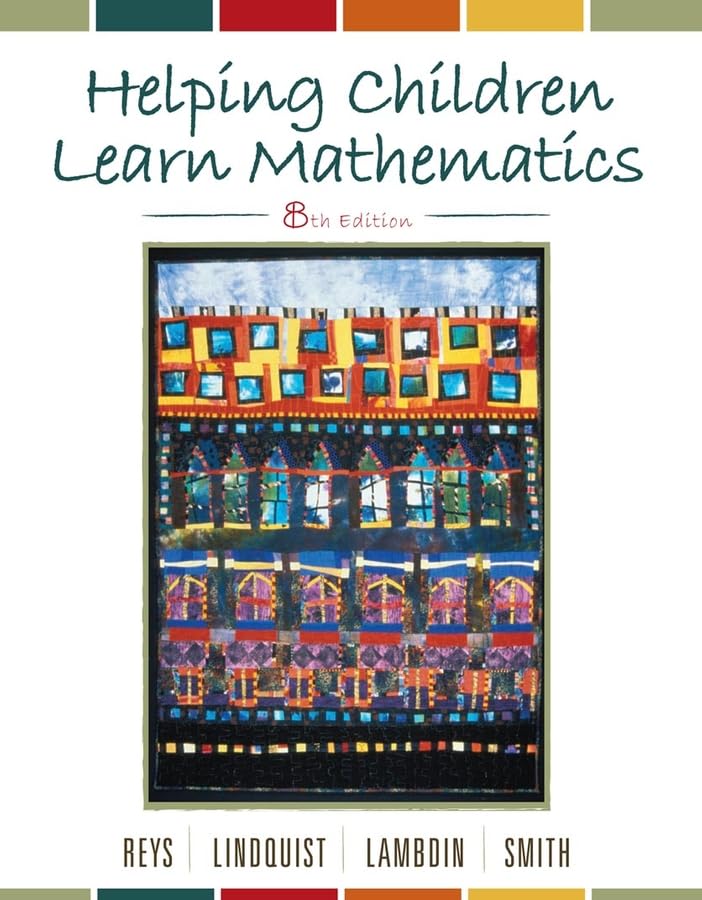
Imagen de Amazon.com

Portada de Syndetics
Imagen de OpenLibrary
Helping children learn mathematics Robert E. Reys ...[et al.].
Detalles de publicación: Hoboken, NJ John Wiley & Sons c2007.Edición: 8th edDescripción: xiv, 481, [30] p. ill. (some col.) 28 cmISBN:- 0471710954 (pbk.)
- 372.7044 H483 2007 22
- QA135.6 .H45 2007
Recursos en línea:
| Imagen de cubierta | Tipo de ítem | Biblioteca actual | Biblioteca de origen | Colección | Ubicación en estantería | Signatura topográfica | Materiales especificados | Info Vol | URL | Copia número | Estado | Notas | Fecha de vencimiento | Código de barras | Reserva de ítems | Prioridad de la cola de reserva de ejemplar | Reservas para cursos | |
|---|---|---|---|---|---|---|---|---|---|---|---|---|---|---|---|---|---|---|
| Libro | Biblioteca Mons. Iñaki Mallona (Arecibo) Colección General ab | 372.7044 H483 2007 (Navegar estantería(Abre debajo)) | Disponible | 60000010029293 |
Total de reservas: 0
Descripciones mejoradas de Syndetics:
The new eighth edition of this successful book presents the tools to help children learn mathematical concepts and skills while utilizing important problem-solving techniques. In the process, it challenges the readers and further stimulates their interest in mathematics. The book is built around three main themes: helping children make sense of mathematics, incorporating field-experiences, and emphasizing major ideas detailed in the National Council of Teachers of Mathematics Principles and Standards for School Mathematics.
Includes bibliographical references (p. 447-462) and index.
Tabla de contenidos provista por Syndetics
- Chapter 1 School Mathematics in a Changing World(p. 1)
- Introduction
- Focus Questions
- What Is Mathematics?(p. 2)
- What Determines the Mathematics Being Taught?(p. 3)
- Needs of the Subject(p. 3)
- Needs of the Child(p. 5)
- Needs of Society(p. 7)
- Your Role(p. 8)
- Where Can You Turn?(p. 9)
- National Guidelines for School Mathematics(p. 9)
- State and Local Guidelines(p. 9)
- Research(p. 9)
- Cultural and International Resources(p. 9)
- History(p. 10)
- Textbooks and Other Materials(p. 10)
- Electronic Materials(p. 11)
- Professional Organizations(p. 11)
- Professional Development(p. 12)
- Other Teachers(p. 12)
- What Is Your Role Now?(p. 12)
- A Glance at Where We've Been
- Things to Do: From What You've Read
- Things to Do: Going Beyond This Book
- Annotated Resources
- Chapter 2 Helping Children Learn Mathematics with Understanding(p. 15)
- Snapshot of a Lesson
- Introduction
- Focus Questions
- How Can We Support the Diverse Learners in Our Classrooms?(p. 16)
- Creating a Positive Learning Environment(p. 17)
- Avoiding Negative Experiences that Increase Anxiety(p. 18)
- Establishing Clear Expectations(p. 19)
- Treating All Students as Equally Likely to Have Aptitude for Mathematics(p. 19)
- Helping Students Improve Their Ability to Retain Mathematical Knowledge and Skills(p. 20)
- How Can We Help Children Acquire Both Procedural Knowledge and Conceptual Knowledge?(p. 21)
- In the Classroom 2-1 Different Kinds of Four-sided Figures(p. 22)
- How Do Children Learn Mathematics?(p. 22)
- Building Behavior(p. 23)
- Constructing Understanding(p. 25)
- How Can We Help Children Make Sense of Mathematics?(p. 27)
- In the Classroom 2-2 Patterns with Blocks(p. 29)
- Recommendation 1 Teach to the Developmental Characteristics of Students(p. 27)
- Recommendation 2 Actively Involve Students(p. 29)
- Recommendation 3 Move Learning from Concrete to Abstract(p. 31)
- Recommendation 4 Use Communication to Encourage Understanding(p. 32)
- A Glance at Where We've Been
- Things to Do: From What You've Read
- Things to Do: Going Beyond This Book
- Book Nook for Children
- Annotated Resources
- Chapter 3 Planning and Teaching(p. 37)
- Snapshot of a Lesson
- Introduction
- Focus Questions
- Preparing to Teach: Questions to Ask Before Planning Begins(p. 39)
- In the Classroom 3-1 Place Value(p. 41)
- Do I Understand the Mathematics I Am Teaching?(p. 39)
- What Are the Developmental Characteristics of My Students?(p. 40)
- What Do My Students Already Know?(p. 40)
- What Kinds of Tasks Will I Give My Students?(p. 42)
- How Will I Encourage My Students to Talk, What Kinds of Questions Will I Ask, and How Will I Group My Students?(p. 44)
- What Materials Will My Students and I Use?(p. 46)
- Planning for Effective Teaching(p. 51)
- The Importance of Planning(p. 51)
- Levels of Planning(p. 52)
- Planning Different Types of Lessons(p. 52)
- Meeting the Needs of All Students(p. 59)
- Assessment and Analysis in Planning(p. 62)
- A Glance at Where We've Been
- Things to Do: From What You've Read
- Things to Do: Going Beyond This Book
- Book Nook for Children
- Annotated Resources
- Chapter 4 Assessment: Enhanced Learning and Teaching(p. 68)
- Snapshot of a Lesson
- Introduction
- Focus Questions
- Assessment of Learning: Summative Assessment(p. 70)
- Assessment for Learning: Formative Assessment(p. 73)
- Phases of Assessment(p. 73)
- Making Instructional Decisions(p. 74)
- Monitoring Student Progress(p. 74)
- Evaluating Student Achievement(p. 75)
- Ways to Assess Students' Abilities and Dispositions(p. 75)
- In the Classroom 4-1 Primary Interview on Place Value(p. 80)
- Observation(p. 77)
- Questioning(p. 78)
- Interviewing(p. 78)
- Performance Tasks(p. 81)
- Self-Assessment and Peer Assessment(p. 82)
- Work Samples(p. 84)
- Portfolios(p. 84)
- Writings(p. 86)
- Teacher-Designed Written Tests(p. 87)
- Standardized Achievement Tests(p. 88)
- Keeping Records and Communicating about Assessments(p. 89)
- Recording the Information(p. 89)
- Communicating the Information(p. 91)
- Cultural Connections(p. 93)
- A Glance at Where We've Been
- Things to Do: From What You've Read
- Things to Do: Going Beyond This Book
- Book Nook for Children
- Annotated Resources
- Chapter 5 Processes of Doing Mathematics(p. 97)
- Snapshot of a Lesson
- Introduction
- Focus Questions
- Problem Solving(p. 99)
- In the Classroom 5-1 Rolling the Dice(p. 101)
- Reasoning and Proof(p. 104)
- Reasoning Is About Making Generalizations(p. 106)
- Reasoning Leads to a Web of Generalizations(p. 106)
- Reasoning Leads to Mathematical Memory Built on Relationships(p. 106)
- Learning through Reasoning Requires Making Mistakes and Learning from Them(p. 107)
- Communication(p. 107)
- Connections(p. 109)
- Representations(p. 111)
- Creating and Using Representations(p. 112)
- Selecting, Applying, and Translating Among Representations(p. 112)
- Using Representations to Model and Interpret Phenomena(p. 113)
- Cultural Connections(p. 113)
- A Glance at Where We've Been
- Things to Do: From What You've Read
- Things to Do: Going Beyond This Book
- Book Nook for Children
- Annotated Resources
- Chapter 6 Helping Children with Problem Solving(p. 119)
- Snapshot of a Lesson
- Introduction
- Focus Questions
- What Is a Problem and What Is Problem Solving?(p. 121)
- Teaching Mathematics through Problem Solving(p. 123)
- In the Classroom 6-1 Which Rectangle Is Biggest?(p. 128)
- Factors for Success in Problem Solving(p. 124)
- Choosing Appropriate Problems(p. 125)
- Finding Problems(p. 129)
- Having Students Pose Problems(p. 130)
- Using Calculators and Computers(p. 131)
- Strategies for Problem Solving(p. 132)
- Act It Out(p. 133)
- Make a Drawing or Diagram(p. 134)
- Look for a Pattern(p. 135)
- Construct a Table(p. 136)
- Guess and Check(p. 136)
- Work Backward(p. 137)
- Solve a Similar but Simpler Problem(p. 137)
- In the Classroom 6-2 Solve A Similar But Simpler Problem(p. 138)
- The Importance of Looking Back(p. 139)
- Looking Back at the Problem(p. 140)
- Looking Back at the Answer(p. 140)
- Looking Back at the Solution Process(p. 140)
- Looking Back at One's Own Thinking(p. 140)
- Helping All Students with Problem Solving(p. 141)
- Managing Time(p. 141)
- Managing Classroom Routines(p. 141)
- Managing Student Needs(p. 141)
- Cultural Connections(p. 143)
- A Glance at Where We've Been
- Things to Do: From What You've Read
- Things to Do: Going Beyond This Book
- Book Nook for Children
- Annotated Resources
- Chapter 7 Counting and Number Sense in Early Childhood and Primary Grades(p. 149)
- Snapshot of a Lesson
- Number Sense
- Focus Questions
- Prenumber Concepts(p. 153)
- In the Classroom 7-1 Who Am I?(p. 154)
- In the Classroom 7-2 Alike-and-Difference Trains(p. 155)
- Classification(p. 153)
- Patterns(p. 156)
- Comparisons(p. 157)
- Early Number Development(p. 158)
- Conservation(p. 158)
- Group Recognition(p. 159)
- Counting(p. 160)
- In the Classroom 7-3 Numbers on a Calendar(p. 163)
- In the Classroom 7-4 Counting on ... and on ... and on(p. 164)
- In the Classroom 7-5 Counting on and Back(p. 165)
- In the Classroom 7-6 Hunting for Numbers(p. 165)
- In the Classroom 7-7 Skip Counting(p. 166)
- Counting Principles(p. 160)
- Counting Stages(p. 161)
- Counting Strategies(p. 163)
- Counting Practice(p. 166)
- Developing Number Benchmarks(p. 167)
- Making Connections(p. 167)
- Cardinal, Ordinal, and Nominal Numbers(p. 170)
- Writing Numerals(p. 171)
- Cultural Connections(p. 172)
- A Glance at Where We've Been
- Things to Do: From What You've Read
- Things to Do: Going Beyond This Book
- Book Nook for Children
- Annotated Resources
- Chapter 8 Extending Number Sense: Place Value(p. 177)
- Snapshot of a Lesson
- Introduction
- Focus Questions
- Our Numeration System(p. 179)
- Nature of Place Value(p. 180)
- Modeling-Ungrouped and Pregrouped(p. 181)
- Modeling-Proportional and Nonproportional(p. 181)
- Grouping or Trading(p. 183)
- Beginning Place Value (Early Childhood)(p. 183)
- A Place to Start(p. 183)
- In the Classroom 8-1 Using A Hundred Chart(p. 186)
- In the Classroom 8-2 What's in a Score?(p. 187)
- Extending Place Value(p. 188)
- In the Classroom 8-3 Counting by Hundreds(p. 191)
- Counting and Patterns(p. 190)
- Regrouping and Renaming(p. 192)
- Reading and Writing Numbers(p. 193)
- In the Classroom 8-4 The Power of 10 on the Thousand Chart(p. 193)
- Rounding(p. 196)
- Cultural Connections(p. 198)
- A Glance at Where We've Been
- Things to Do: From What You've Read
- Things to Do: Going Beyond This Book
- Book Nook for Children
- Annotated Resources
- Chapter 9 Operations: Meanings and Basic Facts(p. 203)
- Snapshot of a Lesson
- Introduction
- Focus Questions
- Helping Children Develop Number Sense and Computational Fluency(p. 205)
- Facility with Counting(p. 206)
- Experience with a Variety of Concrete Situations(p. 207)
- Familiarity with Many Problem Contexts(p. 207)
- Experience in Talking and Writing about Mathematical Ideas(p. 207)
- Developing Meanings for the Operations(p. 208)
- Addition and Subtraction(p. 208)
- Multiplication and Division(p. 209)
- In the Classroom 9-1 Rectangles and More Rectangles(p. 211)
- Mathematical Properties(p. 212)
- Overview of Basic Fact Instruction(p. 213)
- Start Where the Children Are(p. 214)
- Build Understanding of the Basic Facts(p. 215)
- Focus on How to Remember Facts(p. 215)
- In the Classroom 9-2 Games for Practicing Basic Facts(p. 217)
- Thinking Strategies for Basic Facts(p. 218)
- Thinking Strategies for Addition Facts(p. 218)
- Thinking Strategies for Substraction Facts(p. 222)
- Thinking Strategies for Multiplication Facts(p. 223)
- Thinking Strategies for Division Facts(p. 226)
- Cultural Connections(p. 229)
- A Glance at Where We've Been
- Things to Do: From What You've Read
- Things to Do: Going Beyond This Book
- Book Nook for Children
- Annotated Resources
- Chapter 10 Computation Methods: Calculators, Mental Computation, and Estimation(p. 233)
- Snapshot of a Lesson
- Introduction
- Focus Questions
- Balancing Your Instruction(p. 236)
- Calculators(p. 237)
- In the Classroom 10-1 Calculators Versus Mental Computation-When to Use Which(p. 239)
- Using Calculators Requires Thinking(p. 238)
- Using Calculators Can Raise Student Achievement(p. 238)
- Calculators Are Not Always the Fastest Way of Doing Computations(p. 238)
- Calculators Are Useful for More Than Just Doing Computations(p. 239)
- Mental Computation(p. 240)
- Strategies and Techniques for Mental Computation(p. 240)
- Encouraging Mental Computation(p. 242)
- In the Classroom 10-2 How Would You do it (Whole Numbers)?(p. 244)
- In the Classroom 10-3 How Would You do it (Fractions)?(p. 244)
- Estimation(p. 245)
- Front-End Estimation(p. 247)
- Adjusting(p. 247)
- In the Classroom 10-4 Front-End Estimation(p. 248)
- Compatible Numbers(p. 248)
- Flexible Rounding(p. 249)
- Clustering(p. 251)
- Choosing Estimation Strategies(p. 251)
- Cultural Connections(p. 252)
- A Glance at Where We've Been
- Things to Do: From What You've Read
- Things to Do: Going Beyond This Book
- Book Nook for Children
- Annotated Resources
- Chapter 11 Standard and Alternative Computational Algorithms(p. 257)
- Snapshot of a Lesson
- Introduction
- Focus Questions
- Teaching Algorithms with Understanding(p. 259)
- Using Materials(p. 260)
- Using Place Value(p. 260)
- Addition(p. 260)
- In the Classroom 11-1 Capture 5(p. 262)
- In the Classroom 11-2 Starters(p. 264)
- Standard Addition Algorithm(p. 263)
- Partial-Sum Addition Algorithm(p. 263)
- Higher-Decade Addition(p. 265)
- Subtraction(p. 265)
- In the Classroom 11-3 Look for Patterns(p. 265)
- In the Classroom 11-4 Racing with Base-Ten Blocks(p. 267)
- Standard Subtraction Algorithm(p. 265)
- Partial-Difference Subtraction Algorithm(p. 268)
- Multiplication(p. 269)
- In the Classroom 11-5 What's Missing?(p. 270)
- Multiplication with One-Digit Multipliers(p. 269)
- Multiplication by 10 and Multiples of 10(p. 270)
- Multiplication with Zeros(p. 271)
- Multiplication with Two-Digit Multipliers(p. 271)
- Multiplication with Large Numbers(p. 272)
- Division(p. 272)
- In the Classroom 11-6 The Missing Digits Game(p. 276)
- In the Classroom 11-7 Making Examples(p. 276)
- In the Classroom 11-8 Easy Does It!(p. 277)
- Division with One-Digit Divisors(p. 273)
- Division with Two-Digit Divisors(p. 277)
- Making Sense of Division with Remainders(p. 277)
- Checking(p. 278)
- In the Classroom 11-9 The Remainder Game (For 2 to 4 Players)(p. 278)
- Choosing Appropriate Methods(p. 279)
- Building Computational Proficiency(p. 279)
- In the Classroom 11-10 What Number Am I!(p. 280)
- Cultural Connections(p. 279)
- A Glance at Where We've Been
- Things to Do: From What You've Read
- Things to Do: Going Beyond This Book
- Book Nook for Children
- Annotated Resources
- Chapter 12 Fractions and Decimals: Meanings and Operations(p. 286)
- Snapshot of a Lesson
- Introduction
- Focus Questions
- Conceptual Development of Fractions(p. 288)
- In the Classroom 12-1 Three-Fourths(p. 292)
- In the Classroom 12-2 Fraction Bars(p. 293)
- In the Classroom 12-3 Sharing Rods(p. 293)
- In the Classroom 12-4 Comparing Models(p. 296)
- In the Classroom 12-5 Can You Divide It?(p. 298)
- In the Classroom 12-6 Whole Hog(p. 299)
- Three Meanings of Fractions(p. 289)
- Models of the Part-Whole Meaning(p. 290)
- Making Sense of Fractions(p. 291)
- Ordering Fractions and Equivalent Fractions(p. 295)
- Benchmarks(p. 299)
- Mixed Numbers and Improper Fractions(p. 299)
- Operations with Fractions(p. 300)
- Addition and Subtraction(p. 300)
- Multiplication(p. 302)
- Division(p. 304)
- Conceptual Development of Decimals(p. 305)
- In the Classroom 12-7 A New Twist on Old Rhymes(p. 305)
- In the Classroom 12-8 Can You Beat the Toss?(p. 306)
- Relationship to Common Fractions(p. 306)
- Relationship to Place Value(p. 307)
- Ordering and Rounding Decimals(p. 308)
- Operations with Decimals(p. 309)
- In the Classroom 12-9 What's Your Answer?(p. 309)
- Addition and Subtraction(p. 309)
- Multiplication and Division(p. 309)
- In the Classroom 12-10 Plug-in Puzzles(p. 311)
- Cultural Connections(p. 311)
- A Glance at Where We've Been
- Things to Do: From What You've Read
- Things to Do: Going Beyond This Book
- Book Nook for Children
- Annotated Resources
- Chapter 13 Ratio, Proportion, and Percent: Meanings and Applications(p. 315)
- Snapshot of a Lesson
- Introduction
- Focus Questions
- Ratios(p. 318)
- In the Classroom 13-1 Know Your Coins(p. 319)
- Proportions(p. 320)
- Percents(p. 325)
- In the Classroom 13-2 Using Percents(p. 328)
- In the Classroom 13-3 Estimating Percents(p. 329)
- Understanding Percents(p. 326)
- Applying Percents(p. 329)
- Cultural Connections(p. 331)
- A Glance at Where We've Been
- Things to Do: From What You've Read
- Things to Do: Going Beyond This Book
- Book Nook for Children
- Annotated Resources
- Chapter 14 Algebraic Thinking(p. 335)
- Snapshot of a Lesson
- Introduction
- Focus Questions
- Problems, Patterns, and Relations(p. 338)
- In the Classroom 14-1 Thinking About Patterns(p. 339)
- Problems(p. 338)
- Patterns(p. 338)
- Relations(p. 340)
- In the Classroom 14-2 Balance Me(p. 341)
- Language and Symbols of Algebra(p. 342)
- In the Classroom 14-3 In-Out Machine(p. 343)
- Equality and Inequality(p. 342)
- Variables(p. 344)
- Expressions and Equations(p. 344)
- Modeling, Generalizing, and Justifying(p. 344)
- In the Classroom 14-4 Painting Cubes(p. 348)
- In the Classroom 14-5 From a Rule to a Graph(p. 351)
- Routine Problems(p. 344)
- Patterns and Pattern Problems(p. 346)
- Nonroutine Problems(p. 348)
- Functions(p. 349)
- Properties of Numbers and Number Theory(p. 351)
- Cultural Connections(p. 354)
- A Glance at Where We've Been
- Things to Do: From What You've Read
- Things to Do: Going Beyond This Book
- Book Nook for Children
- Annotated Resources
- Chapter 15 Geometry(p. 358)
- Snapshot of a Lesson
- Introduction
- Focus Questions
- Properties of Two- and Three-Dimensional Shapes(p. 361)
- In the Classroom 15-1 Solid Mystery(p. 365)
- In the Classroom 15-2 What Can You Discover?(p. 366)
- In the Classroom 15-3 Gumdrops and Toothpicks(p. 367)
- In the Classroom 15-4 Build Your Own Pyramid(p. 368)
- In the Classroom 15-5 Find Me(p. 368)
- In the Classroom 15-6 Less is Best (A Game for Two or More)(p. 370)
- In the Classroom 15-7 How Many Lines?(p. 371)
- In the Classroom 15-8 Show My Sides(p. 371)
- In the Classroom 15-9 How Many Degrees in a Quadrilateral?(p. 372)
- In the Classroom 15-10 Piezles(p. 373)
- In the Classroom 15-11 What's My Altitude?(p. 374)
- In the Classroom 15-12 Classify Me(p. 375)
- In the Classroom 15-13 Can You Find It?(p. 375)
- Three-Dimensional Shapes(p. 362)
- Two-Dimensional Shapes(p. 368)
- Locations and Spatial Relationships(p. 376)
- In the Classroom 15-14 Shapes on a Grid(p. 377)
- Transformations(p. 378)
- Visualization and Spatial Reasoning(p. 379)
- In the Classroom 15-15 Shape Maker(p. 380)
- Using Geometric Instructional Tools(p. 379)
- Using Mental Images(p. 380)
- Cultural Connections(p. 381)
- A Glance at Where We've Been
- Things to Do: From What You've Read
- Things to Do: Going Beyond This Book
- Book Nook for Children
- Annotated Resources
- Chapter 16 Measurement(p. 386)
- Snapshot of a Lesson
- Introduction
- Focus Questions
- The Measurement Process(p. 390)
- In the Classroom 16-1 Perceptual Comparison of Lengths(p. 391)
- In the Classroom 16-2 Direct Comparison of Length(p. 391)
- In the Classroom 16-3 Indirect Comparison of Length(p. 392)
- In the Classroom 16-4 Comparing Height and Circumference(p. 393)
- In the Classroom 16-5 Are We the Same Size?(p. 395)
- In the Classroom 16-6 Measuring Length with Arbitrary Units(p. 397)
- In the Classroom 16-7 Make Your Own(p. 401)
- In the Classroom 16-8 Breaking up is not Hard to Do(p. 403)
- Identifying Attributes(p. 390)
- Choosing a Unit(p. 396)
- Comparing an Object to a Unit and Finding the Number of Units(p. 398)
- Reporting Measurements(p. 403)
- Comparing Measurements(p. 404)
- In the Classroom 16-9 Solving Conversion Problems with Square Units(p. 405)
- Equivalences(p. 404)
- Conversions(p. 405)
- Estimating Measurements(p. 406)
- Connecting Attributes(p. 407)
- In the Classroom 16-10 Estimating Measurements(p. 407)
- In the Classroom 16-11 With My Area, I Can Change My Shape!(p. 408)
- Area and Shape(p. 408)
- Volume and Shape(p. 408)
- Perimeter and Area(p. 408)
- Volume and Surface Area(p. 409)
- In the Classroom 16-12 Same Volume, Different Shape(p. 409)
- In the Classroom 16-13 Do you Know How to Connect Perimeter and Area?(p. 409)
- In the Classroom 16-14 What is the Connection Between Volume and Area?(p. 410)
- Cultural Connections(p. 409)
- A Glance at Where We've Been
- Things to Do: From What You've Read
- Things to Do: Going Beyond This Book
- Book Nook for Children
- Annotated Resources
- Chapter 17 Data Analysis, Statistics, and Probability(p. 414)
- Snapshot of a Lesson
- Introduction
- Focus Questions
- Data Analysis(p. 418)
- In the Classroom 17-1 Let's Find Out(p. 418)
- Posing a Question and Collecting Data(p. 418)
- Surveys(p. 418)
- Experiments(p. 419)
- Simulations(p. 419)
- Displaying Data(p. 419)
- In the Classroom 17-2 Sharing Data(p. 426)
- Quick and Easy Graphing Methods(p. 420)
- Plots(p. 421)
- Picture Graphs(p. 423)
- Bar Graphs(p. 424)
- Histograms(p. 424)
- Pie Graphs(p. 424)
- Line Graphs(p. 426)
- Graphical Roundup(p. 426)
- Analyzing and Communicating Results(p. 428)
- Data Sense(p. 428)
- Analysis(p. 428)
- Misleading Graphs(p. 428)
- Communicating Results(p. 429)
- Descriptive Statistics(p. 430)
- In the Classroom 17-3 Peanuts(p. 434)
- Measure of Variation: Range(p. 430)
- Measures of Central Tendency or Averages(p. 430)
- Choosing Averages(p. 433)
- Probability(p. 435)
- In the Classroom 17-4 What's the Average?(p. 435)
- In the Classroom 17-5 What are the Chances?(p. 436)
- In the Classroom 17-6 What's More Likely?(p. 437)
- In the Classroom 17-7 What's the Probability?(p. 439)
- In the Classroom 17-8 Rolling and Recording(p. 439)
- In the Classroom 17-9 Are you a Winner?(p. 440)
- In the Classroom 17-10 Can you Make Predictions?(p. 441)
- Probability of an Event(p. 436)
- Randomness(p. 440)
- Independence of Events(p. 440)
- Misconceptions about Probability(p. 442)
- Cultural Connections(p. 442)
- A Glance at Where We've Been
- Things to Do: From What You've Read
- Things to Do: Going Beyond This Book
- Book Nook for Children
- Annotated Resources
- References(p. 447)
- Appendix A Standards and Expectations, National Council of Teachers of Mathematics, 2000(p. 463)
- Index(p. 471)
- Appendix B Masters