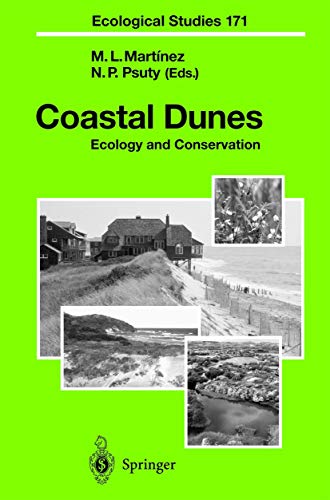

Coastal dunes ecology and conservation M.L. Martínez, N.P. Psuty (eds.).
Series Ecological studies ; v. 171.Detalles de publicación: Berlin New York Springer c2004.Descripción: xxiv, 386 p. ill. (some col.), maps (some col.) 24 cmISBN:- 3540408290 (hardback : acid-free paper)
- 577.5/83 22
- QH541.5.S26 C625 2004
| Imagen de cubierta | Tipo de ítem | Biblioteca actual | Biblioteca de origen | Colección | Ubicación en estantería | Signatura topográfica | Materiales especificados | Info Vol | URL | Copia número | Estado | Notas | Fecha de vencimiento | Código de barras | Reserva de ítems | Prioridad de la cola de reserva de ejemplar | Reservas para cursos | |
|---|---|---|---|---|---|---|---|---|---|---|---|---|---|---|---|---|---|---|
| Libro | Biblioteca de Mayagüez Colección General mb | QH541.5 .S26 C625 2004 (Navegar estantería(Abre debajo)) | Disponible | 50000002172137 |
Descripciones mejoradas de Syndetics:
Coastal dunes occur in almost every latitude - from tropical to polar - and have been substantially altered by human activities. Many are already severely and irreversibly degraded. Although these ecosystems have been studied for a long time (as early as 1835), there has been a strong emphasis on the mid-latitude dune systems and a lack of attention given to the tropics where, unfortunately, much of the modern exploitation and coastal development for tourism is occurring.
This book brings together coastal dune specialists from tropical and temperate latitudes, which together cover a wide set of topics, including: geomorphology, community dynamics, ecophysiology, biotic interactions and environmental problems and conservation. A major product of this book is a set of recommendations for future research, identifying relevant topics where detailed knowledge is still lacking. It also identifies management tools that will promote and maintain the rich diversity of the dune environments in the context of continuing coastal development.
Includes bibliographical references and index.
Tabla de contenidos provista por Syndetics
- I What Are Sand Dunes?
- 1 A Perspective on Coastal Dunes(p. 3)
- 1.1 Coastal Dunes and Their Occurrence(p. 3)
- 1.2 Relevance of Coastal Dunes(p. 3)
- 1.3 Current Conservation Status(p. 5)
- 1.4 Aims and Scope of the Book(p. 6)
- References(p. 10)
- 2 The Coastal Foredune: A Morphological Basis for Regional Coastal Dune Development(p. 11)
- 2.1 Conceptual Setting(p. 11)
- 2.2 Dichotomies of Inquiry(p. 12)
- 2.3 Dune Morphology Related to Sediment Supply and Dune-Beach Exchange(p. 15)
- 2.4 Continuum Scenario(p. 17)
- 2.4.1 River Mouth Discharge(p. 18)
- 2.4.2 Scenario Complexity(p. 20)
- 2.5 General Model(p. 22)
- 2.6 Humans as a Variable(p. 24)
- 2.7 Conclusions(p. 24)
- References(p. 25)
- 3 Coastal Dunes in the Tropics and Temperate Regions: Location, Formation, Morphology and Vegetation Processes(p. 28)
- 3.1 Introduction(p. 28)
- 3.2 Climatic Conditions in the Tropics(p. 28)
- 3.3 The Location of Coastal Dunes in the Tropics(p. 30)
- 3.4 Are There Differences Between Tropical and Temperate Coastal Dunes Types and Processes?(p. 33)
- 3.5 Foredunes(p. 34)
- 3.5.1 Flow Dynamics in Vegetation(p. 34)
- 3.5.2 Tropical Versus Temperate Foredune Trends and Morphologies(p. 35)
- 3.6 Gross Dune-Field Morphology(p. 37)
- 3.7 Rate of Dune-Field Vegetation Colonisation and Re-Vegetation Processes(p. 39)
- 3.8 Types of Dune-Field Vegetation Colonisation and Dune Morphologies(p. 40)
- 3.9 Conclusions(p. 44)
- References(p. 45)
- II The Flora and Fauna of Sand Dunes
- 4 Temperate Zone Coastal Dunes(p. 53)
- 4.1 Coastal Zone Temperate Climates(p. 53)
- 4.2 Coastal Dunes of Western North America(p. 56)
- 4.3 Conservation and Management(p. 60)
- References(p. 64)
- 5 Vegetation Dynamics and Succession in Sand Dunes of the Eastern Coasts of Africa(p. 67)
- 5.1 Introduction(p. 67)
- 5.2 Successional Change Along the Southern African Coast(p. 67)
- 5.2.1 Studies on Prograding Dune Fields(p. 68)
- 5.2.2 Studies on Transgressive Dune Fields and Partially Eroding Coastlines(p. 73)
- 5.2.3 Studies on Rocky Shores and Eroding Coastlines(p. 76)
- 5.3 Changes in Dune succession Dune to Aliens(p. 76)
- 5.3.1 The Effect of Ammophila arenaria as a Dune Pioneer on the Southern Cape coast(p. 76)
- 5.3.2 The Effect of Invasive Communities of Acacia cyclops in the Southern and Eastern Cape(p. 78)
- 5.3.3 Introduction of Casuarina equisetifolia as a Dune Stabilizer(p. 79)
- 5.4 Discussion(p. 80)
- 5.4.1 Distinguishing the Mechanism of Succession with Indigenous Pioneers(p. 80)
- 5.4.2 Effects of Aliens and the Need for Dune Stabilization(p. 81)
- 5.4.3 Conservation of Biodiversity and Dune Ecosystems, and Future Studies(p. 81)
- References(p. 82)
- 6 Coastal Dune Slacks(p. 85)
- 6.1 Introduction(p. 85)
- 6.2 The Dune Slack Environment(p. 86)
- 6.2.1 Hydrological System(p. 86)
- 6.2.2 Adaptations to Flooding and Low Nutrient Supply(p. 87)
- 6.3 Succession in Dune Slacks(p. 87)
- 6.3.1 Nutrient Limitation During Succession(p. 89)
- 6.3.2 Seed Banks and Succession(p. 89)
- 6.3.3 Stability of Pioneer Stages(p. 92)
- 6.4 Disturbances in Ecosystem Functioning(p. 95)
- 6.5 Restoration of Dune Slacks(p. 97)
- References(p. 99)
- 7 Coastal Dune Forest Rehabilitation: A Case Study on Rodent and Bird Assemblages in Northern KwaZulu-Natal, South Africa(p. 103)
- 7.1 Introduction(p. 103)
- 7.2 Study Area(p. 104)
- 7.2.1 Indian Ocean Coastal Dunes(p. 104)
- 7.2.2 The Coastal Sand Dune Forests of KwaZulu-Natal(p. 104)
- 7.2.3 The Post-Mining Rehabilitation ofCoastal Dunes(p. 105)
- 7.3 Materials and Methods(p. 107)
- 7.3.1 Rodents(p. 107)
- 7.3.2 Birds(p. 107)
- 7.4 Results and Discussion(p. 108)
- 7.4.1 Rodents(p. 108)
- 7.4.2 Birds(p. 112)
- 7.5 Conclusions(p. 113)
- References(p. 114)
- III Living in a Stressful Environment
- 8 Burial of Plants as a Selective Force in Sand Dunes(p. 119)
- 8.1 Introduction(p. 119)
- 8.2 Storm Damage ofForedunes-A Case History(p. 120)
- 8.2.1 Return(p. 121)
- 8.2.2 Re-Establishment(p. 123)
- 8.3 A Conceptual Model of Plant Response to Burial(p. 124)
- 8.4 Post-Burial Responses ofPlants(p. 125)
- 8.4.1 Seeds and Seed Bank(p. 125)
- 8.4.2 Seedlings(p. 127)
- 8.4.3 Adult Plants(p. 128)
- 8.4.4 Plant Communities(p. 128)
- 8.5 Burial-The Primary Cause ofZonation(p. 129)
- 8.6 Degeneration Response(p. 130)
- 8.7 Stimulation Response(p. 131)
- 8.8 Summary(p. 132)
- References(p. 133)
- 9 Physiological Characteristics of Coastal Dune Pioneer Species from the Eastern Cape, South Africa, in Relation to Stress and Disturbance(p. 137)
- 9.1 Introduction(p. 137)
- 9.2 A Conceptual Model of Resource Limitation and Plant Performance(p. 138)
- 9.3 Study Site, Species and Parameters Measured(p. 140)
- 9.4 Water Relations(p. 141)
- 9.5 Mineral Nutrients(p. 144)
- 9.6 Photosynthetic Characteristics(p. 144)
- 9.7 Growth Rates(p. 146)
- 9.8 Stress and Disturbance(p. 150)
- 9.9 Conclusions(p. 152)
- References(p. 153)
- 0 Plant Functional Types in Coastal Dune Habitats(p. 155)
- 10.1 Plant Functional Types(p. 155)
- 10.2 Dune Habitats as Environmental Islands(p. 157)
- 10.2.1 Adverse Interactions(p. 159)
- 10.3 Some Examples of Application of Plant FTs to Dune Vegetation Analysis(p. 159)
- 10.4 Dune Habitat Confinement(p. 164)
- 10.5 Conclusions(p. 166)
- References(p. 167)
- IV Biotic Interactions
- 11 Arbuscular Mycorrhizas in Coastal Dunes(p. 173)
- 11.1 Introduction(p. 173)
- 11.2 Life History of AM Fungi in Sand Dunes(p. 174)
- 11.3 AM Fungi in Sand Dunes(p. 176)
- 11.4 Seasonality ofAM Fungi in Sand Dunes(p. 177)
- 11.5 Effects ofArbuscular Mycorrhizas on the Establishment and Growth of Sand Dune Plants(p. 178)
- 11.6 Arbuscular Mycorrhizas and Sand Dune Succession(p. 181)
- 11.7 Arbuscular Mycorrhizas in Sand Dune Restoration and Stabilization(p. 183)
- References(p. 184)
- 12 The Role ofAlgal Mats on Community Succession in Dunes and Dune Slacks(p. 189)
- 12.1 Introduction(p. 189)
- 12.2 Hydrological Dynamics of Slacks in Coastal Dune Systems(p. 89)
- 12.3 Algal Communities in Slacks and Other Coastal Zones(p. 90)
- 12.4 The Role of Algae During Primary Succession(p. 193)
- 12.5 A Study Case on the Gulf of Mexico(p. 197)
- 12.6 Importance ofAlgae for Slack Conservation(p. 200)
- 12.7 Conclusions(p. 201)
- References(p. 202)
- 13 Plant-Plant Interactions in Coastal Dunes(p. 205)
- 13.1 Introduction(p. 205)
- 13.2 Facilitation(p. 207)
- 13.3 Competition(p. 209)
- 13.3.1 Grass Encroachment(p. 210)
- 13.3.2 Invasive Plants(p. 212)
- 13.4 Epiphytes(p. 213)
- 13.4.1 Non-Parasites(p. 213)
- 13.4.2 Parasites(p. 216)
- 13.5 Conclusions(p. 217)
- References(p. 218)
- 14 Ant-Plant Interactions: Their Seasonal Variation and Effects on Plant Fitness(p. 221)
- 14.1 Importance of Interspecific Interactions(p. 221)
- 14.2 Richness and Seasonal Variation of Ant-Plant Interactions(p. 222)
- 14.3 Importance of Nectar to Ants in Tropical Seasonal Environments(p. 225)
- 14.4 Effect of Ants on Plant Fitness(p. 227)
- 14.4.1 Myrmecophylla (Schomburgkia tibicinis) christinae (Orchidaceae)(p. 229)
- 14.4.2 Paullinia fuscescens (Sapindaceae)(p. 231)
- 14.4.3 Opuntia stricta (Cactaceae)(p. 232)
- 14.4.4 Turnera ulmifolia (Turneraceae)(p. 234)
- 14.5 Conclusion(p. 235)
- References(p. 236)
- V Environmental Problems and Conservation
- 15 Environmental Problems and Restoration Measures in Coastal Dunes in the Netherland(p. 243)
- 15.1 Introduction(p. 243)
- 15.2 Differences Between Renodunaal and Wadden Districts(p. 244)
- 15.3 Impact of Availability of P on Biomass Production and Successional Trends(p. 245)
- 15.3.1 Renodunaal District(p. 245)
- 15.3.2 Wadden District(p. 247)
- 15.4 Effect of Mineralization of Nitrogen(p. 247)
- 15.4.1 Impact of Litter Production(p. 247)
- 15.4.2 Impact ofLitter Decomposition(p. 249)
- 15.5 Role of Ammophila arenaria in the Wadden District(p. 250)
- 15.6 Restoration(p. 250)
- 15.6.1 Effect ofGrazing and Annual Mowing(p. 251)
- 15.6.2 Effect of Sod Cutting(p. 253)
- 15.6.3 Effect ofIncreased Aeolian Activity(p. 254)
- 15.7 Concluding Remarks(p. 255)
- References(p. 256)
- 16 The Costs of our Coasts: Examples of Dynamic Dune Management from Western Europe(p. 259)
- 16.1 Introduction(p. 259)
- 16.2 Coastal Dunes: Dynamic Systems and Management(p. 259)
- 16.3 Examples from Western Europe: England and The Netherlands(p. 261)
- 16.4 The Sefton Coast (England)(p. 262)
- 16.4.1 Area(p. 262)
- 16.4.2 Management(p. 263)
- 16.4.3 The Sefton Coast in the 21st Century(p. 264)
- 16.4.4 Recreation(p. 266)
- 16.4.4.1 Visitor Research(p. 266)
- 16.4.4.2 Visitor Typology(p. 266)
- 16.4.5 Costs ofManagement(p. 267)
- 16.5 The Meijendel Dunes (The Netherlands)(p. 268)
- 16.5.1 Area(p. 268)
- 16.5.2 Management by the Dunewater Company(p. 269)
- 16.5.3 Recreation: Better Possibilities for People to Enjoy Nature(p. 269)
- 16.5.4 Meijendel and the Production of Drinking Water(p. 272)
- 16.5.5 Development ofa Natural Core Area(p. 272)
- 16.5.6 Costs ofManagement(p. 274)
- 16.5.7 Visitors Appraisal(p. 275)
- 16.6 Dune Management in a Changing Society(p. 275)
- References(p. 276)
- 17 Animal Life in Sand Dunes: From Exploitation and Prosecution to Protection and Monitoring(p. 279)
- 17.1 Introduction(p. 279)
- 17.2 Cropping Stock and Game: The Medieval Sand Dunes as a Store of Animal Goods(p. 280)
- 17.3 Nature Conservation Starts with Bird Protection(p. 281)
- 17.4 The Complexity of Biotic Interactions(p. 284)
- 17.5 Coastal Zone Management: Can Animals be Integrated? 290 References(p. 293)
- 18 Coastal Vegetation as Indicators for Conservation(p. 297)
- 18.1 Introduction(p. 297)
- 18.1.1 Environmental Indicators(p. 297)
- 18.1.2 Ecological Indicators(p. 298)
- 18.2 Methods(p. 301)
- 18.2.1 Ecological Indicators Selection(p. 301)
- 18.2.2 Calculation ofEcological Indicators(p. 304)
- 18.3 Results(p. 306)
- 18.3.1 Environmental Indicators for the Region (Landscape-Scale Indicators)(p. 306)
- 18.3.2 Ecological Indicators for Coastal Dunes (Plant-Community Scale)(p. 306)
- 18.4 Discussion and Conclusion(p. 309)
- Appendix: Floristic List of Northern Baja California Coastal Sand Dune Systems(p. 311)
- References(p. 316)
- 19 A Case Study ofConservation and Management of Tropical Sand Dune Systems: La Mancha-El Llano(p. 319)
- 19.1 Introduction(p. 319)
- 19.2 Dune Conservation and Management(p. 319)
- 19.3 Beach and Dune Biodiversity and Protected Areas in Mexico 320
- 19.4 Community Management for the Conservation of Coastal Resources: La Mancha-El Llano Case Study(p. 325)
- References(p. 332)
- 20 European Coastal Dunes: Ecological Values, Threats, Opportunities and Policy Development(p. 335)
- 20.1 Introduction(p. 335)
- 20.2 Distribution of Coastal Dunes along Europe's Coast: A Short Geography(p. 336)
- 20.3 Ecological Values Related to Biodiversity(p. 338)
- 20.4 Trends, Threats and Opportunities(p. 340)
- 20.4.1 Agriculture: Intensification as well as Marginalization(p. 340)
- 20.4.2 Urbanisation, Industries, Harbour Development(p. 340)
- 20.4.3 Infrastructure(p. 341)
- 20.4.4 Tourism/Recreation(p. 341)
- 20.4.5 Forestry(p. 342)
- 20.4.6 Coastal Processes, Climate Change and Sea Level Rise, Aeolian Processes(p. 342)
- 20.4.7 Coastal Defence Works(p. 343)
- 20.5 Policy Analysis of Dune Conservation in Europe(p. 343)
- 20.5.1 Bern Convention(p. 344)
- 20.5.2 EU Policy(p. 344)
- 20.5.3 National Policies(p. 346)
- 20.6 SWOT Analysis(p. 347)
- 20.7 Conclusions(p. 347)
- 20.7.1 EU Countries(p. 347)
- 20.7.2 Accession Countries(p. 349)
- 20.7.3 Non-EU Countries(p. 349)
- 20.8 Recommendations(p. 349)
- References(p. 350)
- VI The Coastal Dune Paradox: Conservation vs Exploitation?
- 21 The Fragility and Conservation of the World's Coastal Dunes: Geomorphological, Ecological and Socioeconomic Perspectives(p. 355)
- 21.1 Current Worldwide Status of Coastal Dunes(p. 355)
- 21.2 Current Research Trends (What Do We Know?)(p. 356)
- 21.2.1 Variable Morphologies(p. 356)
- 21.2.3 Succession(p. 357)
- 21.2.3 Adaptations(p. 358)
- 21.2.4 Tropical vs. Mid-Latitudes(p. 359)
- 21.3 Fragile Ecosystems?(p. 361)
- 21.4 Management Practices(p. 361)
- 21.5 Future Trends and Perspectives(p. 364)
- References(p. 367)
- Taxonomic Index(p. 371)
- Subject Index