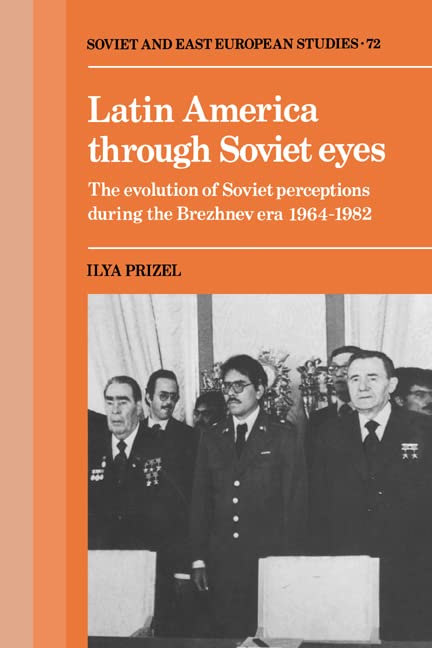

Latin America through Soviet eyes the evolution of Soviet perceptions during the Brezhnev era 1964-1982 Ilya Prizel.
Series Soviet and East European studies ; 72Detalles de publicación: Cambridge [England] New York Cambridge University Press 1990.Descripción: xiii, 253 p. 24 cmISBN:- 0521373034
- Public opinion -- Soviet Union -- History
- Politicians -- Soviet Union -- Attitudes
- Journalists -- Soviet Union -- Attitudes
- Scholars -- Soviet Union -- Attitudes
- Latin Americanists -- Soviet Union -- Attitudes
- Latin America -- Foreign public opinion, Soviet -- History
- Soviet Union. -- Relations -- Latin America
- Latin America -- Relations -- Soviet Union
- 980.03/072047 20
- F1416.S65 P75 1990
| Imagen de cubierta | Tipo de ítem | Biblioteca actual | Biblioteca de origen | Colección | Ubicación en estantería | Signatura topográfica | Materiales especificados | Info Vol | URL | Copia número | Estado | Notas | Fecha de vencimiento | Código de barras | Reserva de ítems | Prioridad de la cola de reserva de ejemplar | Reservas para cursos | |
|---|---|---|---|---|---|---|---|---|---|---|---|---|---|---|---|---|---|---|
| Libro | Biblioteca Encarnación Valdés Colección General bev | 980.03 P961L (Navegar estantería(Abre debajo)) | Disponible | 80000001440273 |
Descripciones mejoradas de Syndetics:
Latin America through Soviet Eyes provides an original and comprehensive assessment of changing Soviet perceptions of politics in Latin America during the Brezhnev years. Dr Prizel surveys the views of Soviet academics and journalists as well as of politicians on three main areas. He explores the changing Soviet perceptions of Latin America's domestic politics including the Church, the military and national liberation movements; he examines the role of Latin America in global politics and the way in which the USA has influenced regional events, and he discusses the emerging Soviet-Latin American relationship. Case studies of Mexico, Chile, Brazil and Argentina provide a framework for understanding changing Soviet perceptions in the context of the domestic dynamics of specific individual countries. This book is based on a wealth of Russian, Spanish and English language sources. Soviet academic journals, newspapers, communist party journals and the numerous books published by the Institute of Latin America of the Academy of Sciences in the USSR provide the Soviet view of Latin America and this is examined against a background of regional perceptions expressed in Spanish-American material.
Includes bibliographical references (p. 203-244) and index.
Tabla de contenidos provista por Syndetics
- Preface
- Acknowledgments
- Introduction
- Part I Soviet Perceptions of Latin America+s Global Role: Introduction
- 1 Soviet perceptions of US-Latin American relations
- 2 Latin America+s role in the capitalist division of labor
- 3 Latin America+s role in the Third World
- 4 Soviet views on Latin America+s regional integration
- 5 Soviet conclusions regarding Latin America+s ability to conduct an independent foreign policy
- Part II Soviet Perceptions of Latin American Social Structures: Introduction
- 6 The Latin American church
- 7 The Latin American armed forces
- 8 Latin American labor unions
- 9 Bourgeois political parties
- 10 Wars of national liberation or peaceful transformation?
- Part III Soviet-Latin American Relations During the Brezhnev Era: Introduction
- 11 Case study: Mexico
- 12 Case study: Chile
- 13 Case study: Brazil and Argentina
- Part IV Conclusion: The Emerging Soviet Perception of Latin America and the Future of Soviet Policy Toward the Hemisphere
- Conclusions
- Epilogue - Latin America: the Long March
- Notes
- Bibliography
- Index