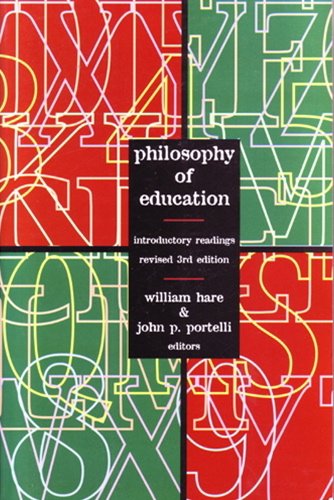
Imagen de portada de Amazon
Imagen de Amazon.com
Imagen de cubierta Syndetics
Portada de Syndetics
Imagen de OpenLibrary

Philosophy of education introductory readings William Hare & John P. Portelli, editors.

Colaborador(es): Detalles de publicación: Canada Detselig Enterprises Ltd. 2001.Edición: 3r edDescripción: 409 p. 23 cmISBN:
  • 1550592165
Tema(s): Clasificación CDD:
  • 21 370.1 P5685
Clasificación LoC:
  • LB1025.3 .P53 2001
Valoración
    Valoración media: 0.0 (0 votos)
Existencias
Imagen de cubierta Tipo de ítem Biblioteca actual Biblioteca de origen Colección Ubicación en estantería Signatura topográfica Materiales especificados Info Vol URL Copia número Estado Notas Fecha de vencimiento Código de barras Reserva de ítems Prioridad de la cola de reserva de ejemplar Reservas para cursos
Libro Biblioteca Encarnación Valdés Colección General bev 370.1 P5685 2001 (Navegar estantería(Abre debajo)) Disponible 80000002113515
Total de reservas: 0

Descripciones mejoradas de Syndetics:

"Philosophy of Education" is designed to engage readers with a broad range of contemporary perspectives on significant educational issues, including, pluralism and democracy in education, the problem of indoctrination, the nature and value of critical teaching, controversy in the classroom, and educational standards.
In this third edition, it remains the intention of the editors to offer a collection of essays in the philosophy of education which will provide students in teacher education programs with a lively and accessible introduction to some of the central debates and issues in the field. In addition, teachers, administrators and graduate students should find this collection a valuable resource. As with the first and second editions, and given the intended readership, the editors have selected discussions which establish a connection between philosophical reflection and pedagogical practice, in the belief that philosophical understanding is a vital aspect of professional development.

Includes bibliographical references.

Extracto provisto por Syndetics

Introduction This fourth edition, like its predecessors, is designed first and foremost to make available a collection of essays in philosophy of education that will offer preservice teachers a stimulating and accessible introduction to some of the most important issues in the field. Classroom teachers, school administrators, teacher educators, educational policy makers, graduate students, and general readers alike will also find this collection a valuable resource in connection with problems that relate to educational theory and practice. As with the earlier editions, and given our intended readership, we have included contributions that connect philosophical reflection with current debates concerning approaches to teaching, methods of assessment, the content of the curriculum, and many other practical matters that relate to schools and student learning. This reflects our belief that philosophical understanding is a vital aspect of professional development. We have chosen essays that will challenge readers to formulate their own views on matters that are the subject of lively discussion among philosophers and educators, and that are intended to encourage a thoughtful engagement with theories and practices that shape contemporary education. What kinds of philosophical problems are taken up in these selections? Reflective teachers will quickly find themselves involved with difficult and important questions that clearly have great relevance for educational policy and practice. Along with our contributors, readers will surely wonder whether a certain kind of testing is appropriate, what limits there might be on a teacher's conduct beyond the classroom, if and when it might be justifiable for a teacher to take a stand on a value issue, what would make a school or classroom democratic or socially just, how far we can rely on research findings about teaching, whether sensitive material should be discussed in class, what genuine dialogue involves, and so on. Such questions inevitably draw us into reflection on "common sense" views and assumptions about education and teaching that have been accepted without serious debate; they focus attention on the language we use to describe education, teaching, and schooling, and its influence on the way we understand and approach our work as educators; they require us to think more carefully about our educational aims and how they can be justified; moreover, they stimulate us to look for imaginative ways in which we might attempt to pursue our ideals or resolve dilemmas that we confront in our work. In earlier editions, we put forward the view that philosophy of education involves a critical inquiry into educational concepts, values, and practices. Philosophy of education as critical inquiry means that philosophy itself is a practice that intrinsically raises critical awareness, encourages self-reflexivity, and contributes to the development of intellectual and moral virtues that are essential to good teaching. Our hope is that the selections included here will bear out these claims and show that critical reflection has an important bearing on practical educational decisions. Student teachers and others encountering philosophy of education for the first time might wonder how best to approach these essays, knowing they will meet with controversial and provocative views and theories that may well conflict with their own ideas and values. Bertrand Russell remarks that if people "have a determination never to surrender certain philosophic beliefs, they are not in the frame of mind in which philosophy can be profitably pursued" (Russell, 1927, p. 299). This comment reminds us that we need to approach philosophical discussions with an open-minded outlook, ready to consider objections to our views and to revise them if we discover we are mistaken (Hare, 1979). Philosophy of education does not arrive at conclusions that all philosophers accept; philosophical ideas typically remain controversial and debatable. In the end, we must judge for ourselves, but this should come after we have given serious consideration to the best arguments we can find, and the conclusions we reach should be held in the same open-minded way. This attitude does not mean that we lack confidence in our beliefs or that we regard other beliefs as equally acceptable but that we see our ideas as open to revision in the light of further evidence and argument (Hare, 1993). The topics, issues, and problems selected for inclusion in this volume are much discussed by philosophers of education today, and this has led to work of high quality that teachers and educators will find relevant and thought-provoking. Six major themes serve to organize the chapters into the various parts that comprise this collection. Each part has its own introduction providing an overview of the chapters in that group and drawing attention to important questions that arise from the discussion. In each part, readers will find there are arguments, insights, and examples that prove to be helpful in thinking about problems and issues that are discussed elsewhere in the book. - Part I offers teachers provocative and informative perspectives on philosophy, theory, and practice. A central theme concerns the way in which philosophy and educational theory influence a teacher's outlook and independent views. - Part II turns to certain issues that arise in classroom teaching. Attention is focused on pedagogical situations and controversial areas where teachers need to make difficult choices guided by educational principles. - Part III takes up issues that concern democracy and social justice. These essays prompt reflection on the ideals and values embedded in these notions and what it would mean to see them reflected in education and schooling. - Part IV deals with matters related to standards, efficiency, and measurement in education. The arguments here raise concerns about assumptions and practices prevalent in contemporary schooling that threaten to undermine our educational aims. - Part V explores issues relating to rights, freedoms, and conflicts in education. The problem of balancing conflicting rights and freedoms is examined, and the possibility of understanding others with different values is explored. - Part VI presents certain general conceptions of education and teaching. These discussions challenge teachers to look critically at the somewhat narrow ways in which their work is often defined and to develop a deeper understanding of their role. There is a wealth of material for discussion and debate in these essays. Student teachers may find it useful to supplement these readings with case studies related to teaching and education (Hare and Portelli, 2003); those who wish to read further in philosophy of education can readily do so and references are provided below. Excerpted from Philosophy of Education: Introductory Readings All rights reserved by the original copyright owners. Excerpts are provided for display purposes only and may not be reproduced, reprinted or distributed without the written permission of the publisher.
Compartir
logopucpr-y-vive

Contáctanos

¡Queremos saber de ti!

Tel. 787.841.2000 Ext. 1801

bibliotecavaldes@pucpr.edu

⁣Búscanos en las redes

© 2026 Desarrollado por Ignite Online • All Rights Reserved • Powered by Koha.