Reseñas proporcionadas por Syndetics
Library Journal Review
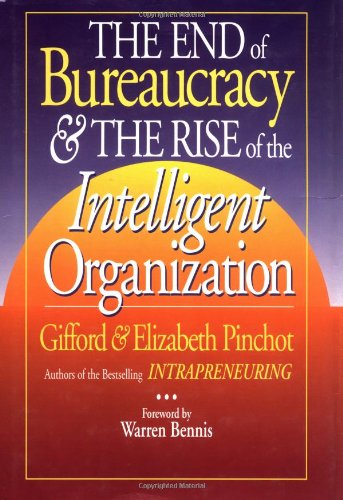
Applying the principles of free markets and free enterprise to the structure of corporate organizations, the authors of Intrapreneuring ( LJ 3/1/85) outline an alternative to the cumbersome, pyramid-style, bottle-necking bureaucracy still entrenched in the corporate world today. They expand on their concept of ``intrapreneurship'' here by centering their plan on lateral associations, freedom to form teams within the corporate structure, the free flow of information, and the liberating sensation that ensues when all workers are allowed to formulate, implement, and claim ownership of corporate ideas. The effective organization utilizes the intelligence of all individuals within the corporation, relinquishing responsibility to the front-line workers who may better understand the problems of their own areas and find cost-efficient solutions. Highly recommended.-- Randy Abbott, Univ. of Evansville Libs., Ind. (c) Copyright 2010. Library Journals LLC, a wholly owned subsidiary of Media Source, Inc. No redistribution permitted.
Publishers Weekly Review
The Pinchots ( Intrapreneuring ) here tackle the numbing influence of bureaucracies, which, they write, are ``no more appropriate to sophisticated work today than serfdom was to the factory work of the early Industrial Revolution.'' They foresee a conversion to post-bureaucratic organizations in which teams form the basic unit of empowerment, freeing employees to concentrate on total quality, high performance tasks, reengineering and intrapreneuring. The authors bolster their arguments with case studies (Dana, ConAgra, the Canadian National Railroad) and perceptive positions on benchmarking, customer service and workplace responsibility. Their material on the factors that make teams effective illuminates ideas expounded by total quality management theoreticians. Stressing that intrapreneurial experimentation is needed so ``the people upstairs notice what is working,'' the authors present a managerial construct worth considering. (Mar.) (c) Copyright PWxyz, LLC. All rights reserved
CHOICE Review
The authors, Fortune 100 consultants, former owners of businesses, and coauthors of Intrapreneuring (1985), assert that organizational survival demands new structures. Slow, stultifying, top-down forms do not match today's competitive business environment. Using examples of innovative practices drawn from AT&T, Hewlett-Packard, Digital Equipment, US Forest Service, and others, they develop a vision of the viable firm. In it, managers have mainly a facilitative role, decisions are pushed down to well-trained work teams, information freely flows up and down so that teams can make informed decisions and monitor themselves (and divide the tasks and income of their quite autonomous units). With teams responsible for gaining new business from internal and external customers, each group survives or fails as a small enterprise and thus learns the best practices. This is a fine companion to Joseph H. Boyett and Henry R. Conn's Workplace 2000 (1992); the views overlap and together provide a persuasive forecast. This important, clearly written book is especially useful for executives and graduate students and their teachers in management and the sociology of organizations. C. Tausky; University of Massachusetts at Amherst
Booklist Review
The millennium draws even nearer as the Pinchots, authors of Intrapreneuring, prose~lytize widely for a new kind of corporation: the nonbureaucratic, intelligent corporation. Examples of its beginnings are found everywhere--in the multidimensionality of 3M, with its autonomous business units; in the paperless offices of Oticon A/S, a Danish hearing-aid manufacturer; and in the customized trailers built by Wabash National. Though the intelligent corporation, a company believing in seven distinct "rules"--from widespread truth and rights to limited governance--is not yet a reality, the authors provide plenty of hard data, charts, and uncommon case histories to argue that "yes, this is the way to work." By detailing the strengths and weaknesses of traditional bureaucracies, by demonstrating persuasively that, without freedom of choice and a community of concern, business "as is" will not survive, they create a framework in which to reinvent the corporation. ~--Barbara Jacobs