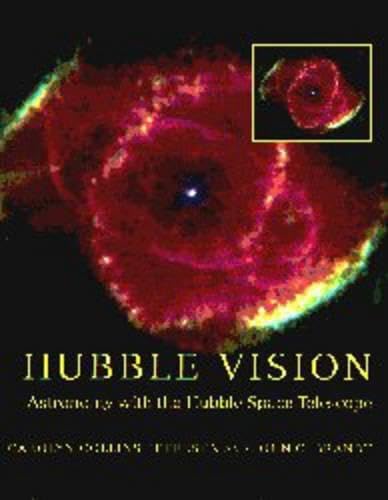
Imagen de portada de Amazon
Imagen de Amazon.com
Imagen de cubierta Syndetics
Portada de Syndetics
Imagen de OpenLibrary

Hubble vision Astronomy with the hubble space telescope Carolyn Collins Petersen and John C. Brandt.

Por: Colaborador(es): Detalles de publicación: New York Cambridge University Press 1995.ISBN:
  • 0521496438
Tema(s): Clasificación LoC:
  • QB 500.268 .P38 1996
Valoración
    Valoración media: 0.0 (0 votos)
Existencias
Imagen de cubierta Tipo de ítem Biblioteca actual Biblioteca de origen Colección Ubicación en estantería Signatura topográfica Materiales especificados Info Vol URL Copia número Estado Notas Fecha de vencimiento Código de barras Reserva de ítems Prioridad de la cola de reserva de ejemplar Reservas para cursos
Libro Biblioteca de Mayagüez Colección General mb QB 500.268 .P38 1996 (Navegar estantería(Abre debajo)) Disponible 50000001836740
Total de reservas: 0

Descripciones mejoradas de Syndetics:

The refurbished Hubble Space Telescope has revealed spectacular and intriguing details in every object it has turned its acute gaze upon. What discoveries has the HST made so far? And how does this telescope actually work? This lavishly illustrated volume is the first to answer these questions in a complete review of the most exciting science to come from the Hubble Space Telescope. From the local Solar System and nearby stars, to the most distant quasars and early Universe, this volume presents a superb collection of the most dramatic images taken by the HST, supported by a lively and informative, but non-technical guide. Hubble Vision offers a view of the Universe as never seen before and will capture the imagination of all those interested in the astronomical quest of understanding our Universe - from the general reader and amateur astronomer through to the professional scientist.

Tabla de contenidos provista por Syndetics

  • Preface
  • 1 Space telescope: The dream and the reality
  • 2 Observing with the Hubble Space Telescope
  • 3 The Solar System
  • 4 Stars and the interstellar medium
  • 5 Galaxies
  • 6 Cosmology
  • Epilogue
  • Glossary and bibliography
  • Index

Reseñas proporcionadas por Syndetics

Library Journal Review

After a disastrous start featuring a flawed optical system and a flood of negative publicity, the reengineered Hubble Space Telescope (HST) is now producing many important scientific findings. This book, coauthored by an astronomer and a science writer, relates both the unpleasant inaugural years of the HST and the successes that now vindicate the expensive project. Because the volume is aimed at a general audience, the authors have included some sections giving the basic scientific background needed to put the HST data into context. At times readers may feel burdened by large doses of aerospace jargon and the language of advanced astronomical research, but those who persist will be rewarded with a balanced overview of the Hubble story. Recommended for public and academic libraries.‘Jack W. Weigel, Univ. of Michigan Lib., Ann Arbor (c) Copyright 2010. Library Journals LLC, a wholly owned subsidiary of Media Source, Inc. No redistribution permitted.

CHOICE Review

Astronomer Brandt (Univ. of Colorado), science author of this superbly illustrated book, is ably assisted by Petersen, a journalist from Boulder. They have covered the whole story of the Hubble Space Telescope (HST), from its initially flawed optics through its refurbishment by astronauts Story Musgrave and Jeff Hoffman in 1993 to its important astronomical discoveries thereafter. Due credit is given to Princeton's Lyman Spitzer, who had the original idea, and to Edwin Hubble, whose name was adopted. The authors describe the telescope design and its instruments (cameras, spectrographs, photometers), then proceed to its many uses. Its high resolution is important for objects near and far, from planets in the solar system to stars and nebulae in our galaxy, to the most distant galaxies and quasars. Petersen and Brandt describe the organization of scientists and engineers that operates HST, the Space Science Institute, and the panels of researchers who pick the targets and problems. There is an epilog on HST's future, a helpful glossary, three pages of references, and a good, 12-column index. The text is easy to read, with no formal mathematics. Highly recommended. All levels above fifth grade. T. Page; NASA Johnson Space Center
Compartir
logopucpr-y-vive

Contáctanos

¡Queremos saber de ti!

Tel. 787.841.2000 Ext. 1801

bibliotecavaldes@pucpr.edu

⁣Búscanos en las redes

© 2026 Desarrollado por Ignite Online • All Rights Reserved • Powered by Koha.