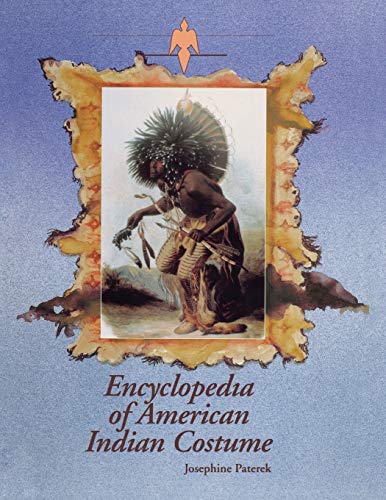
A beautifully produced and illustrated (bandw) reference that offers complete descriptions and cultural contexts of the dress and ornamentation of the North American Indian tribes. The volume is divided into ten cultural regions, with each chapter giving an overview of the regional clothing. Individual tribes of the area follow in alphabetical order. Tribal information includes men's basic dress, women's basic dress, footwear, outer wear, hair styles, headgear, accessories, jewelry, armor, special costumes, garment decoration, face and body embellishment, transitional dress after European contact, and bibliographic references. Appendices include a description of clothing arts and a glossary. Annotation copyright by Book News, Inc., Portland, OR
Includes bibliographical references and index.
Reseñas proporcionadas por Syndetics
CHOICE Review
This impressive reference work took ten years to write, and the waiting was well worth it. Nothing of this scope and magnitude on this subject has been done before. Paterek (emerita, speech and theater, Univ. of Wisconsin) focuses on traditional (non-European) and early transition materials of Native Americans and Inuits (the author chose to use the less-favored terms "American Indian" and "Eskimo" in this work). In addition to basic dress, the author describes footwear, hairstyles, accessories, armor, decoration, and masks. An introduction explains the organization and contents: North America is divided into ten cultural regions, and each section begins with a description of the area and an overview of the individual tribes in alphabetical order. An appendix on clothing arts is especially informative, giving details of the clothing and how it was constructed, with a section of diagrams. The 150 black-and-white illustrations are attractive and well chosen. The photographs come from a large number of museums. A glossary of terms, a comprehensive bibliography, and a detailed and accurate index complete this well-written work. Paterek's one other book, Costuming for the Theatre (1959), a handbook for amateur theatrical groups, is much used to this day. Highly recommended for all libraries. P. Brauch; Brooklyn College, CUNY
Booklist Review
Many nations share the North American continent; the diversities of clothing styles of Native Americans are documented in this book. Offering complete descriptions and the cultural context of the dress and ornamentation of these Americans, this authoritative book is accessible to everyone from the upper elementary student to adults. The book is divided into 10 cultural regions north of Mexico. Each region is described in a general manner. The tribes that inhabited the area are listed in a table at the beginning of the chapter, and those that are further described are followed by a page number. The description of the costume of each specific tribe is given in a consistent order, including men's basic, women's basic, footware, outer wear, hairstyles, headgear, accessories, jewelry, armor, special costumes, garment decoration, face and body embellishment, and masks. A final paragraph on transitional dress refers to how clothing changed after involvement with Europeans. Beyond the basic description, the author includes insight into the culture, natural materials, and societal influences that led to the diversity of costumes. More than 400 large black-and-white photographs, some of them by famous photographers such as Edward Curtis, and drawings and paintings by noted artists, such as Karl Bodmer and George Catlin, illustrate the entries. A list of key sources for the information follows each entry. Appendixes include a glossary and descriptions of the materials used in clothing and the techniques of their production, with line drawings of many articles. An extensive bibliography, divided by cultural region, is followed by a detailed index. The index lists not only tribes and pieces of clothing, but also such subjects as puberty customs and looms. Although technically a book on clothing, the Encyclopedia of American Indian Costume would serve well in the college, public, or school library for broader research on the many tribes listed. (Reviewed September 1, 1994)
Notas de autor provistas por Syndetics
Josephine Paterek , PhD, is professor emeritus of speech and theatre at the University of Wisconsin, River Falls, WI.