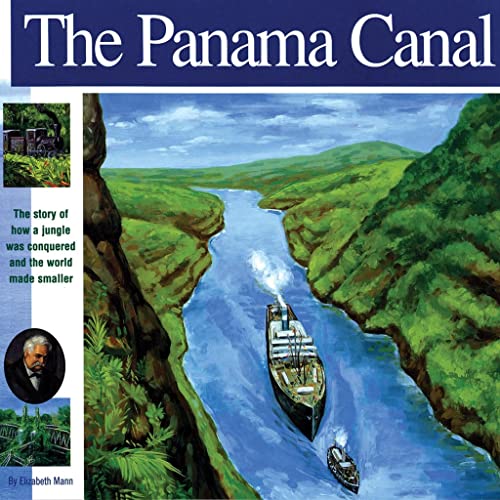

The Panama Canal Elizabeth Mann with illustrations by Fernando Rangel.
Detalles de publicación: New York Mikaya Press 1998.Descripción: 48 p. il. 26cmISBN:- 0965049345
| Imagen de cubierta | Tipo de ítem | Biblioteca actual | Biblioteca de origen | Colección | Ubicación en estantería | Signatura topográfica | Materiales especificados | Info Vol | URL | Copia número | Estado | Notas | Fecha de vencimiento | Código de barras | Reserva de ítems | Prioridad de la cola de reserva de ejemplar | Reservas para cursos | |
|---|---|---|---|---|---|---|---|---|---|---|---|---|---|---|---|---|---|---|
| Libro | Biblioteca Mons. Iñaki Mallona (Arecibo) Colección General ab | 972.875 M281p (Navegar estantería(Abre debajo)) | Disponible | 60000010063243 |
Descripciones mejoradas de Syndetics:
Panama was less than 50 miles wide, yet difficult to bridge by canal -- its swamps were disease-ridden, its mountainous rain forest challenged the most brilliant engineers, and its oppressive heat exhausted the hardiest workers. Engineers found ways to cut through the forest, medical visionaries conquered the diseases, and workers endured the jungle. Yet there were also broken treaties, political tyranny, and the tragedy of thousands of West Indian workers forced to live in awful, segregated conditions.
Wonders of the World series
The winner of numerous awards, this series is renowned for Elizabeth Mann's ability to convey adventure and excitement while revealing technical information in engaging and easily understood language. The illustrations are lavishly realistic and accurate in detail but do not ignore the human element. Outstanding in the genre, these books are sure to bring even the most indifferent young reader into the worlds of history, geography, and architecture.
"One of the ten best non-fiction series for young readers."
- Booklist
Reseñas proporcionadas por Syndetics
School Library Journal Review
Gr 3-6-A solid, approachable introduction to the often amazing story of the Panama Canal, complete with full-color illustrations and historical photos. Mann traces the starts and stops of the undertaking from its French origins to its completion by the Americans, fueled throughout by the labor of workers from all over the world. The construction of the canal, with its locks and dams, is not an easy subject to relate. However, the author manages to render the technical language in the simplest of terms. She also addresses the unfair working and living conditions of the many laborers from the Caribbean. A pull-out illustration of how the canal works is included. Tim McNeese's The Panama Canal (Lucent, 1997) is more thorough, but for younger readers, Mann's book more than suffices.-Carol Fazioli, The Brearley School, New York City, NY (c) Copyright 2010. Library Journals LLC, a wholly owned subsidiary of Media Source, Inc. No redistribution permitted.Booklist Review
Gr. 4^-6. From the author of The Roman Colosseum [BKL D 15 98] and other books in The Wonders of the World series comes a dynamic introduction to the building of the Panama Canal, from the failure of Ferdinand de Lesseps and the French to the opening of the U.S.-constructed canal on August 15, 1914, an event completely overshadowed by the start of World War I. Mann describes how President Theodore Roosevelt manipulated events by helping Panama rebel against Colombia and getting a treaty signed with Panama that gave the U.S. carte blanche to build the canal. There were many obstacles, such as rampant diseases (eventually conquered by Dr. William Gorgas), the hostile climate, the wild and destructive Chagres River, and the formidable Cordillera Mountains, which the canal had to cross. The author does not gloss over the many worker deaths and the poor living conditions and wages afforded the majority of the workers, who were blacks from the Caribbean islands of Barbados and Jamaica. Lush full-page paintings by Fernando Rangel convey a genuine sense of the tropical jungle as well as the building of the canal; archival photos and prints round out the visuals, which include a centerfold that shows how the locks raise and lower ships. This will serve well both as recreational reading and as material for report writers. --Sally EstesNotas de autor provistas por Syndetics
Elizabeth Mann has written nine Wonders of the World books, an award-winning series. She is former teacher in New York, holds an M.S.E. and is cofounder of Mikaya Press.
Fernando Rangel was born in Bogata, Colombia, and grew up in Queens, N.Y. He earned a B.F.A. at the School of Visual Arts and trained at the Chatauqua School of Art.