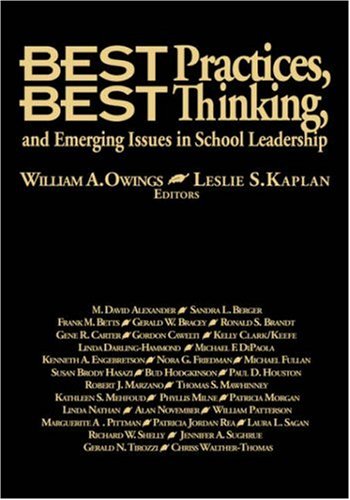

Best practices, best thinking, and emerging issues in school leadership edited by William Owings and Leslie Kaplan.
Detalles de publicación: Thousand Oaks, CA. Corwin Press c2003.Descripción: xxiv, 279 p. 25 cmISBN:- 0761978623 (c)
- 0761978631 (p)
- 371.2 B5611 21
- LB2805 .B47 2003
| Imagen de cubierta | Tipo de ítem | Biblioteca actual | Biblioteca de origen | Colección | Ubicación en estantería | Signatura topográfica | Materiales especificados | Info Vol | URL | Copia número | Estado | Notas | Fecha de vencimiento | Código de barras | Reserva de ítems | Prioridad de la cola de reserva de ejemplar | Reservas para cursos | |
|---|---|---|---|---|---|---|---|---|---|---|---|---|---|---|---|---|---|---|
| Libro | Biblioteca Encarnación Valdés Colección General bev | 371.2 B5611 (Navegar estantería(Abre debajo)) | Disponible | 80000002159732 |
Descripciones mejoradas de Syndetics:
Featuring the leading figures in educational leadership, this new resource from Owings and Kaplan connects best thinking with best practices and emerging issues in school leadership. The contributing authors--including Michael Fullan, Linda Darling-Hammond, Alan November, Robert Marzano, Gerald Tirozzi, and Gene Carter--present leading research and key considerations to assist in making decisions about new programs and new directions for your school.
This book highlights:
Future Trends Recruiting High-Stakes Testing Teacher Quality Technology Curriculum and Instruction Special Education School Law Political Environment Building-level Change Parent/Community RelationshipsBest Practices, Best Thinking, and Emerging Issues in School Leadership unites the ideas of these leading educators and researchers with the perspectives of practicing principals, reconciling theory and fieldwork with recommendations for best practice--truly applying research-into-practice into one manageable, accessible guide.
Includes bibliographical references and index.
Tabla de contenidos provista por Syndetics
- Prologue
- A Brief Look at the ISLLC Standards
- About the Editors
- About the Contributors
- Part I Understanding Schools and School Leadership
- 1 Changing Demographics: A Call for Leadership
- ISLLC Questions
- References
- 2 Media and Political Misrepresentation of Public Education
- ISLLC Questions
- References
- Lessons Learned
- Part II Leading Change
- 3 Implementing Change at the Building Level
- ISLLC Questions
- References
- 4 Challenges to Leading and Sustaining School Change
- ISLLC Questions
- 5 The New Effective Schools
- ISLLC Questions
- References
- 6 Politics and Education: A Conundrum for School Leadership
- ISLLC Questions
- References
- Lessons Learned
- Part III Teaching and Learning
- 7 Curriculum and Instruction: Critical and Emerging Issues for Educational Leadership
- ISLLC Questions
- References
- 8 Enhancing Teaching
- ISLLC Questions
- References
- 9 Teacher Quality
- ISLLC Questions
- References
- 10 Using Technology to Change School Learning Culture
- ISLLC Questions
- Reference
- 11 Integrating Technology Into Instructional Design
- ISLLC Questions
- Annotated References
- 12 Professional Development in Instructional Technology: A Case Study
- ISSLC Questions
- Lessons Learned
- Reference
- Part IV Meeting Individual Learners' Needs
- 13 What Instructional Leaders Need to Know About Special Education
- ISLLC Questions
- References
- 14 Making Inclusion Work
- ISLLC Questions
- References
- 15 Talent Development With English Language Learners
- ISLLC Questions
- References
- 16 Connecting Authentic Knowledge and Academic Accountability Through Personal Learning Plans
- ISLLC Questions
- References
- 17 Severely and Profoundly Disabled Students in the School Community
- ISLLC Questions
- 18 Working With Special Education Advocates
- ISLLC Questions
- 19 Technology and Gifted Learners
- ISLLC Questions
- References
- Lessons Learned
- Part V Accountability
- 20 High-Stakes Testing
- ISLLC Questions
- 21 Are Standards the Answer?
- ISLLC Questions
- 22 Critical Issues in School Law
- ISLLC Questions
- 23 Emerging Issues in Special Education Law
- ISLLC Questions
- 24 Sustaining the Investment: Technology or Teachers?
- Lessons Learned
- Part VI Future Trends in Education
- 25 Changes in Educational Practice
- ISLLC Questions
- References
- 26 Changes in the Educational Landscape
- ISLLC Questions
- Lessons Learned
- Epilogue
- Index
Notas de autor provistas por Syndetics
William A. Owings was Emeritus Professor of Educational Leadership at Old Dominion University in Norfolk, Virginia. Owings had worked as a public school teacher, an elementary school and high school principal, assistant superintendent, and superintendent of schools. His scholarly publications, co-authored with Leslie S. Kaplan, included books on educational leadership and school finance as well as articles in National Association of Secondary School Principals (NASSP) Bulletin, Journal of School Leadership, Journal of Effective Schools, Phi Delta Kappan, Teachers College Record , the Journal of Education Finance , and the Eurasian Journal of Business and Economics. Owings had served on the state and international boards of the Association for Supervision and Curriculum Development (ASCD) and was a member of the Journal of Education Finance Editorial Advisory Board. He also reviewed articles for the NASSP Bulletin Educational Administration Quarterly , Eurasian Journal of Business and Economics , Asia Pacific Journal of Education , and International Journal of Education Research . He was a frequent presenter at state and national conferences and a consultant on educational leadership, school finance, and instructional improvement. The National Education Finance Association honored Owings with its 2024 Lifetime Achievement Award and in 2014, recognized him as a "Distinguished Fellow of Research and Practice." Owings and Kaplan share the 2008 Virginia Educational Research Association Charles Edgar Clear Research Award for Consistent and Substantial Contributions to Educational Research and Scholarship.Leslie S. Kaplan , a retired school administrator in Newport News, Virginia, is a full-time education writer, a former researcher with the Old Dominion University (ODU) Research Foundation, and adjunct professor of educational leadership at ODU in Norfolk, VA. She has provided middle school and high school instructional leadership as well as central office leadership as a director of program development. Before becoming a school administrator, she worked as a middle school and high school English teacher and school counselor with articles frequently published in The School Counselor . Kaplan''s scholarly publications, co-authored with William A. Owings, appear in numerous professional journals. In addition to this fourth edition of Foundations of Education , she has co-authored several books and monographs with Owings, including American Public School Finance (4thed.); Introduction to the Principalship (2nded.); Equity Audits and School Resource Allocation: Applying Critical Resource Theory to Increase Equal Opportunity in Schools ; Critical Resource Theory: A Conceptual Lens for Identifying, Diagnosing, and Addressing Inequities in School Funding; Organizational Behavior for School Leadership: Leveraging Your School for Success; Culture Re-Boot: Reinvigorating School Culture to Improve Student Outcomes; Leadership and Organizational Behavior in Education; Teacher Quality, Teaching Quality, and School Improvement; Best Practices, Best Thinking, and Emerging Issues in School Leadership ; and Enhancing Teacher and Teaching Quality . Kaplan served for 20 years on the NASSP Bulletin Editorial Board. With experiences in a variety of education roles, she has the unique distinction of being honored as both Virginia''s Counselor of the Year and Assistant Principal of the Year. She is a past president of the Virginia Counselors'' Association and the Virginia Association for Supervision and Curriculum Development, and she served as Board Member and Secretary for Voices for Virginia''s Children. She is a 2014 National Education Finance Academy "Distinguished Fellow of Research and Practice.