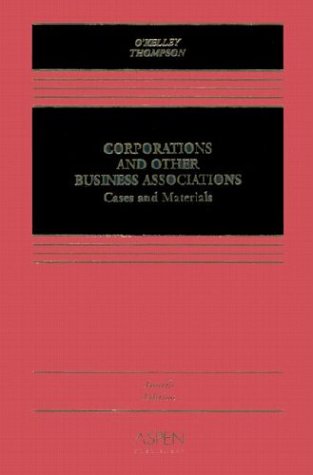

Corporations and other business associations cases and materials Charles R.T. O'Kelley, Robert B. Thompson.
Detalles de publicación: New York Aspen Publishers c2003.Edición: 4th edDescripción: xxxii, 1071 p. 27 cm. teacher's manualISBN:- 0735529248
- KF 1413 .O43 2003
| Imagen de cubierta | Tipo de ítem | Biblioteca actual | Biblioteca de origen | Colección | Ubicación en estantería | Signatura topográfica | Materiales especificados | Info Vol | URL | Copia número | Estado | Notas | Fecha de vencimiento | Código de barras | Reserva de ítems | Prioridad de la cola de reserva de ejemplar | Reservas para cursos | |
|---|---|---|---|---|---|---|---|---|---|---|---|---|---|---|---|---|---|---|
| Libro | Biblioteca de Derecho Mons. Fremiot Torres Oliver Colección General biblioteca derecho | KF 1413 .O43 2003 (Navegar estantería(Abre debajo)) | Disponible | 70000000773445 |
Descripciones mejoradas de Syndetics:
This sophisticated yet accessible casebook balances economic and legal theory with a flexible organization, popular case selection, and effective problems. Updated and strengthened for its Fourth Edition, Corporations and Other Business Associations: Cases and Materials is the foundation of an effective teaching package for courses in corporations or business organizations. Your colleagues nationwide who depend on the O'Kelley and Thompson casebook praise its: balance of theory, cases, and problems, with law and economics theory enriching the book, without dominating the focus carefully selected and edited cases, blending classic and contemporary choices excellent and ample problems to explore the practical applications of theory in the business world - by placing the problems at the end of each chapter, The authors reinforce the preceding case and textual material readable, straightforward writing that makes the book sophisticated, but not intimidating strong coverage of non-corporate business associations accompanying annual statutory supplement the Fourth Edition introduces much new and revised material: expanded coverage of securities law and disclosure duties in general major new cases, including Brehm v. Disney (clarification of pleading requirements in derivative suits), Emerald Partners v. Berlin (clarification of relationship between 102(b)(7) exculpation provisions and entire fairness review), Chesapeake v. Shore (on the application of the Unocal standard of review And The Blasius standard of review) and McMullin v. Beran (review of the fiduciary duties owed by controlling shareholders) new material on federal regulation of insider trading refinements To The website, including additional materials, illustrations, and documents hyperlinked to cases
Includesbibliographical references and index.
Tabla de contenidos provista por Syndetics
- Preface(p. xxvii)
- Acknowledgments(p. xxxi)
- 1 Economic and Legal Aspects of the Firm(p. 1)
- A. Some Basic Concepts and Terminology(p. 1)
- 1. What Is a "Firm"?(p. 1)
- 2. What Is the Difference Between a Sole Proprietorship and a Business Association?(p. 2)
- B. Organizing the Firm: Selecting a Value-Maximizing Governance Structure(p. 2)
- 1. Business Planning: The Role of the Corporate Lawyer in Organizing a Firm(p. 2)
- 2. The Goal of Informed Rational Choice Between Competing Investment Options(p. 3)
- 3. Transaction Costs and Choice of Organizational Form(p. 6)
- 4. State-Provided Governance Structures(p. 9)
- 5. Non-Judicial Mechanisms That Supplement and Reinforce Private Ordering(p. 11)
- C. The Firm and the Law of Agency(p. 13)
- 1. Introduction(p. 13)
- 2. Agency Law and the Choice of Sole Proprietorship Form(p. 13)
- 3. Fiduciary Limits on Agent's Right of Action(p. 14)
- 4. Limits on the Firm's Right to Discharge an Employee at Will(p. 28)
- 5. Agency Law and Relations with Creditors(p. 36)
- 2 Partnerships and Limited Liability Companies(p. 47)
- A. Introduction(p. 47)
- 1. Traditional Noncorporate Business Associations(p. 47)
- 2. Emergence of Additional Limited Liability Entities as the Norm(p. 50)
- 3. Determining the Legal Nature of the Relationship(p. 52)
- B. Fiduciary Duty(p. 57)
- 1. The Duty of Loyalty(p. 57)
- 2. The Duty of Care(p. 65)
- C. Management of the Partnership's Business and Affairs(p. 68)
- 1. Allocation of Decision-Making Authority(p. 68)
- 2. Responsibility for the Unauthorized Contractual Acts of a General Partner(p. 72)
- 3. Partnership's Liability for Partners' Actionable Conduct(p. 80)
- D. Dissociation and Dissolution: Accommodating the Changing Needs of the Partnership and Its Partners(p. 87)
- 1. At-Will Partnerships and the Dissolution Framework(p. 87)
- 2. Wrongful Dissociation(p. 111)
- 3. Partner Expulsion or Freeze-out: Fiduciary Duty Owed to Unwanted Partners(p. 120)
- 4. Contracting to Prevent Opportunistic Withdrawal: The Fiduciary Duties Owed by Withdrawing Partners(p. 126)
- 3 The Corporate Form and the Specialized Roles of Shareholders, Directors, and Officers(p. 135)
- A. The Corporate Form(p. 135)
- 1. Overview(p. 135)
- 2. Directors(p. 136)
- 3. Officers(p. 137)
- 4. Shareholders(p. 137)
- B. The Formation of the Corporation and the Governance Expectations of the Initial Participants(p. 140)
- 1. Where to Incorporate: State Corporation Laws as Competing Sets of Standard Form Rules(p. 140)
- 2. Formation: The Articles of Incorporation(p. 143)
- 3. Determining Shares to Issue(p. 144)
- 4. Determining Voting Rights: Using Articles and Bylaws to Change Legal Norms(p. 146)
- 5. Looking Ahead: Shareholder Action After Electing Directors(p. 150)
- 6. Initial Issuance of Securities(p. 175)
- C. Shareholder Investment and Governance in Publicly Held Corporations and the Impact of Federal Law(p. 188)
- 1. How Publicly Held Corporations Are Different(p. 188)
- 2. The Role of Federal Law for Publicly Held Corporations(p. 197)
- 3. Shareholder Access to Corporate Records and Shareholder Lists: An Intersection of Federal and State Law(p. 216)
- 4 Fiduciary Duty, Shareholder Litigation, and the Business Judgment Rule(p. 221)
- A. Introduction to Fiduciary Duty and the Business Judgment Rule(p. 221)
- 1. Overview(p. 221)
- 2. Directors' Discretion to Determine General Business Policies(p. 223)
- 3. Directors' Discretion to Consider Interests of Non-Shareholder Constituencies(p. 226)
- B. The Fiduciary Duty of Care(p. 230)
- 1. Overview(p. 230)
- 2. Director's Basic Oversight Duties(p. 234)
- 3. Duty of Care in the Decisional Setting(p. 241)
- 4. Statutory Exculpation Provisions(p. 260)
- 5. The Board's Responsibility to Monitor and Prevent Illegal Activity(p. 265)
- C. The Fiduciary Duty of Loyalty(p. 276)
- 1. Introduction(p. 276)
- 2. The Corporate Opportunity Doctrine(p. 276)
- 3. Conflicting Interest Transactions(p. 296)
- D. Special Aspects of Derivative Litigation(p. 324)
- 1. Introduction(p. 324)
- 2. The Demand Requirement(p. 325)
- E. Indemnification and Insurance(p. 370)
- 1. Introduction(p. 370)
- 2. Indemnification(p. 370)
- 3. Insurance(p. 379)
- 5 Protecting Participants' Expectations in a Closely Held Business(p. 381)
- A. Introduction(p. 381)
- B. Contracting as a Device to Limit the Majority's Discretion(p. 385)
- 1. As to Director Decisions(p. 385)
- 2. Voting Agreements as to Shareholder Decisions(p. 401)
- C. Fiduciary Duty and Threat of Dissolution as a Check on Opportunistic Majority Action(p. 407)
- 1. Traditional Judicial Deference to Majority's Discretion(p. 407)
- 2. The Partnership Analogy as a Basis for Enhancing Minority Shareholders' Rights(p. 412)
- 3. The Modern Approach to Involuntary Dissolution(p. 438)
- D. Share Repurchase Agreements(p. 452)
- E. Limited Liability Companies(p. 466)
- 1. The Evolution of LLCs(p. 466)
- 2. The Importance of Contract in LLCs(p. 468)
- 3. The Role of Fiduciary Duty(p. 474)
- 4. Exit and Liquidity in LLCs(p. 480)
- 6 The Corporation as a Device to Allocate Risk(p. 487)
- A. Introduction(p. 487)
- B. Corporate Law Rules Specifying an "Equity Cushion"(p. 488)
- 1. Historical Overview(p. 488)
- 2. Statutory Rules Governing the Equity Cushion(p. 490)
- C. Piercing the Veil(p. 501)
- 1. Introduction(p. 501)
- 2. Piercing the Corporate Veil to Reach Real Persons(p. 504)
- 3. Piercing the Corporate Veil to Reach Incorporated Shareholders(p. 526)
- 4. Piercing in LLCs(p. 542)
- D. Ambiguous or Legally Defective Allocation of the Risk of Loss(p. 548)
- 1. Introduction(p. 548)
- 2. Contracts on Behalf of Nonexistent Entities(p. 549)
- 3. Allocating the Risk of Loss from Unauthorized Actions(p. 559)
- 7 Mergers and Other "Friendly" Control Transactions(p. 579)
- A. Introduction(p. 579)
- B. Mergers and Dissenter's Rights(p. 581)
- 1. Mergers(p. 581)
- 2. Dissenter's Rights(p. 595)
- C. Contracting Around Appraisal and Voting Rights(p. 598)
- 1. Use of Alternative Transactional Forms(p. 598)
- 2. "De Facto" Mergers(p. 600)
- D. The Intersection Between the Appraisal Remedy and Fiduciary-Duty-Based Judicial Review(p. 609)
- 1. Cash-Out Mergers and the Business Purpose Test(p. 609)
- 2. The Weinberger Approach(p. 617)
- E. Appraisal and Entire Fairness Review After Weinberger(p. 632)
- 1. Valuation Under Statutory Appraisal(p. 632)
- 2. Appraisal as the Exclusive Remedy(p. 641)
- 3. Fashioning Relief for Controlling Shareholder's Failure to Prove Entire Fairness(p. 652)
- 4. Third-Party Mergers(p. 661)
- F. Transfer of Control for a Premium(p. 680)
- 1. Fundamental Principles(p. 680)
- 2. Sale of Corporate Opportunity(p. 691)
- 8 Changes in Control: Hostile Acquisitions(p. 705)
- A. The Market for Corporate Control(p. 705)
- B. Judicial Review of Tender Offer Defenses(p. 715)
- 1. Traditional Review(p. 715)
- 2. The Enhanced Scrutiny Framework(p. 721)
- C. Judicial Review of Voting Contest Defenses(p. 766)
- 1. Judicial Limits on Inequitable Actions(p. 766)
- 2. Enhanced Review of Good Faith Actions(p. 771)
- 3. Unocal Review of Measures Affecting the Shareholder Franchise(p. 779)
- D. Testing the Limits of Pre-Planned Defenses(p. 788)
- E. Distinguishing Direct and Derivative Actions in the Entrenchment Context(p. 799)
- F. State Anti-Takeover Statutes(p. 809)
- G. Differing Incentives in Proxy Fights(p. 817)
- 9 Disclosure and Corporate Governance(p. 821)
- A. Introduction: Disclosure's Distinctive Role(p. 821)
- B. Mandatory Disclosure(p. 823)
- C. Disclosure Related to Shareholder Voting(p. 829)
- 1. Coverage of [section]14(a)(p. 829)
- 2. Rule 14a-9(p. 835)
- D. Disclosure Related to Buying or Selling(p. 866)
- 1. State Law(p. 866)
- 2. Federal Law: Rule 10b-5(p. 872)
- 3. The Reach of Rule 10b-5: Standing and "In Connection with a Purchase or Sale"(p. 873)
- 4. Elements of Common Law Fraud Applied to Rule 10b-5(p. 891)
- 10 Federal Regulation of Tender Offers(p. 937)
- A. The Williams Act(p. 937)
- 1. Disclosure(p. 938)
- 2. Substantive Regulation(p. 949)
- 3. Definition of a Tender Offer(p. 955)
- 4. Antifraud Provisions of the Williams Act(p. 957)
- B. Intersection of Federal Regulation and State Anti-Takeover Statutes(p. 963)
- 11 Insider Trading(p. 983)
- A. The Common Law Foundation for Rule 10b-5(p. 983)
- B. Rule 10b-5 as a Regulator of Insider Trading(p. 986)
- 1. "Classic" Insider Trading as Fraud(p. 986)
- 2. Extensions of the Classic Theory(p. 1004)
- C. Regulation of Insider Trading Under [section]16 of the Securities Exchange Act of 1934(p. 1037)
- 1. Enforcement(p. 1037)
- 2. Computation of Recovery(p. 1041)
- 3. Who Is an Insider?(p. 1042)
- 4. Timing Questions: Transactions Before or After Insider Status(p. 1050)
- 5. Unorthodox Transactions, Tender Offers, and the Definition of Purchase and Sale(p. 1051)
- 6. Derivative Securities(p. 1052)
- Table of Cases(p. 1053)
- Index(p. 1063)