Imagen de portada de Amazon
Imagen de Amazon.com
Imagen de cubierta Syndetics
Portada de Syndetics
Imagen de OpenLibrary

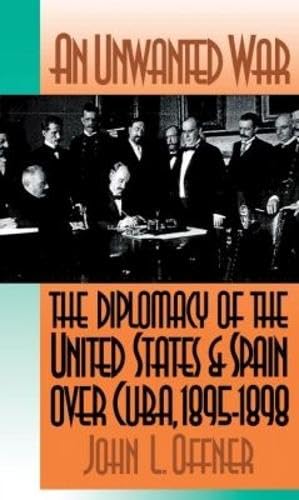
An unwanted war the diplomacy of the United States and Spain over Cuba, 1895-1898 by John L. Offner.

Por: Detalles de publicación: Chapel Hill University of North Carolina Press c1992.Descripción: xii, 306 p. ill., map 25 cmISBN:
  • 0807820385 (alk. paper)
  • 0807843806 (pbk. : alk. paper)
Tema(s): Clasificación CDD:
  • 973.8/92 20
Clasificación LoC:
  • E723 .O44 1992
Valoración
    Valoración media: 0.0 (0 votos)
Existencias
Imagen de cubierta Tipo de ítem Biblioteca actual Biblioteca de origen Colección Ubicación en estantería Signatura topográfica Materiales especificados Info Vol URL Copia número Estado Notas Fecha de vencimiento Código de barras Reserva de ítems Prioridad de la cola de reserva de ejemplar Reservas para cursos
Libro Biblioteca de Mayagüez Colección General mb E723 .O44 1992 (Navegar estantería(Abre debajo)) Disponible 50000002064342
Total de reservas: 0

Descripciones mejoradas de Syndetics:

Offner clarifies the complex relations of the United States, Spain, and Cuba leading up to the Spanish-American War and contends that the war was not wanted by any of the parties but was nonetheless unavoidable. He shows that a final round of peace negotiations failed in large part because internal political constraints limited diplomatic flexibility.

Includes bibliographical references (p. 279-295) and index.

Tabla de contenidos provista por Syndetics

  • Preface(p. ix)
  • Chapter 1 the Cuban Revolution Three Perspectives(p. 1)
  • Chapter 2 Cuba, Cleveland, and Cánovas(p. 17)
  • Chapter 3 Mckinley and Cánovas(p. 37)
  • Chapter 4 the Woodford Mission(p. 54)
  • Chapter 5 Sagasta's Cuban Reforms(p. 68)
  • Chapter 6 Failure of Cuban Reforms(p. 86)
  • Chapter 7 Two Shocks the De Lôme Letter and the Maine Disaster(p. 111)
  • Chapter 8 Backdrop for Diplomacy(p. 127)
  • Chapter 9 Failure to Solve the Crisis(p. 143)
  • Chapter 10 Spanish Suspension of Hostilities(p. 159)
  • Chapter 11 Descent into War(p. 177)
  • Chapter 12 Preliminaries to Peace(p. 194)
  • Chapter 13 the Peace Protocol(p. 209)
  • Chapter 14 Conclusion(p. 225)
  • Appendix(p. 237)
  • Notes(p. 239)
  • Bibliography(p. 279)
  • Index(p. 297)

Reseñas proporcionadas por Syndetics

Library Journal Review

The Spanish-American War of 1898 has not received nearly as much detailed study as other American wars. Compared with such great conflicts as the Civil War and World War I, this small, swift war, with few casualties and an unambiguous conclusion, seemed rather simple. Typically, it has been portrayed as a symbolic struggle between a declining European power and the United States, whose foreign policy would dominate the 20th century. Offner (history, Shippensburg Univ.) does his readers a great service by probing beyond easy generalizations and demonstrating the intricate diplomatic efforts used to avoid military conflict. To his credit, he also explores the perspectives of the Spanish and the Cubans, having done prodigious research in international archives. The tangled relationships that Offner reveals between internal politics and foreign relations make the war seem not quite so simple and much more worthy of study. A fascinating and relevant work in the wake of the recent Persian Gulf War, another war that lasted only a few months.-- Charles K. Piehl, Mankato State Univ., Minn. (c) Copyright 2010. Library Journals LLC, a wholly owned subsidiary of Media Source, Inc. No redistribution permitted.

CHOICE Review

After 35 years and multi-archival research in ten countries, Offner concludes that the US reluctantly entered the war with Spain in 1898 primarily because the Republican party wanted to retain control of Congress. One wonders why it took so long to arrive at this limited causal conclusion. Offner is well aware of other factors: imperialism, foreign markets, national security, the yellow press. Yet all are judged "much less important in carrying the United States into war." The fact that the US was suffering through the worst economic depression in its history up to that time goes practically unnoticed. Offner ignores the need to protect the China market from an Asian base of operations, perhaps in the Philippines, after China's loss to Japan in the 1895 war. Although this book is recommended and does add to knowledge of intimate details of the process leading to war and eventual armistice, readers must consult other works for broader understanding. See David Healy's Drive to Hegemony (1988), Walter La Feber's The New Empire (CH, May'64), and Ernest May's Imperial Democracy (1961) for differing explanations as to why Cuban independence became important enough for the US to pursue war with Spain. Advanced undergraduate; graduate; faculty. S. Prisco III; Stevens Institute of Technology
Compartir
logopucpr-y-vive

Contáctanos

¡Queremos saber de ti!

Tel. 787.841.2000 Ext. 1801

bibliotecavaldes@pucpr.edu

⁣Búscanos en las redes

© 2026 Desarrollado por Ignite Online • All Rights Reserved • Powered by Koha.