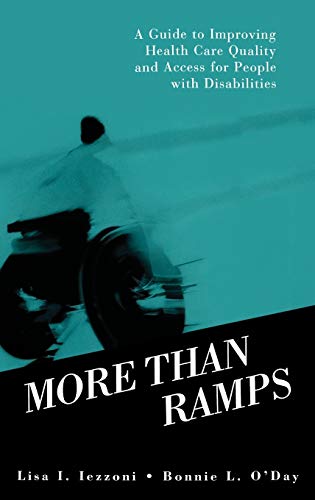

More than ramps a guide to improving health care quality and access for people with disabilities Lisa I. Iezzoni and Bonnie L. O'Day.
Detalles de publicación: New York Oxford Oxford University Press 2006.Descripción: 366 p. ill. 24 cmISBN:- 0195172760 (hbk.)
- 362.4 I229m 22
| Imagen de cubierta | Tipo de ítem | Biblioteca actual | Biblioteca de origen | Colección | Ubicación en estantería | Signatura topográfica | Materiales especificados | Info Vol | URL | Copia número | Estado | Notas | Fecha de vencimiento | Código de barras | Reserva de ítems | Prioridad de la cola de reserva de ejemplar | Reservas para cursos | |
|---|---|---|---|---|---|---|---|---|---|---|---|---|---|---|---|---|---|---|
| Libro | Biblioteca Encarnación Valdés Colección General bev | 362.4 I229m (Navegar estantería(Abre debajo)) | Disponible | 80000002179722 |
Descripciones mejoradas de Syndetics:
Nearly twenty percent of Americans live today with some sort of disability, and this number will grow in coming decades as the population ages. Despite this, the U.S. health care system is not set up to provide care comfortably, safely, and efficiently to persons with disabilities. Individuals with disabilities can therefore face significant barriers to obtaining high quality health care. Some barriers result from obvious impediments, such as doors without automatic openers and examining tables that are too high. Other barriers arise from faulty communication between patients and health care professionals, including misconceptions among clinicians about the daily lives, preferences, values, and abilities of persons with disabilities. Yet additional barriers relate to health insurance limits on items and services essential to maximizing health and independence. This book examines the health care experiences of persons who are blind, deaf, hard of hearing, or who have difficulties using their legs, arms, or hands. The book then outlines strategies for overcoming or circumventing barriers to care, starting by just asking persons with disabilities about workable solutions. Creating safe and accessible health care for persons with disabilities will likely benefit everyone at some point. This book has three parts. The first part looks at the historical roots of healthcare access for persons with disabilities in the United States. The second part discusses the current situation and the special challenges for those with disabilities. The third part looks forward to discuss the ways in which healthcare quality and access can improve.
Includes bibliographical references and index.
Tabla de contenidos provista por Syndetics
- Preface
- Part I Setting the Stage: Disability and Access to Health Care in the United States
- Chapter 1 Roots of the Problem
- Chapter 2 Defining Disability
- Chapter 3 Health Insurance and Accessing the Health Care System
- Part II Health Care Experiences of Persons with Disabilities
- Chapter 4 Finding Care
- Chapter 5 Getting Into and Around Health Care Settings
- Chapter 6 Challenges to Interpersonal Communication
- Chapter 7 Etiquette During Physical Examinations and Interactions with Office Staff
- Chapter 8 Clinical Competence and Technical Communication
- Chapter 9 Pushing Against Boundaries of the Health Care System
- Part III Improving Health Care for Persons with Disabilities
- Chapter 10 Using Universal Design to Accommodate All
- Chapter 11 Self-Management and Advocacy
- Chapter 12 Improving Patient-Clinician Communication
- Chapter 13 Accessible Communication and Information
- Chapter 14 Designing Accsesible Health Care Settings
- Chapter 15 The Internet and Information Technologies
- Chapter 16 Healtlhy and Accessible Communities
- Appendix 1 Internet Resources Addressing General Disability and Health Care Topics
- Appendix 2 Internet Resources Addressing Specific Disabilities, Diseases, and Disorders
- Appendix 3 Suggestions for Improving Accessbility of Health Care Services
- Endnotes
- References