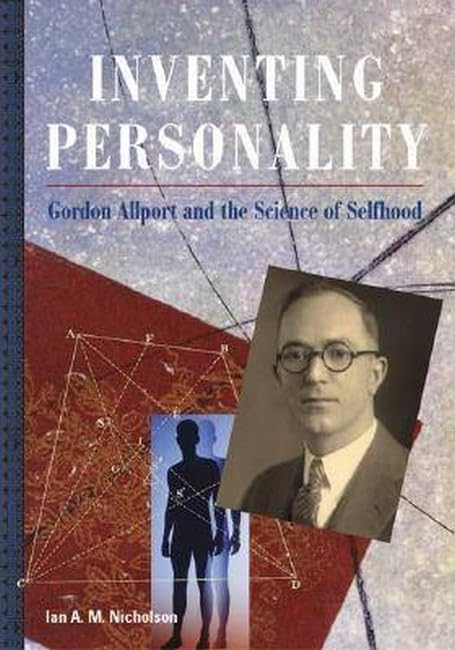

Inventing personality Gordon Allport and the science of selfhood Ian A.M. Nicholson.
Detalles de publicación: Washington, DC American Psychological Association c2003.Edición: 1st edDescripción: x, 301 p. ill. 26 cmISBN:- 155798929X
- 155.2092 N624i 21
- BF109.A54 N53 2003
| Imagen de cubierta | Tipo de ítem | Biblioteca actual | Biblioteca de origen | Colección | Ubicación en estantería | Signatura topográfica | Materiales especificados | Info Vol | URL | Copia número | Estado | Notas | Fecha de vencimiento | Código de barras | Reserva de ítems | Prioridad de la cola de reserva de ejemplar | Reservas para cursos | |
|---|---|---|---|---|---|---|---|---|---|---|---|---|---|---|---|---|---|---|
| Libro | Biblioteca Encarnación Valdés Colección General bev | 155.2092 N624i (Navegar estantería(Abre debajo)) | Disponible | 80000002257411 |
Descripciones mejoradas de Syndetics:
Inventing Personality examines the early career of Gordon Allport (1897-1967) to reveal the history of the personality category he championed. Drawing on an extensive array of previously unpublished biographical materials, Nicholson combines biography with intellectual history to reveal the ways in which Allport's science was embedded in the cultural politics of America in the 1920s and the 1930s. He argues that personality's emergence as an object of science was linked to the gradual demise of character and the self-sacrificing, morally grounded self that it supported. Carefully highlighting Allport's complex commitments to both science and spirituality, Nicholson examines the rich cultural and historical contexts that framed the emergence of personality as a discipline, revealing multiple (even contradictory) meanings of ""personality"" in the language of American selfhood. He asserts that ""personality's"" appeal lay in its ability to integrate and obscure the complex polarities of material and spiritual; old and new; masculine and feminine; and freedom and control - categories rendered unstable in a new and distinctively modern age.
Includes bibliographical references (p. 265-282) and index.
Tabla de contenidos provista por Syndetics
- Illustrations(p. vii)
- Acknowledgments(p. ix)
- Chapter 1. Introduction(p. 3)
- Chapter 2. "Fine Character and Splendid Ideals": Allport's Early Years (1897-1915)(p. 13)
- Chapter 3. A New World: Harvard (1915-1919)(p. 29)
- Chapter 4. The Missionary Life: Robert College, Constantinople (1919-1920)(p. 55)
- Chapter 5. A Science of Personality: Graduate School (1920-1922)(p. 73)
- Chapter 6. A Psychology of the Spirit: Germany and England (1922-1924)(p. 103)
- Chapter 7. Constructing a Category: Personality Psychology at Harvard and Dartmouth (1924-1930)(p. 133)
- Chapter 8. The Politics of Moderation: Personality Psychology at Harvard (1930-1936)(p. 163)
- Chapter 9. Personality and Social Crisis (1937-1938)(p. 191)
- Chapter 10. Conclusion(p. 219)
- Notes(p. 227)
- Bibliography(p. 265)
- Index(p. 283)
- About the Author(p. 301)