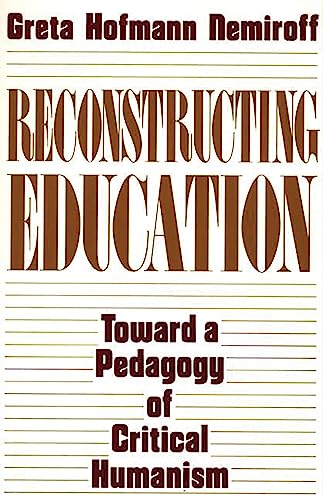

Reconstructing education toward a pedagogy of critical humanism Greta Hofmann Nemiroff.
Detalles de publicación: New York Bergin & Garvey 1992.Descripción: x, 199 p. ill. 24 cmISBN:- 0897892674 (pbk. : alk. paper)
- 0897892666 (alk. paper)
- 370.11/2/0971427 20
- LE5.M6625 N47 1992
| Imagen de cubierta | Tipo de ítem | Biblioteca actual | Biblioteca de origen | Colección | Ubicación en estantería | Signatura topográfica | Materiales especificados | Info Vol | URL | Copia número | Estado | Notas | Fecha de vencimiento | Código de barras | Reserva de ítems | Prioridad de la cola de reserva de ejemplar | Reservas para cursos | |
|---|---|---|---|---|---|---|---|---|---|---|---|---|---|---|---|---|---|---|
| Libro | Biblioteca Encarnación Valdés Colección General bev | 370.112 N434r (Navegar estantería(Abre debajo)) | Disponible | 80000001780256 |
Descripciones mejoradas de Syndetics:
Drawing on elements of progressive education, existential theory, feminist pedagogy, and values education, critical humanism combines the holistic-psychological concerns of humanistic education with the sociopolitical contextualization of critical pedagogy. Developed over the past seventeen years in one of North America's most experimental postsecondary programs, The New School of Dawson College, this theory and practice responds to both the personal and the political needs of students. Reconstructing Education is at once a review of this century's educational theories, an account of the work at the school, and an empowering illustration of the way in which schools can incite the motivation of students and encourage them to become active members in a truly democratic society.
The case study chapters on The New School give concrete examples of how this philosophy is manifested in the school's methodology, structure, and pedagogy and draws heavily on the written work of teachers and students. To formulate a similar approach for a specific school, it is essential to combine a rigorous analysis of existing educational models with the dialectical process of creating and recreating a new model defined by the articulation of both learners' and teachers' affective, cognitive, and socially constructed needs. This is a valuable book for anyone concerned with alternative approaches to education and for courses on educational theory or the philosophy of education.
Includes bibliographical references (p. [185]-193) and index.
Tabla de contenidos provista por Syndetics
- Introduction
- The Evolution of an Educational Philosophy
- The Educational Context in Quebec Popular Educational
- Theories of the 1960s and 1970s Early Philosophical Roots of Humanistic Education
- Theoreticians and Theories of Humanistic Education
- Critical Pedagogy: Contributions and Limitations Reconstructing Pedagogy
- Ideology and Practice at The New School: A Case Study
- The Dialectical Relationship Between Ideology and Praxis Clientele, the Agenda of the State, and Pedagogy at The New School
- The Primary Affiliative Group as Locus of Learning: The Bands Formal
- Curriculum: The Learning Groups The Struggle for Community
- Critical Humanism and the Transformation of Education
- References
- Index