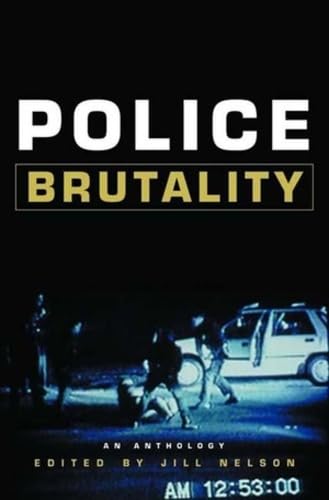

Police brutality an athology edited by Jill Nelson.
Detalles de publicación: New York W.W. Norton & Co. c2000.Edición: 1st edDescripción: 265 p. 25 cmISBN:- 0393048837
- HV 8141 .P567 2000
| Imagen de cubierta | Tipo de ítem | Biblioteca actual | Biblioteca de origen | Colección | Ubicación en estantería | Signatura topográfica | Materiales especificados | Info Vol | URL | Copia número | Estado | Notas | Fecha de vencimiento | Código de barras | Reserva de ítems | Prioridad de la cola de reserva de ejemplar | Reservas para cursos | |
|---|---|---|---|---|---|---|---|---|---|---|---|---|---|---|---|---|---|---|
| Libro | Biblioteca de Derecho Mons. Fremiot Torres Oliver Colección General biblioteca derecho | HV 8141 .P567 2000 (Navegar estantería(Abre debajo)) | Disponible | 70000000643002 |
Descripciones mejoradas de Syndetics:
A collection of essays from a variety of sources examines one of America's most serious domestic problems, investigates its historical and sociological roots, and grapples for solutions.
Includes bibliographical references.
Slangin' rocks, Palestinian style : dispatches from the occupied zones of North America Robin D. G. Kelley -- Persecution of Negroes by roughs and policeman, in the city of New York, August 1900 : Citizens' Protective League complied by Frank Moss -- Police brutality : portent of disaster and discomforting divergence Derrick Bell -- action under siege : Elijah Muhammad, the FBI and police-state culture in Chicago Claude A. Clegg III -- What did I do to be so Black and Blue?" : police violence and the Black community Katheryn K. Russell -- obtacle illusions : the cult of racial apperance Patricia J. Williams -- What's new? : the truth, as usual Stanley Crouch -- From the inside looking out : twenty-nine years in the New York Police Department Lieutenant Arthur Doyle -- Another day at the front : encounters with the fuzz on the American battlefront Ishmael Reed -- Under the veil of suspicion : organizing resistence and struggling for libreration Richard Austin -- Point no. 7 : we want an immediate end to police brutality and the murder of Black people : why I joined the Black Panther Party Flores Alexander Forbes -- The crisis of police brutality and misconduct in America : the causes and the cure Ron Daniels.
Tabla de contenidos provista por Syndetics
- Introduction(p. 9)
- Part I. Historical Perspectives
- 1 "Slangin' Rocks ... Palestinian Style" Dispatches from the Occupied Zones of North America(p. 21)
- 2 Persecution of Negroes by Roughs and Policemen, in the City of New York, August 1900 Citizens' Protective League(p. 60)
- 3 Police Brutality Portent of Disaster and Discomforting Divergence(p. 88)
- 4 Nation under Siege Elijah Muhammad, the FBI, and Police-State Culture in Chicago(p. 102)
- Part II. The Politics of Police Brutality
- 5 "What Did I Do to Be So Black and Blue?" Police Violence and the Black Community(p. 135)
- 6 Obstacle Illusions The Cult of Raciat Appearance(p. 149)
- 7 What's New? The Truth, As Usual(p. 157)
- Part III. Policing the Police
- 8 From the Inside Looking Out Twenty-nine Years in the New York Police Department(p. 171)
- Part IV. Repression and Resistance
- 9 Another Day at the Front Encounters with the Fuzz on the American Battlefront(p. 189)
- 10 Under the Veil of Suspicion Organizing Resistance and Struggling for Liberation(p. 206)
- 11 Point No. 7: We Want an Immediate End to Police Brutality and the Murder of Black People Why I Joined the Black Panther Party(p. 225)
- 12 The Crisis of Police Brutality and Misconduct in America The Causes and the Cure(p. 240)
- Biographical Notes(p. 261)
- Acknowledgments(p. 265)
Reseñas proporcionadas por Syndetics
Library Journal Review
Currently, there are accusations of police corruption and brutality throughout America. Hate groups are accused of operating within the ranks of the Cleveland Police Department, the falsifying of information in an LAPD gang-tracking database has potentially contaminated numerous court cases, and the recent incidents of alleged police brutality in New York involving Abner Louima, Amadou Diallo, and Patrick Dorismond shocked and alarmed many citizens. Unfortunately, such incidents are not rare. Nelson (journalism, CUNY), the author of Volunteer Slavery, has compiled a very timely collection of 12 original essays detailing numerous examples of police brutality perpetrated primarily against African Americans. Contributed by the likes of Derrick Bell and Stanley Crouch, the pieces in this very informative book examine the long history of abusive police behaviors and include descriptions of lynchings, racial profiling, and the hazards of "driving while black." This mostly one-sided approach in examining police brutality could have benefited tremendously from the inclusion of interviews with the police themselves, as they try to justify extreme behaviors. Recommended for academic libraries.DTim Delaney, Canisius Coll., Buffalo (c) Copyright 2010. Library Journals LLC, a wholly owned subsidiary of Media Source, Inc. No redistribution permitted.Publishers Weekly Review
In tones ranging from soulful to provocative to didactic, these 12 fiery essays by a variety of distinguished contributors argue that there is currently a plague of police brutality, foisted upon minority communities as a result of drug war "innovations" in policing. Editor Nelson (Volunteer Slavery), who teaches journalism at CCNY, addresses in a terse introduction the "outrage," "disgust" and "sadness" she felt after the police shooting of unarmed Amadou Diallo in New York City, which drove her to assemble this volume. Most of the contributions are excellent and even startling. Most thought-provoking is journalist and critic Stanley Crouch's fusion of harsh personal recollection (of his teenage brother being pummeled after heckling a police officer) balanced by the more modulated idea that the real danger to minority communities is their alienation from the police. Columbia law professor Patricia Williams contrasts the presumption of guilt that appears to hover over black youths with the presumption of innocence that allowed Dylan Klebold and Eric Harris to amass guns, ammunition and grenades in Littleton, Colo. Gripping "secret histories" of black experience come from Claude Clegg III's fascinating reconstruction of Elijah Muhammad's nascent Nation of Islam and its alternate hostility toward and pragmatic cooperation with the FBI and with Mayor Daley's Chicago machine. Other pieces (by NYU historian Robin D.G. Kelley and novelist and poet Ishmael Reed, among others) take an overly rhetorical, separatist tone. In light of the egregious violations represented by the tragic figures of Abner Louima, Rodney King and other victims of actual and alleged police brutality, one forgives this volume its forcefulness. This is a memorable and useful contribution to an increasingly volatile national dialogue. (May) (c) Copyright PWxyz, LLC. All rights reservedCHOICE Review
This collection, written by authors who have sound credentials in the study of racial discrimination, focuses on race-based abuse of power by US police officers. It addresses abuse from individual extreme cases to systemic, pervasive, negative environments. Chapters vary in quality, with some focusing on images and feelings and others analyzing embedded discriminatory systems and structures. The book lacks an integrating introduction or conclusion, so chapters tend to stand alone. Some chapters are lightly referenced. On the whole, the writing is straightforward and easy to read. Recommended for public and undergraduate academic libraries seeking to expand their criminal justice or diversity collections. R. T. Sigler; University of AlabamaBooklist Review
The grim realities of U.S. race relations are evident in new examinations of police brutality targeting minorities and the pernicious practice of racial profiling. Meeks inspects the officially unacknowledged racial profiling that police, security guards, salesclerks, and others use to determine how much they should scrutinize minorities--a practice that leads to a corresponding disrespect. He considers the rationale for profiling, the difficulty of combating it, and efforts to legislatively mandate the data collection that will verify that profiling is occurring. In addition, Meeks recounts incidents in which blacks, notably including actor Danny Glover, were subjected to profiling by police and others, and he offers practical advice on how minorities can protect their rights and their lives against this disturbing practice. Nelson's collection of essays by Derrick Bell, Ishmael Reed, Stanley Crouch, and others explores the history and politics of police brutality. The writers trace police brutality against African Americans back to slavery. Since then, law enforcement officials have been complicit in capturing runaway slaves, lynchings, harassment of black militant groups, and, currently, targeting minorities for excessive force. The collection includes affidavits from victims of New York City police brutality in 1900; they testify to how little has changed between then and the recent shooting of Amadou Diallo. A compelling reader on the enduring evil of police brutality in a democratic society and its tacit social acceptance. --Vanessa BushNotas de autor provistas por Syndetics
Jill Nelson is an associate professor of journalism at the City College of New York & has written for the "New York Times Book Review" among other publications.(Bowker Author Biography)