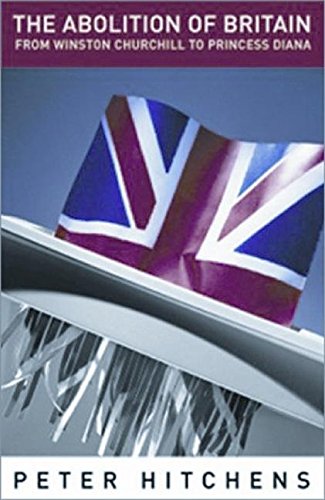

The abolition of Britain from Winston Churchill to Princess Diana Peter Hitchens.
Detalles de publicación: San Francisco Encounter Books c2002.Descripción: xii, 342 p. 23 cmISBN:- 1893554392 (alk. paper)
- 941.085 H6749a 22
- DA566.4 .H5 2002
| Imagen de cubierta | Tipo de ítem | Biblioteca actual | Biblioteca de origen | Colección | Ubicación en estantería | Signatura topográfica | Materiales especificados | Info Vol | URL | Copia número | Estado | Notas | Fecha de vencimiento | Código de barras | Reserva de ítems | Prioridad de la cola de reserva de ejemplar | Reservas para cursos | |
|---|---|---|---|---|---|---|---|---|---|---|---|---|---|---|---|---|---|---|
| Libro | Biblioteca Encarnación Valdés Colección General bev | 941.085 H6749a (Navegar estantería(Abre debajo)) | Disponible | 80000002376518 |
Descripciones mejoradas de Syndetics:
A surprise best seller in England, The Abolition of Britain is bitingly witty and fiercely argued, yet also filled with somber appreciation for what "the idea of England" has always meant to the West and to the world at large. One English critic called The Abolition of Britain "an elegant jeremiad" in which Peter Hitchens identifies everything that has gone wrong with Britain since World War II and makes the case for "those many millions who feel that they have become foreigners in their own land and wish with each succeeding day that they could turn the clock back." Writing with passion and flair, Hitchens targets the pernicious effects of TV culture, the "corruption and decay" of the English language, the loss of politeness, and the "syrupy confessional mood" brought on by the death of Diana, which Hitchens contrasts with the somber national response to the death of Winston Churchill. If there is a term that summarizeseverything that has gone wrong in Britain, it is "Tony Blairism," which Hitchens sees as having rewritten England's history, trivialized its journalism, subverted its educational system and cultural standards, and overthrown accepted notions of patriotism, faith, and morality. The New Britain is government by focus group in which people are told what to feel as a way of preventing them from asking how they want to be governed. Looking at the changed face of his country, Hitchens finds a "politically correct zeal for the new" whose impact on daily life has been "as devastating in effect, if not in violence, as Mao tse Tung's Cultural Revolution in China."
Originally published: London : Quarter Books, 1999.
Includes bibliographical references (p. [339]-342).
Tabla de contenidos provista por Syndetics
- Preface to the Second Edition(p. vii)
- Introduction: A Modern Man(p. 1)
- 1 The Warrior and the Victim(p. 17)
- 2 Born Yesterday(p. 44)
- 3 Class War(p. 64)
- 4 The Pink Bits(p. 84)
- 5 Hell Freezes Over(p. 105)
- 6 The Telescreen Triumphs(p. 128)
- 7 Forty Years On(p. 144)
- 8 A Real Bastard(p. 162)
- 9 The Queen's English(p. 177)
- 10 Difficulties with Girls(p. 190)
- 11 Last Exit to Decency(p. 207)
- 12 Suburbs of the Mind(p. 221)
- 13 The Pill That Cured Morality(p. 232)
- 14 Health Warning(p. 248)
- 15 Is Britain Civilized?(p. 263)
- 16 Year Zero(p. 273)
- Conclusion: Chainsaw Massacre(p. 289)
- Afterword(p. 319)
- Notes(p. 329)
- Acknowledgements(p. 337)
- Works Cited(p. 339)