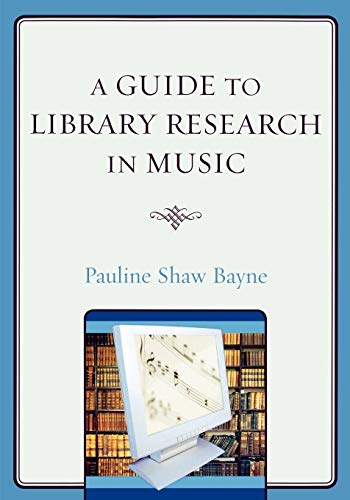
Imagen de portada de Amazon
Imagen de Amazon.com
Imagen de cubierta Syndetics
Portada de Syndetics
Imagen de OpenLibrary

A guide to library research in music Pauline Shaw Bayne.

Por: Detalles de publicación: Lanham, Md. Scarecrow Press 2008.Descripción: xiv, 274 p. 25 cmISBN:
  • 9780810862111 (pbk. : alk. paper)
  • 0810862115 (pbk. : alk. paper)
Tema(s): Clasificación CDD:
  • 780.72 B3611g 22
Clasificación LoC:
  • ML3797 .B29 2008
Contenidos:
The short course : music research and writing. The research process ; Starting-point resources : reference books ; Starting-point resources : journals ; Starting-point resources : bibliographies ; A case study ; Scholarly writing ; Writing samples -- How to : discover and use resources. Browsing as a discovery strategy ; Databases : structured for searching ; Subject searching in library catalogs : controlled vocabulary ; Subject searching in indexes and abstracts ; Keyword searching ; Related-record searching and citation indexes ; Other discovery methods : experts and the Internet ; Using thematic catalogs -- Resources : the literature of music. M : the music scores and recordings ; ML : music literature ; MT : instruction and study.
Valoración
    Valoración media: 0.0 (0 votos)
Existencias
Imagen de cubierta Tipo de ítem Biblioteca actual Biblioteca de origen Colección Ubicación en estantería Signatura topográfica Materiales especificados Info Vol URL Copia número Estado Notas Fecha de vencimiento Código de barras Reserva de ítems Prioridad de la cola de reserva de ejemplar Reservas para cursos
Referencia Biblioteca Encarnación Valdés Sala de Referencia bev 780.72 B3611g (Navegar estantería(Abre debajo)) Disponible 80000002383852
Total de reservas: 0

Descripciones mejoradas de Syndetics:

A Guide to Library Research in Music introduces the process and techniques for researching and writing about music. This informative textbook provides concrete examples of different types of writing, offering a thorough introduction to music literature. It clearly describes various information-searching techniques and library-based organizational systems and introduces the array of music resources available.

Pauline Shaw Bayne has cleanly organized the material in three succinct parts, allowing for three independent tracks of study. Part I treats essentials of the research process. It explains starting point resources like library catalogs, dictionaries, and bibliographies; addresses scholarly documentation, the use of style manuals, and basics of copyright; and provides samples of common written research products. Part 2 develops skills and strategies for library and Internet-based research, describing database structures and library catalogs, subject searching in catalogs and journal indexes, keyword searching techniques, related-record searching and citation databases, and the use of experts, the Internet, and thematic catalogs. In Part 3, Bayne describes music uniform titles and select resources that follow the organization of a music library, such as score collections, books and journals in music literature, and music teaching publications.

Each chapter concludes with learning exercises to aid the students' concept application and skill development. Appendixes provide short cuts to specific topics in library organizational systems, including Library of Congress Subject Headings and Classification. The concluding bibliography provides a quick overview of music literature and resources, emphasizing electronic and print publications since 2000, but including standard references that all music researchers should know.

The concluding bibliography provides a quick overview of music literature and resources, emphasizing electronic and print publications since 2000, but including standard references that all music researchers should know.s, keyword searching techniques, related-record searching and citation databases, and the use of experts, the Internet, and thematic catalogs. In Part 3, Bayne describes music uniform titles and select resources that follow the organization of a music library, such as score collections, books and journals in music literature, and music teaching publications.

Each chapter concludes with learning exercises to aid the students' concept application and skill development. Appendixes provide short cuts to specific topics in library organizational systems, including Library of Congress Subject Headings and Classification. The concluding bibliography provides a quick overview of music literature and resources, emphasizing electronic and print publications since 2000, but including standard references that all music researchers should know.The concluding bibliography provides a quick overview of music literature and resources, emphasizing electronic and print publications since 2000, but including standard references that all music researchers should know.references that all music researchers should know.

Includes bibliographical references and indexes.

The short course : music research and writing. The research process ; Starting-point resources : reference books ; Starting-point resources : journals ; Starting-point resources : bibliographies ; A case study ; Scholarly writing ; Writing samples -- How to : discover and use resources. Browsing as a discovery strategy ; Databases : structured for searching ; Subject searching in library catalogs : controlled vocabulary ; Subject searching in indexes and abstracts ; Keyword searching ; Related-record searching and citation indexes ; Other discovery methods : experts and the Internet ; Using thematic catalogs -- Resources : the literature of music. M : the music scores and recordings ; ML : music literature ; MT : instruction and study.

Reseñas proporcionadas por Syndetics

Library Journal Review

Bayne (retired, Univ. of Tennessee, Knoxville) and Komara (State Univ. of New York, Potsdam; 100 Books Every Blues Fan Should Own) take readers through the wide breadth of music research. Those using the book can read cover to cover, use the alternative reading order suggested by the authors (moving between overview chapters in Part 1 and skill-developing chapters in Part 2), or dive into sections as needed. The work is divided into three parts. "The Short Course" breaks down the basics of research, covering library catalogs and dictionaries, the use of style manuals, and copyright. "How To" helps readers hone skills for finding information, and "Resources" "explores the logic behind the arrangement of music materials using the Library of Congress classification system." The format makes what may be an overwhelming task easy to digest, highlighting subject-specific searching techniques and resources. Like the first edition, this one doesn't disappoint, and the authors spotlight new resources available since the original was published in 2008. Included are four appendixes giving particulars of Library of Congress classifications, a bibliography of sources referred to in each chapter, and two indexes in author-title and subject formats. VERDICT Written for students at the undergraduate and graduate level, as well as for general learners, this is a necessary tool for those looking for guidance in finding music research.--Elizabeth Berndt-Morris, Loeb Music Lib., Harvard Univ., Cambridge, MA

CHOICE Review

This book is intended as a textbook for music research classes, but it could also be a valuable resource for serious music researchers. Bayne (emer., Univ. of Tennessee, Knoxville) wrote the first edition (2008), and is now joined by Komara (SUNY Potsdam). Like the first edition, the volume is divided into three parts: "The Short Course: Music Research and Writing," "How To: Discover and Use Resources," and "Resources: The Literature of Music." Each chapter starts with basics, defining what a certain type of research resource or process is and providing significant examples, and each ends with learning exercises appropriate for class use. Both print and electronic resources receive ample coverage. Notably, part 3 details the complex Library of Congress classification system for music and includes supporting appendixes. The amount of space given to this often-overlooked topic is a welcome validation of its importance to music researchers. A valuable resource for university music libraries and for public libraries with significant music collections. Summing Up: Recommended. Upper-division undergraduates through faculty; professionals. --Donna Arnold, University of North Texas

Notas de autor provistas por Syndetics

Pauline Shaw Bayne is assistant dean of libraries at the University of Tennessee and teaches the graduate course in Music Bibliography at the School of Music at Tennessee.
Compartir
logopucpr-y-vive

Contáctanos

¡Queremos saber de ti!

Tel. 787.841.2000 Ext. 1801

bibliotecavaldes@pucpr.edu

⁣Búscanos en las redes

© 2026 Desarrollado por Ignite Online • All Rights Reserved • Powered by Koha.