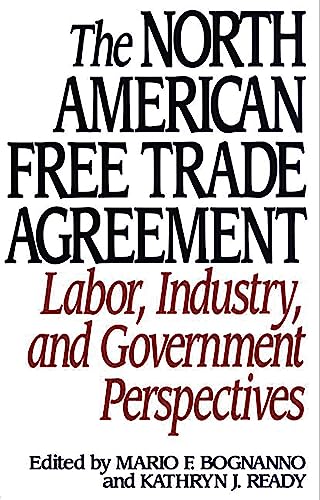

The North American free trade agreement labor, industry and goverment perspectives edited by Mario F. Bognnano and Kathryn J. Ready.
Detalles de publicación: Westport, CT Quorum Books 1993.ISBN:- 089930849X
| Imagen de cubierta | Tipo de ítem | Biblioteca actual | Biblioteca de origen | Colección | Ubicación en estantería | Signatura topográfica | Materiales especificados | Info Vol | URL | Copia número | Estado | Notas | Fecha de vencimiento | Código de barras | Reserva de ítems | Prioridad de la cola de reserva de ejemplar | Reservas para cursos | |
|---|---|---|---|---|---|---|---|---|---|---|---|---|---|---|---|---|---|---|
| Libro | Biblioteca de Mayagüez Colección General mb | HF 1746 .N67 1993 (Navegar estantería(Abre debajo)) | Disponible | 50000001830719 |
Descripciones mejoradas de Syndetics:
After more than two years of negotiations, in December 1992, the governments of Canada, Mexico, and the United States signed the North American Free Trade Agreement. During the months leading up to the signing, labor, industry, environment, and religious groups from the three countries actively debated and lobbied their respective trade negotiators to gain support for their particular concerns. Lobbying by these groups continues as policy deliberations shift from treaty negotiations to the submission of enabling legislation and, ultimately in the United States, congressional authorization.
This volume brings together key spokespeople from labor, industry, and government and presents the main arguments for and against the Free Trade Agreement as well as views on the Agreement's impact. The book is intended for policy makers, business managers, labor organizations, environmentalists, academics, students, and others who have an interest in understanding and exploring the issues surrounding the NAFTA debate.
Includes bibliographical references.
Tabla de contenidos provista por Syndetics
- Preface
- Introduction: NAFTA and Its Actors
- Background NAFTA: Labor, Industry, and Government Perspectives
- Proceedings North American Free Trade Agreement's Impact on Labor
- A Canadian Labor Perspective on a North American Free Trade Agreement
- The Canadian-U.S. Free Trade Agreement: Lessons to Guide the Evolution of NAFTA
- Reaction Panel Remarks Made at the Conference on North American Free Trade: Labor, Industry, and Government Policy Perspectives
- The Impact of Free Trade on Industry
- Estimating the Impact of the U.S.-Mexican Free Trade Agreement on Industrial Labor
- The Road to the North American Free Trade Agreement: Laissez-Faire or a Ladder Up?
- Impact of the Potential Free Trade Agreement between the United States and Mexico on Collective Bargaining from the Point of View of U.S. Companies
- Free Trade, Globalization, and U.S. Labor: What Are the Long-Run Dynamics?
- The Impact of Free Trade on the Collective Agreement
- International Unions and Transnational Collective Bargaining
- The North American Free Trade Agreement as an Element of U.S. Trade Policy
- International Competition and the Evolution of a North American Free Trade Area
- The Role of Trade in North American Integration
- International Unions and Transnational Collective Bargaining
- The North American Free Trade Agreement Negotiations and the Canadian-U.S. Free Trade Agreement: Revisiting Unfinished Business
- International Unions and Transnational Collective Bargaining
- The Impact of NAFTA on Collective Agreements in Canada: Issues and Trends
- Provisions of Collective Agreements: A Comparison of Selected Portions of Labor Arguments Negotiated in Canada and the United States
- The Impact of NAFTA on Labor by Stephen I. Schlossberg Mutual Labor-Management Concerns to Be Addressed in a North American Free Trade Agenda
- Implications for Labor-Management Relations of the Proposed North American Free Trade Agreement
- Bibliography
Reseñas proporcionadas por Syndetics
CHOICE Review
Representatives from labor, industry, and government (and economists/policy analysts active in the NAFTA debate) met at a November 1991 conference. Participants included US and Canadian nationals, and the Mexican perspective was offered--in written contributions--by representatives from international labor organizations. The book is organized in two parts: Part 1 is a 47-page monograph by Kathryn J. Ready (industrial relations, Univ. of Wisconsin-Eau Claire and coeditor of the volume), and Part 2 is a collection of 22 papers by conference participants, coedited by Mario F. Bognanno (director, Industrial Relations Center, Carlson School of Management, Univ. of Minnesota, Minneapolis.) The monograph is a balanced, well-crafted survey of the issues surrounding NAFTA which incorporates key findings of papers included in Part 2. Notable in Part 2 are papers by Jeff Faux and Thea Lee of the Economic Policy Institute in Washington, and Robert Z. Lawrence of Harvard's Kennedy School of Government, as well as a paper by William C. Gruben of the Federal Reserve Bank of Dallas which critiques the contending contributions of Faux/Lee and Lawrence. A more "academic" treatment of similar issues may be found in NAFTA: An Assessment by Clyde Hufbauer and Jeffrey Schott (CH, Sep'93) and North American Free Trade: Assessing the Impact, ed. by Nora Lustig et al. (CH, Apr'93). General; lower-division undergraduate through professional. R. L. Lucier; Denison UniversityNotas de autor provistas por Syndetics
MARIO F. BOGNANNO is Professor and Director of the Industrial Relations Center at the University of Minnesota.
KATHRYN J. READY is Associate Professor, Department of Business Administration University of Wisconsin-Eau Claire.