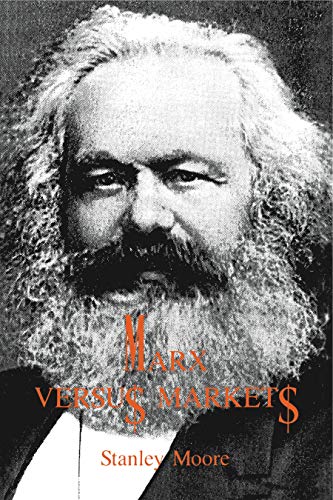

Marx versus markets Stanley Moore.
Detalles de publicación: University Park, Pa. Pennsylvania State University Press c1993.Descripción: x, 126 p. 22 cmISBN:- 0271008652
- 335.4/12 20
- HX39.5 .M649 1993
| Imagen de cubierta | Tipo de ítem | Biblioteca actual | Biblioteca de origen | Colección | Ubicación en estantería | Signatura topográfica | Materiales especificados | Info Vol | URL | Copia número | Estado | Notas | Fecha de vencimiento | Código de barras | Reserva de ítems | Prioridad de la cola de reserva de ejemplar | Reservas para cursos | |
|---|---|---|---|---|---|---|---|---|---|---|---|---|---|---|---|---|---|---|
| Libro | Biblioteca Encarnación Valdés Colección General bev | 335.412 M824m (Navegar estantería(Abre debajo)) | Disponible | 80000001584070 |
Descripciones mejoradas de Syndetics:
The challenge to Marxian theory presented by the current collapse of communist economies centers on the role of markets. Marx versus Markets points out that Marx defines communist economies--even in their lower stage of development--as classless economies without markets. It then examines his claims that classless economies with markets are in some sense inferior to communist economies.
Two conclusions emerge from Stanley Moore's analysis. First, Marx's major arguments for abolishing commodity exchange rely on moral and philosophical premises, derived from Feuerbach in the earlier writings and from Hegel in the later. Second, Marx's ideal of communist economy in incompatible with his materialistic approach to history. Marx's attack on markets flunked the test of theory one hundred years before it flunked the test of practice.
Includes bibliographical references (p. 111-121) and index.
Tabla de contenidos provista por Syndetics
- Preface(p. vii)
- 1 Statement of the Problem Lenin, Marx Tugan-Baranovsky(p. 3)
- 2 Arguments from Principles Of Philosophical Communism 1843-1844(p. 11)
- 3 Arguments from Principles Of: Historical Materialism 1845-1848(p. 23)
- 4 Appeal to Hegel The Critique of The Gotha Program(p. 37)
- 5 Appeal to Hegel Capital(p. 58)
- 6 Two Types of Socialism Marx Against Marx(p. 66)
- 7 Responses to Four Challenges, 1871-1880(p. 77)
- Notes, Works Cited, Index(p. 89)
- Notes(p. 91)
- Works Cited(p. 111)
- Index(p. 122)
Reseñas proporcionadas por Syndetics
CHOICE Review
What, according to Marx and Engels, will the post-capitalist world be like? What economic, and therefore sociopolitical, form, will the first and then final phase of communism take? This highly specialized and well-documented essay is primarily of interest and value to sophisticated Marxologists. It negates the simplistic and popular notion that, according to Marx and Engels, class exploitation will end with the demise of capitalism and, if not under socialism, most certainly under communism, commodity exchange (markets) will disappear. Thus (with all the premises involved) everyone will contribute in many ways according to ability and receive in accordance with need. Moore examines most of Marx's and some of Engels's major works, and those of their many critics, on this subject. What he finds is that the body of orthodox Marxist literature in this regard is replete with contradictions and omissions regarding the existence or disappearance of markets in the post-capitalist world. Marx, according to Moore, failed to reconcile his communist ideal, based on philosophical and humanistic considerations, with the practical aspects of the materialist theory of history. Can communism emerge and work without markets? Scientific socialism, the author concludes, does not provide an answer. This essay is far from easy reading. Recommended for faculty collections. A. Balinky; emeritus, Rutgers, The State University of New Jersey, New BrunswickNotas de autor provistas por Syndetics
Stanley Moore is Professor Emeritus of Philosophy, University of California, San Diego, and author of Marx on the Choice between Socialism and Communism (1980).