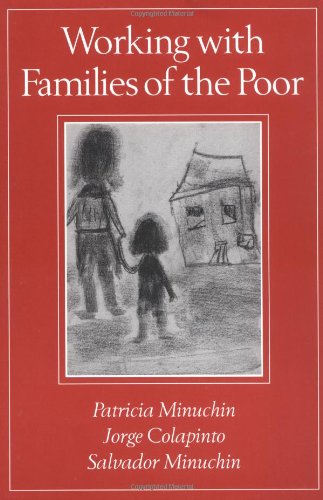

Working with families of the poor Patricia Minuchin, Jorge Colapinto, Salvador Minuchin.
Series The Guilford family therapy seriesDetalles de publicación: New York The Guilford Press 1998.Descripción: viii, 248 p. ill. 23 cmISBN:- 1572303735
- 362.5 M668w
- HV697 .M55 1998
| Imagen de cubierta | Tipo de ítem | Biblioteca actual | Biblioteca de origen | Colección | Ubicación en estantería | Signatura topográfica | Materiales especificados | Info Vol | URL | Copia número | Estado | Notas | Fecha de vencimiento | Código de barras | Reserva de ítems | Prioridad de la cola de reserva de ejemplar | Reservas para cursos | |
|---|---|---|---|---|---|---|---|---|---|---|---|---|---|---|---|---|---|---|
| Libro | Biblioteca de Mayagüez Colección General mb | HV697 .M55 1998 (Navegar estantería(Abre debajo)) | Disponible | 50000002119153 | ||||||||||||||
| Libro | Biblioteca Mons. Iñaki Mallona (Arecibo) Colección General ab | 362.5 M668w (Navegar estantería(Abre debajo)) | Disponible | 60000001984324 |
Descripciones mejoradas de Syndetics:
This eagerly awaited volume draws upon the authors' many years of experience in the inner city to provide vital guidance to therapists working with poor families. While standard counseling models are often limited to individual persons and their problems, this book emphasizes the importance of understanding individual needs within a larger family framework, and considering the family itself within broader organizational and community contexts. Weaving in numerous case histories and examples of practical interventions, the authors demonstrate how their inventive approach can be used to draw out clients' strengths and to make the most of limited social service resources. Readers will learn new techniques to gather information, reframe family assumptions, handle conflict, and explore alternative patterns of interaction. In addition, the authors show therapists how to increase the level of collaboration between poor families and the multiple agencies that provide assistance with foster care, substance abuse counseling, perinatal programs, residential and psychiatric centers for children, and home-based services.
Includes bibliographical references (p. 241-242) and index.
Tabla de contenidos provista por Syndetics
- I Fundamentals of Thought and Practice
- 1 Prologue: Angie, Her Family, and the Community of Helpers
- 2 The Framework: A Systems Orientation and a Family-Centered Approach
- 3 Working in the System: Family-Supportive Skills
- 4 Changing the System: Family-Supportive Procedures
- II Interventions in Different Settings
- 5 Foster Care: An Ecological Model
- 6 Substance Abuse and Pregnancy: A Family-Oriented Perinatal Program
- 7 Institutionalizing Children I: Residential Centers
- 8 Institutionalizing Children II: Psychiatric Wards
- 9 Home-Based Services
- 10 Epilogue
Notas de autor provistas por Syndetics
Salvador Minuchin was born in San Salvador de Jujuy, Argentina on October 13, 1921. He received a medical degree from the National University of Córdoba in Argentina and then enlisted in the Israeli Army during the 1948 war for independence. He studied child psychiatry in the United States. He returned to Israel to treat Holocaust orphans and children displaced by wars, then came back to New York to train in psychoanalysis at the William Alanson White Institute.He went on to work as a child psychiatrist at the Wiltwyck School for delinquent boys in the Hudson Valley, where he developed his theory of structural family therapy. He co-wrote several books including Families of the Slums, Family Healing: Tales of Hope and Renewal from Family Therapy, and Institutionalizing Madness: Families, Therapy and Society. In the mid-1960s, he was the director of psychiatry at Children's Hospital in Philadelphia, director of the Philadelphia Child Guidance Clinic, and a professor at the University of Pennsylvania Medical School. He retired as the clinic's director in 1975 and served as director emeritus and head of training until 1983.
He moved to New York to establish the Family Studies Institute (now the Minuchin Center for the Family), a nonprofit training center for therapists. He also joined the faculty of the New York University School of Medicine as a research professor. He retired in 1996. He died from heart disease on October 30, 2017 at the age of 96.
(Bowker Author Biography)