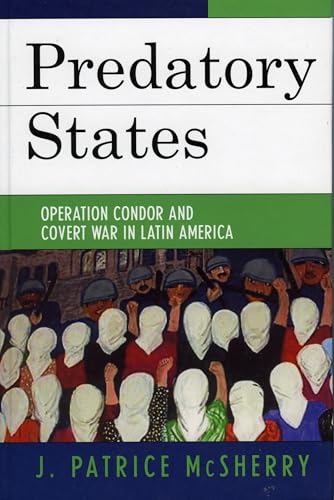

Predatory states Operation Condor and covert war in Latin America J. Patrice McSherry.
Detalles de publicación: Lanham, MD Rowman & Littlefield Publishers, Inc. c2005.Descripción: xxx, 285 p. 24 cmISBN:- 0742536874 (alk. paper)
- 980.033 M1752p 22
- HV6433.L32 O64 2005
| Imagen de cubierta | Tipo de ítem | Biblioteca actual | Biblioteca de origen | Colección | Ubicación en estantería | Signatura topográfica | Materiales especificados | Info Vol | URL | Copia número | Estado | Notas | Fecha de vencimiento | Código de barras | Reserva de ítems | Prioridad de la cola de reserva de ejemplar | Reservas para cursos | |
|---|---|---|---|---|---|---|---|---|---|---|---|---|---|---|---|---|---|---|
| Libro | Biblioteca Encarnación Valdés Colección General bev | 980.033 M1752p (Navegar estantería(Abre debajo)) | Disponible | 80000002309675 |
Descripciones mejoradas de Syndetics:
This powerful study makes a compelling case about the key U.S. role in state terrorism in Latin America during the Cold War. Long hidden from public view, Operation Condor was a military network created in the 1970s to eliminate political opponents of Latin American regimes. Its key members were the anticommunist dictatorships of Chile, Argentina, Uruguay, Bolivia, Paraguay, and Brazil, later joined by Peru and Ecuador, with covert support from the U.S. government. Drawing on a wealth of testimonies, declassified files, and Latin American primary sources, J. Patrice McSherry examines Operation Condor from numerous vantage points: its secret structures, intelligence networks, covert operations against dissidents, political assassinations worldwide, commanders and operatives, links to the Pentagon and the CIA, and extension to Central America in the 1980s. The author convincingly shows how, using extralegal and terrorist methods, Operation Condor hunted down, seized, and executed political opponents across borders. McSherry argues that Condor functioned within, or parallel to, the structures of the larger inter-American military system led by the United States, and that declassified U.S. documents make clear that U.S. security officers saw Condor as a legitimate and useful 'counterterror' organization. Revealing new details of Condor operations and fresh evidence of links to the U.S. security establishment, this controversial work offers an original analysis of the use of secret, parallel armies in Western counterinsurgency strategies. It will be a clarion call to all readers to consider the long-term consequences of clandestine operations in the name of 'democracy.'
Includes bibliographical references (p. 257-269) and index.
What was Operation Condor? -- Cold war security coordination: the global context -- Operation Condor's structures and functioning: the parallel state in operation -- Condor's killing machine: phase II transnational operations -- Phase III: Condor's assassination capability -- Commanders and operatives of Condor -- The Central American Connection -- Conclusions.
Tabla de contenidos provista por Syndetics
- List of Illustrations(p. xi)
- Foreword(p. xiii)
- Preface(p. xvii)
- Acknowledgments(p. xxv)
- Note to Readers on Sources(p. xxvii)
- 1 What Was Operation Condor?(p. 1)
- 2 Cold War Security Coordination: The Global Context(p. 35)
- 3 Operation Condor's Structures and Functioning: The Parallel State in Operation(p. 69)
- 4 Condor's Killing Machine: Phase II Transnational Operations(p. 107)
- 5 Phase III: Condor's Assassination Capability(p. 139)
- 6 Commanders and Operatives of Condor(p. 177)
- 7 The Central American Connection(p. 207)
- 8 Conclusions(p. 241)
- Bibliography(p. 257)
- Index(p. 271)