Reseñas proporcionadas por Syndetics
School Library Journal Review
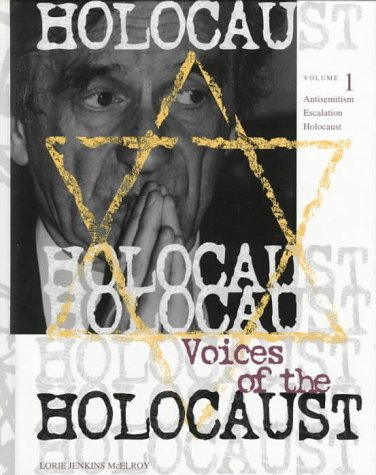
Gr 5 UpA collection of 34 excerpted or full-text poems, memoirs, articles, essays, speeches, and newspaper accounts written by people who were either victims of the Holocaust or commentators on it at the time. The set is divided into broad chapters: "Antisemitism," "Escalation," "Holocaust," "Resisters," "Liberation," and "Understanding." These sections are introduced with background articles that provide context for the "Voices." Each document is introduced and followed by information about its impact, what happened to its author, and a list for further reading. Since most of the testimonies are from adult writers, almost every page has a sidebar to define the more difficult words or the way they were used in the Nazis' euphemistic vocabulary. Biographical sketches of the contributors are included in boxes throughout. The black-and-white photographs are plentiful, but their quality varies. Both volumes have the same front matter and cumulative index. While there are index entries for "Vatican" and "Catholicism," there are none for "Protestants," "Lutherans," or "Churches," although all are discussed in the text. Overall, this resource effectively teaches about the Holocaust on both a factual and emotional level.Marcia W. Posner, Holocaust Memorial and Educational Center of Nassau County, Glen Cove, NY (c) Copyright 2010. Library Journals LLC, a wholly owned subsidiary of Media Source, Inc. No redistribution permitted.
Booklist Review
Each of these two-volume sets geared toward middle-school students offers information on different aspects of the Holocaust. While all three use vocabulary appropriate to the intended audience, Voices relies on primary sources to educate readers while People offers biographical profiles and Understanding provides background and context by describing events. Each attempts to place people and events in historical perspective and to show their impact. The volumes are formatted with wide outside margins where each set places informative captions to their black-and-white photographs and illustrations. Voices also uses this area for its glossary, giving definitions of unfamiliar terms that are indicated within the text by bold print. The brief glossaries in People and Understanding are found at the beginning of each volume. Related information is presented in boxes or sidebars; the boxed text is difficult to read because of the gray barbed-wire design background. All three sets include a time line that covers the period from before the Holocaust up to 1998, and an index. People and Voices offer bibliographies of further reading at the end of each entry. The bibliographies include current and classic adult and young-adult titles. In Voices, bibliographies contain fiction and nonfiction books only, while People also includes print and electronic encyclopedia articles and Internet sites. In Understanding, a bibliography is repeated near the end of each volume and includes general histories, aliases, nonfiction titles on specific topics, and works of fiction, as well as a list of organizations. People contains 60 alphabetized biographies, ranging in length from 6 to 10 pages, of Nazi perpetrators, victims, world leaders, resisters, and rescuers. Most entries have a photo or drawing of the subject and include birth and death dates. Most of the information concerns the subject's relevance to the Holocaust. Sidebars contain short biographies of people related to the main biographee, as well as other related information. In addition to the expected (Adolf Eichmann, Anne Frank, Simon Wiesenthal), biographees include Eva Braun, anti-Semitic radio personality Father Charles Coughlin, Varian Fry ("America's Schindler"), Benito Mussolini, General George Patton, and Pope Pius XII. Understanding is arranged in 14 chapters that survey topics such as Jewish life in Germany before the Holocaust, the rise of the Nazi Party, life in the ghettos, the death camps, the trials that followed the war's end, and contemporary views. Voices includes 34 excerpts from essays, diaries, newspaper articles, letters, and court transcripts. Many of them are primary-source documents, such as the Protocols of the Elders of Zion, the Nuremberg Laws, and Anne Frank's diary. Other pieces, excerpted from novels or personal narratives, include Summer of My German Soldier, Schindler's List, and Playing for Time. The set is divided into six chapters dealing with various aspects of the Holocaust, such as anti-Semitism and resisters. Each chapter contains a historical overview, followed by four to seven excerpts. Each excerpt is accompanied by background information, a discussion of "what happened next," and various relevant facts. Sidebars include a brief biography of the author and information on related issues and events For the middle-school library or public-library young-adult collection looking for introductory material on the Holocaust, these sets will be suitable. The information is accessible to all readers, yet the sets give enough in-depth material to be used as research tools and may serve as the impetus for students to go a step further and read the entire works excerpted or listed in the bibliographies. The three titles form UXL's Holocaust Reference Library and may be purchased separately, or as a set ($132, 0-7876-1739-3) that comes with a cumulative index to all six volumes.