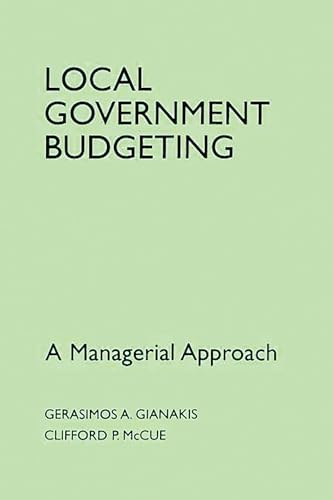

Local Goverment Budgeting A Managerial Approach Gerasimos A. Gianalis.
Detalles de publicación: Westport, Conn. Praeger 1999.Descripción: xvii,188p. 24 cmISBN:- 1567200060 (alk. paper).
- 352.48214 G433l
- HJ 9147 .G5 1999
| Imagen de cubierta | Tipo de ítem | Biblioteca actual | Biblioteca de origen | Colección | Ubicación en estantería | Signatura topográfica | Materiales especificados | Info Vol | URL | Copia número | Estado | Notas | Fecha de vencimiento | Código de barras | Reserva de ítems | Prioridad de la cola de reserva de ejemplar | Reservas para cursos | |
|---|---|---|---|---|---|---|---|---|---|---|---|---|---|---|---|---|---|---|
| Libro | Biblioteca de Mayagüez Colección General mb | HJ 9147 .G5 1999 (Navegar estantería(Abre debajo)) | Disponible | 50000002169547 |
Descripciones mejoradas de Syndetics:
In an effort to bridge the gap between budget theorists and practitioners, this book approaches local government budgeting as the internal resource allocation process of a highly differentiated organization that operates in a very political environment, and whose boundaries are particularly permeable during the formal budget process. Written by academics with extensive practical experience in local government budgeting and finance, this text will be equally useful to practitioners, scholars and students.
Theory building in public budgeting has been dominated by political science and economics, and these approaches have not produced theories that can serve as guides to action for practitioners or help them understand their action environments. In order to produce theory that has meaning for practitioners, researchers should approach the subject as it is experienced by practitioners. The long-term financial health of local governments requires an integrated approach to public budgeting. This book develops theory that illuminates practice. It recognizes that the budget process is the only organization-wide process that integrates all of the agencies that comprise the government, and thus, the budget must address the long-term consequences of any action. The budget process itself is presented as a vehicle to develop the decision premises and organizational values that will support allocative efficiency and productivity.
Includes bibliographical references and index.
Tabla de contenidos provista por Syndetics
- Preface
- The Environment of Local Government Budgeting Budget Formats Budget Execution Budgeting for Productivity Analytical Techniques Local Government Revenues Capital Budgeting and Economic Development Debt Management
- Summary and Synthesis
- Index
Reseñas proporcionadas por Syndetics
CHOICE Review
Gianakis (public administration, Univ. of Central Florida) and McCue (public administration, Florida Atlantic Univ.) meld substantive issues of public budgeting--defined as resource allocation in a political context--to broader concerns of organization theory. As teachers of budgeting who once practiced it in local government, they are critical of overly detached budget literature that draws inspiration from the federal scene alone. Local government, to them, is a venue in which budgeting can uniquely contribute to a unified jurisdiction's efficiency, effectiveness, and long-term financial viability. In addition, the budget process inculcates organizational values, effectuates organizational change, and creates a unifying managerial process. Although the chapters are based on typical textbook topics such as formats, execution, revenues, and debt management, they are written at a provocative level that reaches beyond technicalities alone. Each chapter concludes with a section called "Managerial Issues" that presents questions and suggestions helpful to the practitioner and enlightening to the student. The book looks boring from afar but is actuality quite exciting. Recommended for upper-division undergraduates, graduate students, faculty, and practitioners. C. T. Goodsell Virginia Polytechnic Institute and State UniversityNotas de autor provistas por Syndetics
GERASIMOS A. GIANAKIS is Assistant Professor in the Department of Public Administration, College of Health and Public Affairs, at the University of Central Florida. The author of numerous journal articles and book chapters, he is a member of the American Society of Public Administration. He was previously a budget manager with the city of St. Petersburg, Florida, and he began his public service career as a Management Analyst with the St. Petersburg Police Department.
CLIFFORD P. MCCUE is Assistant Professor at the School of Public Administration, College of Architecture, Urban and Public Affairs, Florida Atlantic University. The author of numerous journal articles, book chapters, and monographs, including Immigration and Its Impact on American Cities (Praeger, 1996), he is a member of the American Society for Public Administration, The Government Finance Officers Association, and the International City/County Managers Association. He has served as Finance Director for the City of South Miami, Senior Budget Director for the City of Hialeah, and Assistant Finance Director/Budget Coordinator of Frederick County, Virginia.