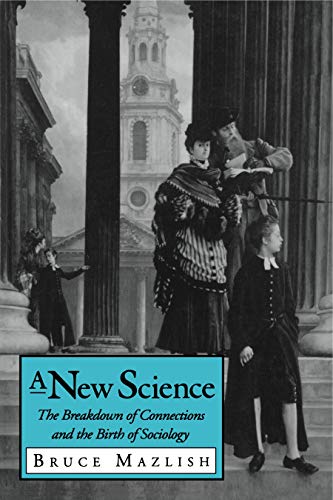

A new science the breakdown of connections and the birth of sociology Bruce Mazlish.
Detalles de publicación: University Park, Pa. Pennsylvania State University Press 1993.Descripción: p. cmISBN:- 0271010924
- 301/.09 20
- HM19 .M39 1993
| Imagen de cubierta | Tipo de ítem | Biblioteca actual | Biblioteca de origen | Colección | Ubicación en estantería | Signatura topográfica | Materiales especificados | Info Vol | URL | Copia número | Estado | Notas | Fecha de vencimiento | Código de barras | Reserva de ítems | Prioridad de la cola de reserva de ejemplar | Reservas para cursos | |
|---|---|---|---|---|---|---|---|---|---|---|---|---|---|---|---|---|---|---|
| Libro | Biblioteca Encarnación Valdés Colección General bev | 301.09 M476n (Navegar estantería(Abre debajo)) | Disponible | 80000001584062 |
Descripciones mejoradas de Syndetics:
This text explains the rise of sociology by placing it in the context of late-18th and early-19th-century social thought.
Originally published: New York : Oxford University Press, 1989.
Includes bibliographical references and index.
Reseñas proporcionadas por Syndetics
CHOICE Review
A sad refrain consistently sounded in the modern world reflects a great nostalgia for the preindustrial, traditional, rural world of face-to-face (though rigidly hierarchical) relations and mutual obligations. One of the most widely read works of the past decade, Robert Bellah's Habits of the Heart (CH, Jul'85), embroiders on this theme, conveying what Mazlish calls a "profound sense of dislocation, a pervasive feeling that all connections. . .have been broken." Mazlish contends that it is precisely this lament, first sung by British essayists, poets, and novelists that generated the subject matter and perspective of sociology. A literary dirge for a lost world provided the occasion for the development of a set of social visions that, carried forward by reformers and revolutionaries like Marx and Engels, created a new academic discipline. This discipline, sociology, focused foremost on the phenomenon of social life as a creation and reflection of human endeavor. The author describes the fate of three central images that, he suggests, frame the process of transformation from lament to science (the cash nexus; social/unsocial humanity; and the Jew) and the role of four founders of sociology--Tonnies, Simmel, Durkheim, and Weber--in composing the transformation. The book is an accessible, fascinating, erudite, and provocative tour de force with a memorable, even gripping, conclusion. It is a must for both college and general libraries. -N. B. Rosenthal, SUNY College at Old WestburyNotas de autor provistas por Syndetics
Bruce Mazlish was born in Brooklyn, New York on September 15, 1923. During World War II, he served in the Office of Strategic Services, the precursor to the C.I.A. He received a bachelor's degree, a master's degree, and a Ph.D. in European history from Columbia University. He joined the Massachusetts Institute of Technology faculty in 1955 and became a full professor in 1960.His first book, The Western Intellectual Tradition: From Leonardo to Hegel, written with the British mathematician and poet Jacob Bronowski, was published in 1960. His other books include In Search of Nixon: A Psychohistorical Inquiry, The Fourth Discontinuity: The Co-Evolution of Humans and Machines, and The Uncertain Sciences. He also wrote psychoanalytic biographies about Henry A. Kissinger, Jimmy Carter, and Mao Zedong. He died on November 27, 2016 at the age of 93.
(Bowker Author Biography)