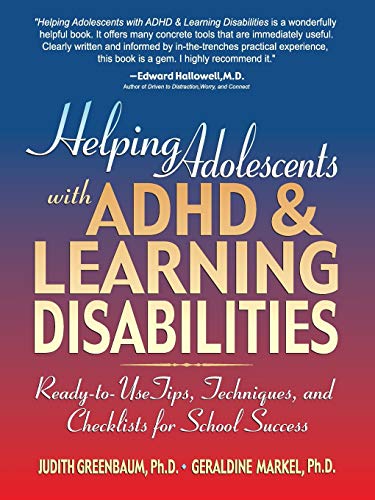

Helping adolescents with ADHD & learning disabilities ready-to-use tips, techniques, and checklists for school success Judith Greenbaum, Geraldine Markel ; illustrations by Alice Beresin.
Detalles de publicación: Paramus, NJ Center for Applied Research in Education c2001.Descripción: xxi, 321 p. ill. 28 cmISBN:- 0130167789
- Helping adolescents with ADHD and learning disabilities
- 371.93 G7985h 21
- LC4712 .G74 2001
| Imagen de cubierta | Tipo de ítem | Biblioteca actual | Biblioteca de origen | Colección | Ubicación en estantería | Signatura topográfica | Materiales especificados | Info Vol | URL | Copia número | Estado | Notas | Fecha de vencimiento | Código de barras | Reserva de ítems | Prioridad de la cola de reserva de ejemplar | Reservas para cursos | |
|---|---|---|---|---|---|---|---|---|---|---|---|---|---|---|---|---|---|---|
| Libro | Biblioteca Encarnación Valdés Colección General bev | 371.93 G7985h (Navegar estantería(Abre debajo)) | Disponible | 80000002179813 |
Descripciones mejoradas de Syndetics:
This problem-solving guide gives teachers and other professionals the information and materials they need to improve ADD/LD teens' academic and social skills and develop appropriate educational programs for them. A practical checklist format makes it easy to locate essential information, and hot topics such as self-management, motivation, homework completion, medication, and assistive technology are covered in detail. The book includes interesting student case histories throughout, over 100 reproducible graphic organizers, and specific recommendations for involving parents. A special appendix at the end of the book identifies 20 common classroom problems, from excessive movement, overactivity and hyperactivity to poor test-taking skills, and lists strategies to help students with ADHD or LD.
Includes bibliographical references (p. 319-321).
Tabla de contenidos provista por Syndetics
- Chapter 1 Adolescents with ADHD and/or LD(p. 1)
- Definitions of ADHD(p. 2)
- Diagnosis of ADHD(p. 8)
- Learning Styles of Students with ADHD and/or LD(p. 10)
- Teacher Roles in the Diagnosis and Support of ADHD and/or LD(p. 16)
- Learning Disabilities(p. 19)
- Language Disabilities(p. 25)
- Central Auditory Processing Disorder(p. 26)
- Nonverbal Learning Disabilities(p. 26)
- Overlapping Disabilities(p. 28)
- Multiple Challenges: Adolescence and ADHD and/or LD(p. 28)
- A Final Word(p. 29)
- Chapter 2 Understanding Legal Requirements(p. 31)
- Major Laws Dealing with Students' Disabilities(p. 32)
- Underlying Premises of IDEA and Section 504(p. 33)
- Ten Major Provisions of the Individuals with Disabilities Education Act (IDEA)(p. 34)
- Differences Between IDEA and Section 504(p. 37)
- Definitions of Learning Disabilities under IDEA and Section 504(p. 38)
- Appeals Procedures(p. 40)
- Constraints Affecting IEP and Section 504 Decisions(p. 42)
- Barriers to Implementing IDEA and Section 504(p. 44)
- Teacher Responsibilities Implied by Law(p. 45)
- Addressing Teacher Questions and Concerns(p. 46)
- A Final Word(p. 47)
- Chapter 3 The Learning Environment(p. 49)
- The Welcome Letter(p. 51)
- Current Research(p. 52)
- Predictable Classroom Problems of Students with ADHD and/or LD(p. 53)
- Components of a Positive Learning Environment(p. 54)
- Monitoring and Assessment of Student Learning(p. 68)
- Team Teaching(p. 70)
- A Final Word(p. 72)
- Chapter 4 Reading and Writing in the Content Areas(p. 73)
- Reading: Current Status(p. 74)
- Writing: Current Status(p. 76)
- Reading to Write, Writing to Read(p. 78)
- Whose Responsibility Is It?(p. 79)
- Effective Readers and Writers(p. 81)
- Teaching Reading and Writing in the Content Area Class(p. 83)
- Active Reading and Writing(p. 88)
- Reading and Writing Accommodations(p. 93)
- A Schoolwide Commitment(p. 97)
- A Final Word(p. 101)
- Chapter 5 Teaching Homework-Completion Skills(p. 103)
- Homework, an Unhappy State of Affairs(p. 104)
- Homework Problems and Their Causes(p. 104)
- Why Is Homework Assigned?(p. 109)
- Homework Responsibilities of the Teacher, Parent, and Student(p. 110)
- Preventing Homework Problems(p. 113)
- Providing Support for Homework Completion(p. 122)
- Providing Homework Accommodations(p. 125)
- Solving Homework Problems(p. 126)
- A Final Word(p. 129)
- Chapter 6 Teaching Adolescents to Use Self-Management(p. 131)
- Importance of Self-Management Skills(p. 132)
- Self Talk(p. 135)
- Visualization(p. 138)
- Managing Anger(p. 139)
- Managing Attention(p. 140)
- Managing Test Anxiety(p. 141)
- Self-Monitoring(p. 141)
- Setting Goals(p. 145)
- Self-Motivation(p. 147)
- Steps for Integrating the Teaching of Self-Management Strategies in Content Area Classes(p. 148)
- A Final Word(p. 150)
- Chapter 7 Developing IEPs and Section 504 Plans(p. 153)
- A Team Approach to the Development of IEPs and Section 504 Plans(p. 155)
- Elements of the IEP and Section 504 Plan(p. 158)
- Responsibilities of the Classroom Teacher(p. 164)
- Responsibilities of the Teacher Consultant and Resource Room Teacher(p. 165)
- Responsibilities of the School Social Worker and School Psychologist(p. 166)
- Goals and Objectives(p. 166)
- Accommodations or Supplemental Aids and Services in the Regular Education Classroom(p. 169)
- Preparing for the IEP or Section 504 Meeting(p. 169)
- The Well-Run Meeting(p. 175)
- A Final Word(p. 175)
- Chapter 8 Behavioral Interventions(p. 179)
- Past Emphasis: Punishment(p. 181)
- A New Direction: Prevention(p. 181)
- Behavioral Support Plans(p. 182)
- Reinforcement(p. 189)
- Planned Ignoring and Extinction(p. 190)
- Response Cost(p. 191)
- Shaping Behavior and Chaining(p. 193)
- Contracting(p. 193)
- Integrating Behavioral Support Plans for Several Students(p. 195)
- Stopping Escalation of Negative Behavior(p. 195)
- Violating Disciplinary Rules or Code of Conduct(p. 196)
- A Final Word(p. 196)
- Chapter 9 Understanding the Role of Medication(p. 199)
- The Teacher's Role(p. 200)
- Beliefs and Attitudes about Medication(p. 200)
- Countering Myths(p. 201)
- Medication Choices(p. 204)
- Warning Signs of Side Effects(p. 206)
- Student Noncompliance(p. 207)
- The Importance of Monitoring(p. 207)
- Christopher, One Student's Story(p. 211)
- A Final Word(p. 216)
- Chapter 10 Gifted Students with ADHD and/or LD(p. 219)
- Gifted Students with ADHD and/or LD(p. 221)
- Some Definitions of Giftedness(p. 229)
- Indications of Giftedness and ADHD and/or LD: A Paradoxical Picture(p. 231)
- Current Status(p. 231)
- Secondary Emotional Problems(p. 233)
- Challenges and Opportunities for Teachers(p. 233)
- Psychoeducational Evaluation(p. 234)
- Section 504 Plans and Classroom Accommodations(p. 235)
- Flexible Programming(p. 235)
- Instructional Planning for the Classroom Teacher(p. 236)
- Thinking and Self-Management Strategies(p. 236)
- Student Involvement(p. 238)
- A Final Word(p. 238)
- Chapter 11 Diversity and Parent Involvement(p. 241)
- Legal Underpinning of Parent Involvement(p. 242)
- Definition of Parent Involvement(p. 243)
- Diversity in the Schools(p. 245)
- The Influence of ADHD and/or LD on the Family(p. 249)
- Parent-Teacher Disagreements about the Education of Students with ADHD and/or LD(p. 251)
- A New Approach to Parent Involvement(p. 252)
- Effective Communication(p. 260)
- A Final Word(p. 263)
- Chapter 12 Preparing for the Future: Transitions to Postsecondary Settings(p. 269)
- Why Students Don't Complete High School or Pursue Further Education(p. 269)
- "A Taste of College," Summer 1995(p. 272)
- Characteristics of Successful Adults with ADHD and/or LD(p. 273)
- IDEA Transition Planning Requirements(p. 275)
- Postsecondary Support for Students with ADHD and/or LD(p. 288)
- Postsecondary Options(p. 291)
- A Sense of Completion(p. 292)
- Appendices
- A Problems and Strategies(p. 295)
- B Organizations(p. 313)
- C Resources(p. 315)
- D World Wide Web Sites(p. 317)
- References(p. 319)