Imagen de Amazon.com

Portada de Syndetics
Imagen de OpenLibrary
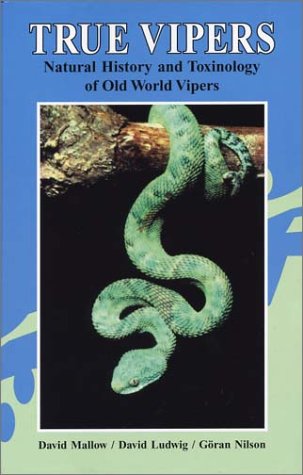
True vipers natural history and toxicology of old world vipers by David Mallow, David Ludwig and Goran Nilson.
Detalles de publicación: Malabar, Fl. Krieger Publishing Co. 2003.Descripción: xiv, 359 p. col. ill. 24 cmISBN:- 0894648772
- 597.963 M255t 2003
- QL666 .O69 M34 2003
| Imagen de cubierta | Tipo de ítem | Biblioteca actual | Biblioteca de origen | Colección | Ubicación en estantería | Signatura topográfica | Materiales especificados | Info Vol | URL | Copia número | Estado | Notas | Fecha de vencimiento | Código de barras | Reserva de ítems | Prioridad de la cola de reserva de ejemplar | Reservas para cursos | |
|---|---|---|---|---|---|---|---|---|---|---|---|---|---|---|---|---|---|---|
| Libro | Biblioteca de Mayagüez Colección General mb | QL666 .O69 M34 2003 (Navegar estantería(Abre debajo)) | Disponible | 50000002147014 |
Total de reservas: 0
Descripciones mejoradas de Syndetics:
A detailed reference work on the nine genera and their species in the subfamily Viperinae. Each account is based on a review of the world literature and includes information on ecology, biology, physiology, toxicology, distribution, behaviour and husbandry.
Includes bibliographical references (p. 301-349).
Tabla de contenidos provista por Syndetics
- Preface(p. xi)
- Acknowledgments(p. xiii)
- Introduction(p. 1)
- Chapter 1 Azemiopinae(p. 13)
- Azemiops(p. 13)
- Azemiops feae Boulenger 1888(p. 14)
- Chapter 2 Causinae(p. 19)
- Causus(p. 19)
- Causus bilineatus Boulenger 1905(p. 20)
- Causus defilippii (Jan 1863)(p. 21)
- Causus lichtensteini (Jan 1859)(p. 24)
- Causus maculatus (Hallowell 1842)(p. 25)
- Causus resimus (Peters 1862)(p. 28)
- Causus rhombeatus (Lichtenstein 1823)(p. 30)
- Chapter 3 Viperinae(p. 35)
- Adenorhinos(p. 35)
- Adenorhinos barbouri (Loveridge 1930)(p. 35)
- Chapter 4 Atheris(p. 39)
- Atheris acuminata Broadley 1998(p. 40)
- Atheris broadleyi Lawson 1999(p. 41)
- Atheris ceratophora Werner 1895(p. 42)
- Atheris chlorechis (Pel 1851)(p. 43)
- Atheris desaixi Ashe 1968(p. 45)
- Atheris hispida Laurent 1955(p. 47)
- Atheris katangensis de Witte 1953(p. 49)
- Atheris nitschei Tornier 1902(p. 50)
- Atheris rungweensis Bogert 1940(p. 51)
- Atheris squamigera (Hallowell 1856)(p. 53)
- Atheris subocularis Fischer 1888(p. 57)
- Chapter 5 Bitis(p. 59)
- Subgenus Bitis Gray 1842(p. 60)
- Bitis arietans (Merrem 1820)(p. 60)
- Subgenus Calechidna Tschudi 1845(p. 71)
- Bitis albanica Hewitt 1937(p. 71)
- Bitis armata Smith 1826(p. 73)
- Bitis atropos (Linnaeus 1758)(p. 74)
- Bitis caudalis (Smith 1839)(p. 79)
- Bitis cornuta (Daudin 1803)(p. 86)
- Bitis heraldica (Bocage 1889)(p. 89)
- Bitis inornata (Smith 1838)(p. 90)
- Bitis peringueyi (Boulenger 1888)(p. 92)
- Bitis rubida Branch 1997(p. 95)
- Bitis schneideri (Boettger 1886)(p. 97)
- Bitis xeropaga Haacke 1975(p. 99)
- Subgenus Macrocerastes Reuss 1939(p. 101)
- Bitis gabonica (Dumeril, Bibron and Dumeril 1854)(p. 101)
- Bitis nasicornis (Shaw 1802)(p. 115)
- Bitis parviocula Bohme 1977(p. 122)
- Subgenus Keniabitis Lenk, Herrmann, Joger, Wink 1999(p. 124)
- Bitis worthingtoni Parker 1932(p. 124)
- Chapter 6 Cerastes(p. 127)
- Cerastes cerastes (Linnaeus 1758)(p. 128)
- Cerastes gasperetti Leviton and Anderson 1967(p. 130)
- Cerastes vipera (Linnaeus 1758)(p. 132)
- Chapter 7 Daboia(p. 141)
- Daboia palaestinae (Werner 1938)(p. 141)
- Daboia russelii (Shaw and Nodder 1797)(p. 150)
- Chapter 8 Echis(p. 161)
- Echis carinatus (Schneider 1801)(p. 162)
- Echis coloratus (Gunther 1878)(p. 164)
- Echis hughesi Cherlin 1990(p. 167)
- Echis jogeri Cherlin 1990(p. 168)
- Echis khosatzkii Cherlin 1990(p. 169)
- Echis leucogaster Roman 1972(p. 170)
- Echis megalocephala Cherlin 1990(p. 171)
- Echis multisquamatus Cherlin 1981(p. 172)
- Echis ocellatus Stemmler 1970(p. 173)
- Echis pyramidum (Geoffroy and Saint-Hillaire 1827)(p. 175)
- Chapter 9 Eristicophis(p. 189)
- Eristicophis macmahonii Alcock and Finn 1897(p. 189)
- Chapter 10 Macrovipera(p. 193)
- Macrovipera deserti (Anderson 1892)(p. 194)
- Macrovipera lebetina (Linnaeus 1758)(p. 195)
- Macrovipera mauritanica (Dumeril and Bibron 1848)(p. 200)
- Macrovipera schweizeri (Werner 1935)(p. 202)
- Chapter 11 Montatheris(p. 205)
- Montatheris hindii (Boulenger 1910)(p. 205)
- Chapter 12 Proatheris(p. 207)
- Proatheris superciliaris (Peters 1854)(p. 207)
- Plates (1.1-14.26)(p. 210)
- Chapter 13 Pseudocerastes(p. 213)
- Pseudocerastes persicus (Dumeril, Bibron and Dumeril 1854)(p. 213)
- Chapter 14 Vipera(p. 219)
- Subgenus Vipera Laurenti 1768(p. 220)
- Vipera ammodytes (Linnaeus 1758)(p. 221)
- Vipera aspis (Linnaeus 1758)(p. 228)
- Vipera latastei Bosca 1878(p. 236)
- Vipera monticola Saint-Girons 1954(p. 237)
- Vipera transcaucasiana Boulenger 1913(p. 239)
- Subgenus Pelias Merrem 1820(p. 241)
- Vipera barani Bohme and Joger 1984(p. 241)
- Vipera berus (Linnaeus 1758)(p. 242)
- Vipera darevskii Vedmederja, Orlov and Tuniyev 1986(p. 252)
- Vipera dinniki Nikolsky 1913(p. 254)
- Vipera kaznakovi Nikolsky 1909(p. 256)
- Vipera nikolskii Vedmederja, Grubant and Rudayeva 1986(p. 258)
- Vipera pontica Billing, Nilson and Sattler 1990(p. 260)
- Vipera seoanei Lataste 1879(p. 261)
- Subgenus Acridophaga Reuss 1927(p. 263)
- Vipera anatolica Eiselt and Baran 1970(p. 266)
- Vipera ebneri Knoeppfler and Sochurek 1955(p. 267)
- Vipera eriwanensis (Reuss 1933)(p. 269)
- Vipera lotievi Nilson, Tuniyev, Orlov, Hoggren and Andren 1995(p. 271)
- Vipera renardi (Christoph 1861)(p. 272)
- Vipera ursinii (Bonaparte 1835)(p. 274)
- Subgenus Montivipera Nilson, Tuniyev, Andren, Orlov, Joger and Herrmann 1999(p. 280)
- Vipera albicornuta Nilson and Andren 1985(p. 280)
- Vipera albizona Nilson and Andren 1990(p. 282)
- Vipera bornmuelleri Werner 1898(p. 283)
- Vipera bulgardaghica Nilson and Andren 1985(p. 285)
- Vipera latifii Mertens, Darevsky and Klemmer 1967(p. 287)
- Vipera raddei (Boettger 1890)(p. 290)
- Vipera wagneri Nilson and Andren 1984(p. 293)
- Vipera xanthina (Gray 1849)(p. 295)
- Bibliography(p. 301)
- Glossary(p. 351)
Reseñas proporcionadas por Syndetics
CHOICE Review
Mallow (Linsly School, West Virginia), Ludwig (ecologist), and Nilson (Goteborg Univ., Sweden) have produced an authoritative work summarizing the biology, natural history, venom toxicity, and epidemiology of 14 genera and 85 Old World snake species popularly known as the "true vipers" of the family Viperidae. The introduction includes information on viperid systematics, venom, envenomation, anatomy, and bite diagnosis and treatment; 14 chapters follow. Chapters 1 and 2 cover subfamilies Azemiopinae and Causinae, respectively. Remaining chapters are devoted to genera of the subfamily Viperinae. Each chapter includes a generic synopsis and species accounts within the respective genera. Species accounts typically include scientific and vernacular names, plate references, and subheadings for recognition, taxonomy and distribution, habitat, food and feeding, behavior, reproduction and development, bite and venom, and remarks. At the book's center are 71 superb color photographs. The narrative is well written, easy to comprehend, and current. Lengthy bibliography; glossary. The book will be useful for herpetologists, reptile breeders, zookeepers, and medical authorities concerned with treatment of snake bites. ^BSumming Up: Recommended. General readers; lower-division undergraduates through professionals. E. D. Keiser University of MississippiNotas de autor provistas por Syndetics
David Mallow, PhD, is an educator and scientist with a diverse background and a lifelong interest in herpetology. He is head of the science department at The Linsly School in Wheeling, West Virginia, where he has taught biology for the past seventeen years. In addition to teaching he leads student trips abroad each summer to rainforests and coral reefs around the worldDavid Ludwig, PhD, is an ecologist and environmental scientist. His current research programs include intensive investigation of the potential impacts of environmental contamination on reptiles and amphibians and on the value of these organisms as indicators of environmental quality. He has conducted herpetological surveys throughout the United States during ongoing studies of the quantitative roles that reptiles and amphibians play in ecological processes
Goran Nilson, PhD, has a lifelong interest in herpetology, his main working field. He is professor of Structural and Systematic Zoology at Goteborg University, Sweden, and the head of the Vertebrate Department at the Goteborg Natural History Museum. He has been teaching at the department of Zoology, Goteborg University, for a number of years. He is also the chief herpetologist at Goteborg's Universeum Science Center in Goteborg. Much of his research over the years has been focused on vipers, with a special interest in systematic zoology, ecology, and conservation. In addition to research and teaching, he has conducted a considerable number of expeditions in Asia and Europe over the past thirty years