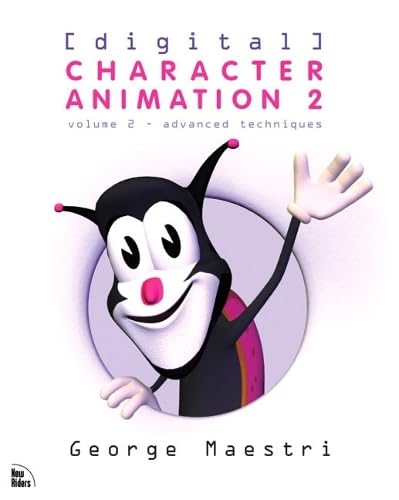

Digital character animation 2, volume II advanced techniques George Maestri.
Detalles de publicación: Indianapolis, Ind. New Riders c2002.Descripción: 2 v. col. ill. 26 cmISBN:- 0735700443
| Imagen de cubierta | Tipo de ítem | Biblioteca actual | Biblioteca de origen | Colección | Ubicación en estantería | Signatura topográfica | Materiales especificados | Info Vol | URL | Copia número | Estado | Notas | Fecha de vencimiento | Código de barras | Reserva de ítems | Prioridad de la cola de reserva de ejemplar | Reservas para cursos | |
|---|---|---|---|---|---|---|---|---|---|---|---|---|---|---|---|---|---|---|
| Libro | Biblioteca de Mayagüez Colección General mb | TR897.7 .M343 2002 (Navegar estantería(Abre debajo)) | v.2 | Disponible | 50000002130911 |
Descripciones mejoradas de Syndetics:
As soon as George Maestri's classic (digital) Character Animation was released, people began asking when he was going to do on edition for trully high-end users with the most advanced skill sets. Here it is; George writes directly to CG professionals, with more non-software-specific approaches to character animation.
Includes bibliographical references (p. [269]-271) and index.
v. 1. Essential techniques -- v. 2. Advanced techniques.
Tabla de contenidos provista por Syndetics
- Introduction(p. xv)
- 1 Real World Production(p. 2)
- Getting Started in Filmmaking(p. 4)
- People(p. 4)
- Getting Money(p. 5)
- Pitching Ideas(p. 6)
- Development Deals(p. 7)
- Budgets(p. 7)
- Deadlines(p. 8)
- Developing a Schedule(p. 9)
- How Much Will It Cost?(p. 10)
- Making the Most of Your Budget(p. 11)
- Making a Film(p. 13)
- Story and Ideas(p. 13)
- Modeling and Setup(p. 13)
- Dialogue(p. 14)
- Leica Reels(p. 17)
- Layout(p. 19)
- Animation(p. 20)
- Keeping Track of Things(p. 21)
- Rendering and Output(p. 22)
- Adding Sound Effects(p. 24)
- Distribution(p. 25)
- 2 Story(p. 26)
- Characters and Story(p. 28)
- Motivation Creates Character(p. 28)
- Obstacles Create Conflict(p. 29)
- Conflict Creates Drama(p. 29)
- Story Through Action(p. 30)
- Visuals Come First(p. 31)
- Developing a Story(p. 32)
- Keep It Simple(p. 32)
- Brainstorming a Premise(p. 33)
- Developing Your Premise into a Story(p. 35)
- Developing a Script(p. 37)
- Dialogue(p. 37)
- Visualizing Your Story(p. 38)
- Finalizing Your Story(p. 41)
- Conclusion(p. 41)
- 3 Rigging Characters(p. 42)
- Sliders(p. 44)
- Automation(p. 44)
- Wiring Things Together(p. 45)
- Direct Relationships(p. 45)
- Set-Driven Keys(p. 45)
- Expressions(p. 46)
- Scripting(p. 50)
- Skeletal Setups(p. 50)
- Grab Points and Handles(p. 51)
- Setting Up a Foot(p. 52)
- Spine Setup(p. 54)
- Ribs(p. 55)
- Shoulders(p. 56)
- Forearms(p. 56)
- Hands(p. 58)
- Facial Rigging(p. 60)
- The Jaw(p. 60)
- Present Facial Poses(p. 61)
- Replacement Animation(p. 62)
- Visibility(p. 62)
- If/Then(p. 62)
- Setting Up Replacement Animation(p. 63)
- Set-Driven Keys and Replacement Animation(p. 64)
- Skinning(p. 65)
- Deformers(p. 65)
- Conclusion(p. 66)
- 4 Animation Tips and Tricks(p. 68)
- Making Characters Think(p. 70)
- Thinking Starts in the Head(p. 70)
- Characters Are Whole(p. 70)
- 50/50 Rule(p. 71)
- Simplicity Is Key(p. 71)
- Dialogue(p. 71)
- Listening to the Track(p. 71)
- The Body and Dialogue(p. 72)
- The Mouth and Dialogue(p. 74)
- Facial Animation(p. 76)
- Expression Changes(p. 76)
- Eyes(p. 76)
- Animating the Body(p. 80)
- Overcoming Stiffness(p. 80)
- Hand and Arm Motion(p. 81)
- Grabbing/Gripping(p. 83)
- Takes and Double Takes(p. 84)
- Staggers(p. 87)
- Animating Laughter(p. 88)
- Breakdown of a Laugh(p. 88)
- Multiple Characters(p. 89)
- Choreography(p. 90)
- Who Comes First(p. 90)
- Crowds(p. 90)
- Environment(p. 90)
- Conclusion(p. 91)
- 5 Human Motion(p. 92)
- Using Reference(p. 94)
- Balance and Weight(p. 94)
- Gravity and Other Forces(p. 95)
- Character Mass(p. 96)
- How the Body Moves(p. 97)
- Muscle Energy(p. 97)
- Pendulum Effect(p. 97)
- Spinning(p. 98)
- Animating Locomotion(p. 99)
- Changing Speed(p. 99)
- Changing Direction(p. 101)
- Going Up and Down Slopes(p. 104)
- Jumping(p. 105)
- Leaping(p. 107)
- Dealing with External Forces(p. 109)
- Lifting(p. 109)
- Pushing(p. 110)
- Pulling(p. 111)
- Getting Pulled(p. 111)
- Animating Rhythm and Dance(p. 112)
- Understanding Tempo(p. 112)
- Figuring Out the Steps(p. 113)
- Getting the Hips Moving(p. 114)
- Moving On Up(p. 115)
- Stepping Out(p. 116)
- Adding Character(p. 117)
- Martial Arts(p. 117)
- Posing for Martial Arts(p. 117)
- Conclusion(p. 122)
- 6 Acting(p. 124)
- Acting Versus Animating(p. 126)
- Acting and Story(p. 126)
- Know Your Tools(p. 126)
- Know Your Audience(p. 127)
- Know Your Characters(p. 127)
- Character Descriptions(p. 128)
- Character Biographies(p. 129)
- Acting Technique(p. 130)
- Creating Empathy(p. 130)
- Creating Inspiration(p. 132)
- Creating Movement(p. 132)
- Acting and the Body(p. 140)
- The Head(p. 140)
- The Shoulders(p. 140)
- The Hands(p. 141)
- The Spine and Posture(p. 142)
- Other Techniques(p. 144)
- Sense Memory(p. 145)
- Animal Exercises(p. 145)
- Affective Memory(p. 146)
- Conclusion(p. 146)
- 7 Animal Motion(p. 148)
- Four-Legged Mammals(p. 150)
- Skeletons for Quadrupeds(p. 151)
- Analysis of a Four-Legged Walk(p. 152)
- Animating a Four-Legged Walk Cycle(p. 153)
- Other Four-Legged Gaits(p. 155)
- Trot(p. 155)
- Canter(p. 156)
- Gallop(p. 156)
- Stylized Walks(p. 157)
- Reptiles(p. 157)
- Snakes(p. 158)
- Serpentine Locomotion(p. 158)
- Sidewinding(p. 158)
- Concertina Locomotion(p. 159)
- Rectilinear Locomotion(p. 160)
- Setting Up a Snake(p. 160)
- Dinosaurs(p. 161)
- Insects and Spiders(p. 163)
- Setting Up Insects for Animation(p. 163)
- Analysis of Six-Legged Walks(p. 164)
- Spider Walks(p. 166)
- Conclusion(p. 167)
- 8 Anthropomorphic Animation(p. 168)
- How Real Can You Go?(p. 170)
- Creating Your Character(p. 170)
- Modeling Your Character(p. 171)
- Adding Faces(p. 171)
- Adding Limbs(p. 172)
- Character Setup(p. 173)
- Animating Objects(p. 174)
- The Big Secret: Timing(p. 174)
- Animating a Jointed Character(p. 174)
- Animating Deformed Characters(p. 176)
- Conclusion(p. 188)
- 9 Games(p. 190)
- Producing Games(p. 192)
- People Involved in Game Production(p. 192)
- Platforms(p. 193)
- Game Design(p. 194)
- Creating Characters for Games(p. 195)
- Textures(p. 196)
- Setup for Games(p. 197)
- Animating for Games(p. 198)
- Games and Staging(p. 199)
- Standard Moves(p. 201)
- Cycles(p. 203)
- Creating a Cycle(p. 203)
- Animating a Simple Cycled Walk(p. 203)
- Moving Characters(p. 206)
- Hooking Up(p. 206)
- Flowcharting(p. 207)
- One-to-One(p. 207)
- One-to-Many(p. 207)
- Many-to-Many(p. 208)
- Conclusion(p. 209)
- Index(p. 210)
Notas de autor provistas por Syndetics
Growing up in Arizona, George Maestri was well renowned as the kid who could always draw a really cool Camaro. He got his first taste of computers before high school when he taught himself to program computer games on his Dad's mainframe. He landed his first programming job at age 16, writing code for the Altair 8800. He earned a degree in computer science and Silicon Valley quickly seduced him, where he worked as an engineer on early Unix-based graphics systems in the '80s. After a few years, he noticed that the people who created art on computers had a lot more fun than the engineers who made the machines. This sparked an early midlife crisis and George embarked on a career change.
George enrolled in the animation program at DeAnza College in Cupertino, California, and was soon making his own student films. There he met Joe Murray, who had just pitched an animated series idea to Nickelodeon. Joe hired George to help with development of Rocko's Modern Life. Soon after that, George found himself working day and night on the pilot as an animator and assistant producer. Miraculously, the show was picked up, and George moved to Los Angeles in 1993, where he worked on Rocko's Modern Life as a writer for the entire run of the show, earning a Cable Ace nomination in the process.
During his time at Nickelodeon, George taught himself 3D animation. His interest in this subject soon landed him a monthly column covering 3D animation for DV magazine. George has continued working as a freelance journalist, writing articles on animation production for magazines such as Computer Graphics World, Animation Magazine, Film & Video, and Digital Magic.
In 1995, George found himself at Film Roman as a writer and creator, developing new concepts for animated series. Several of his projects were picked up for development by major networks. George also got his first taste of 3D animation production, animating a 3D Felix for the CBS Series The Twisted Tales of Felix the Cat.
George worked as a freelance animation director until he was hired as the original animation producer on South Park in 1997. In this capacity, George ramped up production and hired the original staff of artists, animators, and technical directors. He also used his computer background to develop the techniques and technology for animating cut-out characters using Alias.
After South Park, George went back to freelancing and found himself on the road. He taught animation at NanYang Polytechnic in Singapore and then flew to Paris to direct a live-action/3D pilot at Medialab for Film Roman. George then became an animation consultant at Curious Pictures in New York, where he helped set up the production of A Little Curious, the first TV series animated in Maya.
During this time, George was creating and pitching his own projects. He sold two properties into development: The Experts (co-developed with Jerry Beck) to Warner Bros., and The Forgotten Ones to Disney/ABC. George wrote and directed both pilots.
In 1999, The Experts was renamed Karen & Kirby and George's characters became part of the Kids WB family. George set up the production and directed all 13 of the three-minute episodes, which aired during The Big Cartoonie Show. George, along with Jerry Beck, also acted as story editor. One of these episodes, "When Animals Go Berserk," was shown to wide acclaim at a number of festivals, including the LA Animation Celebration and Siggraph 2000.
George is the author of Digital Character Animation 2, Volume I: Essential Techniques (New Riders, 1999). He is also the editor of the New Riders digital series.