Reseñas proporcionadas por Syndetics
Library Journal Review
When Matthew and Luke wrote their gospels, modern scholarship suspects, they began with two sources to which they added their own material: the Gospel of Mark and a second source called ``Q'' (from Quelle , or ``source'' in German). Mack (New Testament, School of Theology at Claremont) identifies from within the gospels themselves what a Q document might have looked like. Deducing three stages of an emergent text, he isolates what may be the earliest version of Jesus' words and their impact on the community before an organized ``church'' adapted them to its own purposes. Deftly written, this book reads like a good mystery, saving the payoff of Q's impact on Christianity for its final chapters. However, Mack mutes the fact that Q is a hypothesis, and not a universally accepted one, which dilutes the persuasiveness of the book. There is an early layer to the gospels; what it might look like is the conjecture Mack delivers. Still, this is readable and recommended to the theologically curious.-- W. Alan Froggatt, Bridgewater, Ct. (c) Copyright 2010. Library Journals LLC, a wholly owned subsidiary of Media Source, Inc. No redistribution permitted.
Publishers Weekly Review
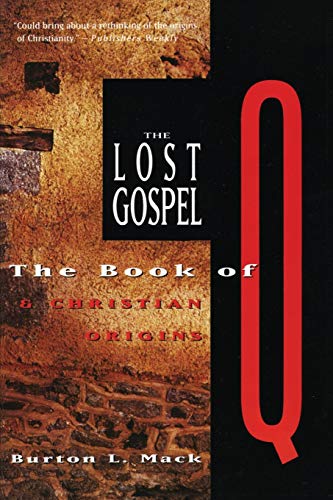
If its premise is accepted by a preponderance of theologians, this debatable study could bring about a rethinking of the origins of Christianity. Mack presents an analysis of the so-called Book of Q , a supposed collection of Jesus's sayings that was compiled by his followers during his lifetime. Certain scholars, deducing the existence of the book, have reconstructed the putative text of this ``lost gospel'' during the last 20 years through a comparison of the gospels of Matthew and Luke, who, it is contended, used Q as a common basis (Q stands for Quelle , German for ``source''). Mack, a professor of New Testament at the School of Theology at Claremont College in Los Angeles, concludes that ``the people of Q''--Jesus's contemporaries--thought of him as a teacher, not as a messiah, and that they did not regard his death as a divine or saving event. Mack offers an earthy, colloquial translation of the Book of Q with its wisdom sayings, exhortations, parables and apocalyptic pronouncements. His portrayal of the early Jesus movement reveals a community based on fictive kinship without regard to class, gender or ethnicity. The discovery of Q , Mack argues, compels us to see the New Testament gospels as imaginative creations rather than historical accounts. $25,000 ad/promo; BOMC and QPB selections. (Apr.) (c) Copyright PWxyz, LLC. All rights reserved
Booklist Review
Those interested in the origins of the New Testament are aware of the Book of Q, an early Christian source from which the gospels of Luke and Matthew take much of their material. But serious discussion of Q, a collection of Jesus' sayings, has taken place mostly in academic circles. There is nothing substandard about Mack's scholarship, but this treatment has the added advantage of being accessible to average readers with an interest in the topic. Mack's thesis is that Q is the best record available for the first 40 years of the various Jesus movements. And unlike the narrative gospels, which have myth and ritual at their center, this set of sayings and instructions possesses a straightforwardness that makes it possible to see Jesus and his original followers in a new light. Besides providing a translation of Q, Mack also explains how it was reconstructed, explores the relationship between Q and other biblical writings, considers who Jesus' first followers might have been, and muses on the implications of the Q document for Christians. A thought-provoking choice for any religion collection. ~--Ilene Cooper