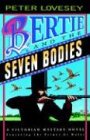
Imagen de portada de Amazon
Imagen de Amazon.com
Imagen de cubierta Syndetics
Portada de Syndetics
Imagen de OpenLibrary

Bertie and the seven bodies Peter Lovesey.

Por: Detalles de publicación: New York Mysterious Press c1990.Descripción: 196 p. 22 cmISBN:
  • 0892963999
Clasificación CDD:
  • 823/.914 20
Clasificación LoC:
  • PR6062.O86 B46 1990
Información de serie: Haga clic para abrir en una nueva ventana
Valoración
    Valoración media: 0.0 (0 votos)
Existencias
Imagen de cubierta Tipo de ítem Biblioteca actual Biblioteca de origen Colección Ubicación en estantería Signatura topográfica Materiales especificados Info Vol URL Copia número Estado Notas Fecha de vencimiento Código de barras Reserva de ítems Prioridad de la cola de reserva de ejemplar Reservas para cursos
Libro Biblioteca de Mayagüez Colección General mb PR6062 .O86 B46 1990b (Navegar estantería(Abre debajo)) Disponible 50000001956142
Libro Biblioteca Encarnación Valdés Colección General bev 823.914 L911b (Navegar estantería(Abre debajo)) Disponible 80000000346133
Total de reservas: 0

Descripciones mejoradas de Syndetics:

The eldest son of Queen Victoria, Bertie will one day be King Edward VII. For the moment, though, his primary responsibility is to enjoy himself, a task at which he excels - bedding society beauties, tormenting his long-suffering wife, and taking his royal bulk off to other people's country estates, there to shoot things, eat enormous meals, and pinch the serving maids. It is at just such an estate that the story unfolds, though this is no ordinary shooting-party, and with a killer afoot, the glittering guest-list is dwindling rapidly. Bertie greets the murders with some delight, as they allow him to exercise his passion for amateur sleuthing (a task at which he doesn't particularly excel). Lovesey wrote Seven Bodies as an homage to Agatha Christie, but he laced his classically structured puzzle with his own sly wit, gleefully poking fun at the pomposities of privilege. Utterly charming ...what a delight! - New York Times A delicious option for fans of Agatha Christie and Anne Perry

Extracto provisto por Syndetics

Chapter 1   Splendid! You have opened my book. You are curious about the mystery of the seven bodies and my part in it. If I am mistaken, forgive me. I bid you good day. Kindly close the book and turn to some memoirs of a less sensational character. I recommend Leaves from the Journal of Our Life in the Highlands , by my dear mother, Her Majesty, Queen Victoria.      If I am correct in my deduction, bravo! Let us plunge together into the plot. It began innocently enough one spring morning in the year 1890.      "So! You have resolved to go back to nature, Alix," I announced with the air of one who has uncovered an intimate secret.      My pretty wife, the Princess of Wales, shot me a startled look. She was seated at the window in her sitting room at Sandringham. "What did you say, Bertie?"      "You are going back to nature. I perceive that you have finally decided to shed your steel appendage."      She frowned. "Is this a riddle?"      "I mean your bustle, of course."      "Bertie!"      "You can't deny it. This afternoon you wrote to your dressmaker informing her that you propose to wear the new narrow skirts in future."      She was openmouthed with amazement.      Not without satisfaction, I said, "If you want to know how I made this discovery, I deduced it."      "Deduced it?"      "I observed what I saw before me and applied the scientific principles of . . . deduction." I paused, to let the word linger in the air for a moment. Then I directed my gaze across the room. "Upon your writing desk is a candle. The wick is blackened, but the candle is not much used. On a bright afternoon such as this, why should anyone light a candle except to melt sealing wax? I deduce that you wrote a letter. How simple when it is explained!"      Alix said, "There is more to explain than that."      "Quite so. On the floor to your left is an open copy of yesterday's Illustrated London News   from which you have removed a page. The torn edge is clearly visible and so are the words ' Opposite: the new straight skirt as designed by Monsieur Worth .' So the chain of reasoning is complete. You saw the picture of the latest fashion from Paris and resolved forthwith to tear it from the magazine and send it to your dressmaker."      She rocked with laughter. "Oh, Bertie!"      "Do my methods amuse you?"      "You couldn't be more mistaken. I haven't the slightest desire to wear straight skirts. They make me look like a beanpole. And I haven't written a single letter all day. I was sewing. At some stage I dropped my thimble. I couldn't see it anywhere on the floor so I lit the candle to look under the writing desk. Some candle grease unfortunately dripped onto the carpet, so I ripped a sheet from the magazine to clean it up before it hardened."      "Alexandra, are you poking fun at me?"      "If you don't believe me, look in the wastepaper basket." I looked, saw that she was right and emitted a bellow of annoyance.      Alix contemplated her fingernails. "Bertie dear, do you think it is wise to persist in this notion that you can be a detective?      The question nettled me, I admit. I responded sharply, "Dammit, one small oversight and I'm branded as a failure. If I'd looked in the wretched wastepaper basket my chain of reasoning would have been different, altogether different. I'm forever being told to find intelligent pursuits and when I do I can't rely on my own wife for encouragement." I turned on my heel and marched out.     Alix knows that my temper  is short and so is its duration. By the next post I received an invitation that altogether restored my humor. A grand battue   at Desborough in October. Desborough--what a prospect! After Sandringham and Holkham, there's no better shooting in the kingdom. Nine hundred acres in Buckinghamshire. Moreover Desborough Hall is one of the great houses of England, with Tudor banqueting hall, ballroom, gun room, chapel and ninety-odd bedrooms.      "I can't resist it," I told Alix over dinner. "I shall accept."      "Who does the invitation come from?" she enquired.      "Lady Amelia Drummond."      She shifted her head to see around the floral arrangement. "An invitation to shoot from a lady?"      "The widow of Freddie Drummond. Haven't you met her?" I heaved a long sigh to signal sympathy for our prospective hostess. "Perhaps you don't recall? She's easily forgotten, poor soul, rather plain in looks, but making superhuman efforts to keep Desborough on the social map. One feels obliged to show support."      "When did Lord Drummond pass away?"      "Last winter, in tragic circumstances. He was gored by a bull."      "How horrid!"      "Yes, he was a frightful mess, they said. He lingered for six weeks, covered in bandages. Then one morning he sat up, uttered something rather vulgar and breathed his last."      "I didn't catch that. What did he mutter?" Sometimes dear Alix trades on her deafness.      "I think it was 'Oh, bother.'"      "I don't call that  vulgar. I've heard far worse from Cocky." Cocky is Alix's pet cockatoo. She gave me a searching look and then took a spoonful of Scotch broth. In a few moments she casually enquired, "About what age would Lady Drummond be, Bertie?"      I hedged. "You could look her up in Debrett. I'm not much of a judge."      "Younger than me?"      "Possibly."      "Under thirty-five?"      "Alix, I haven't the faintest idea. Is it important?"       "Conceivably."     Later that afternoon she cornered  me at my writing desk. From somewhere in the clutter of her rooms she had unearthed a copy of The Tatler with a studio portrait of Lady Amelia, a ravishing dark-haired beauty in a ball gown cut perilously low. "Bertie, I don't know how you could describe her as plain."      I replied somewhat obliquely, "Where do you keep these old magazines? It smells so musty it must be ten years old at least."      "I looked her up in Debrett, as you suggested. She is still only twenty-seven."      I shut the magazine and handed it back to her. "I suppose you're going to try and stop my sport--just because the invitation comes from a young widow of tolerably good looks."      My dear wife gave me an indulgent smile. "Not at all. When have I ever stood in your way? Of course you shall have your shoot. And I shall come too and offer some sisterly sympathy to Lady Drummond."      "You  intend to come?"      She smiled faintly this time. "One feels obliged to show support."      And so the visit was set in motion. Francis Knollys, my private secretary, wrote to advise our hostess of my requirements: a suite comprising bedrooms for each of us, dressing rooms and sitting room. Also accommodation for our retinue of equerries, ladies-in-waiting, footmen, valets, loaders, coachmen, grooms and a member of the Household Police, whose duty it is to guard us from anarchists. Then the guest list had to be approved, a crucial matter as it ultimately turned out. Of sixteen names submitted, I struck out three immediately. If one is planning an agreeable week in the country, one doesn't want to rub shoulders with people who have given offense in the past. Nor, if one wishes to shoot, is one obliged to stand comparison with all  the best guns in the country.      We were left with thirteen names.      "Would you like me to join the party, sir?" Knollys knows my superstitious nature and volunteered at once.      "No," I informed him. "We have more than enough men in this party. We must cross out someone else. Who have we got? Eight gentlemen and five ladies. The balance is fraught with disaster. Who is this reverend fellow, Humphrey Paget? He doesn't sound like a shooting man."      "The family chaplain, sir."      "Ah."      "He buried the late Lord Drummond."      "The best day's work he ever did, from what I remember of Freddie. Better not object to a man of the cloth, I suppose. Who else have we got?"      "Marcus Pelham, Lady Drummond's brother. I presume he's there to perform the duties of host."      "That's as may be, but is he safe?"      "Safe, sir?"      "I wouldn't care to stand with a man who isn't safe."      "I understand he's an expert marksman, sir." Knollys glanced at the list again. "Then there's His Grace the Duke of Bournemouth, who lives on the neighboring estate."      "Dear old Jerry. Good man. Hopeless shot."      "Not safe, sir?"      "Not in the least."      "Shall I strike him out?"      "Better not. The list is pretty undistinguished without him. I'll make sure he's well down the line from me."      "Claude Bullivant. He's a commoner."      "Ah, but he's a card. I like his sense of humor. This is getting damnably difficult."      "There's Colonel C.D. Roberts, V.C."      "A V.C., do you say? That's our man. Blackball him. We can do without a hero turning the ladies' heads, eh, Francis?"      So the number was painlessly reduced to twelve. I had already run through the ladies' names. Two I hadn't previously met, which lent a certain relish to the week in prospect. The summer ran its all-too-familiar  course: Ascot, Epsom, Goodwood, Cowes. I anticipated the shoot in Buckinghamshire as a change from my customary October battue  at Sandringham or Balmoral. And a change is what I got. A never-to-be-forgotten week. Excerpted from Bertie and the Seven Bodies by Peter Lovesey All rights reserved by the original copyright owners. Excerpts are provided for display purposes only and may not be reproduced, reprinted or distributed without the written permission of the publisher.

Reseñas proporcionadas por Syndetics

Publishers Weekly Review

When a killer stalks a dinner-and-gameshooting party on an English country estate, the corpses drop like pheasants. High-living Albert Edward (``Bertie''), Prince of Wales, who made his detective debut in Lovesey's Bertie and the Tinman , is the fumbling sleuth and rakish narrator, loosely modeled on the real-life prince who became King Edward VII. Bertie discovers that the nursery rhyme ``Monday's child is fair of face . . . '' holds the key; each line of the poem points to the next victim. Among the dwindling group of party guests, one of whom is the murderer, are an Amazon explorer, a stuttering poet and a scheming actress. Half the fun of this romp lies in watching Bertie invent, then discard, one theory after another; for a while his suspicions even fall on the widowed hostess he wants to bed. The other half comes from Lovesey's light mockery of Victorian manners and sexual mores in a bright, entertaining tale whose bantering tone conceals artful plotting. (Jan.) (c) Copyright PWxyz, LLC. All rights reserved

Notas de autor provistas por Syndetics

Peter Lovesey was born in Whitton, Middlesex in 1936. He was a teacher before becoming a full-time writer.

Lovesey's first mystery novel was Wobble to Death which introduced Victorian detective Sergeant Cribb. He later introduced Peter Diamond and Bertie in his novels to follow. He also writes under the pseudonym Peter Lear. His works have been translated into 22 languages and several of them were adapted for television and film.

Lovesey's works have earned him numerous awards. He is a three time winner of the CWA Silver Dagger. He also won the CWA Gold Dagger in 1982 and the 2000 CWA Cartier Diamond Dagger Award in recognition of his career in mystery writing. He is the recipient of the Anthony Award, McAvity Award, Ellery Queen Readers' Award and the Mystery Writers of America Golden Mysteries Short Story Prize. Internationally, he has won the Grand Prix de littérature Policiére and the Prix du Roman d'Adventures.

(Bowker Author Biography)

Compartir
logopucpr-y-vive

Contáctanos

¡Queremos saber de ti!

Tel. 787.841.2000 Ext. 1801

bibliotecavaldes@pucpr.edu

⁣Búscanos en las redes

© 2026 Desarrollado por Ignite Online • All Rights Reserved • Powered by Koha.