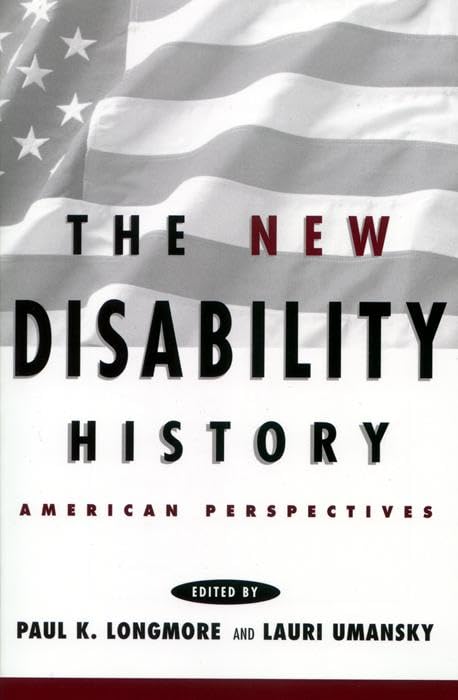

The new disability history American perspectives edited by Paul K. Longmore and Lauri Umansky.
Series The history of disability seriesDetalles de publicación: New York New York University Press c2001.Descripción: vi, 416 p. ill. 24 cmISBN:- 0814785638 (alk. paper)
- 0814785646 (pbk.)
- 305.9/0816 21
- HV1553 .N48 2001
- 71.70
| Imagen de cubierta | Tipo de ítem | Biblioteca actual | Biblioteca de origen | Colección | Ubicación en estantería | Signatura topográfica | Materiales especificados | Info Vol | URL | Copia número | Estado | Notas | Fecha de vencimiento | Código de barras | Reserva de ítems | Prioridad de la cola de reserva de ejemplar | Reservas para cursos | |
|---|---|---|---|---|---|---|---|---|---|---|---|---|---|---|---|---|---|---|
| Libro | Biblioteca Encarnación Valdés Colección General bev | 305.908 N5321 2001 (Navegar estantería(Abre debajo)) | Disponible | 80000002282567 |
Descripciones mejoradas de Syndetics:
A collected volume highlighting disability's hidden history in American society
Disability has always been a preoccupation of American society and culture. From antebellum debates about qualification for citizenship to current controversies over access and reasonable accommodations, disability has been present, in penumbra if not in print, on virtually every page of American history. Yet historians have only recently begun the deep excavation necessary to retrieve lives shrouded in religious, then medical, and always deep-seated cultural, misunderstanding.
This volume opens up disability's hidden history. In these pages, a North Carolina Youth finds his identity as a deaf Southerner challenged in Civil War-era New York. Deaf community leaders ardently defend sign language in early 20th century America. The mythic Helen Keller and the long-forgotten American Blind People's higher Education and General Improvement Association each struggle to shape public and private roles for blind Americans. White and black disabled World War I and II veterans contest public policies and cultural values to claim their citizenship rights.
Neurasthenic Alice James and injured turn-of-the-century railroadmen grapple with the interplay of disability and gender. Progressive-era rehabilitationists fashion programs to make crippled children economically productive and socially valid, and two Depression-era fathers murder their sons as public opinion blames the boys' mothers for having cherished the lads' lives. These and many other figures lead readers through hospital-schools, courtrooms, advocacy journals, and beyond to discover disability's past.
Coupling empirical evidence with the interdisciplinary tools and insights of disability studies, the book explores the complex meanings of disability as identity and cultural signifier in American history.
Includes bibliographical references and index.
Introduction : Disability history : from the margins to the mainstream / Paul K. Longmore and Lauri Umansky -- Disability and the justification of inequality in American history / Douglas C. Baynton -- "Speech has an extraordinary humanizing power" : Horace Mann and the problem of nineteenth-century American deaf education / R.A.R. Edwards -- "This unnatural and fratricidal strife" : a family's negotiation of the Civil War, deafness, and independence / Hannah Joyner -- "Trying to idle" : work and disability in The diary of Alice James / Natalie A. Dykstra -- A pupil and a patient : hospital-schools in progressive America / Brad Byrom -- Cold charity : manhood, brotherhood, and the transformation of disability, 1870-1900 / John Williams-Searle -- The outlook of The problem and the problem with the Outlook : two advocacy journals reinvent blind people in turn-of-the-century America / Catherine J. Kudlick -- Reading between the signs : defending deaf culture in early twentieth-century America / Susan Burch -- Medicine, bureaucracy, and social welfare : the politics of disability compensation for American veterans of World War I / K. Walter Hickel -- Helen Keller and the politics of civic fitness / Kim Nielsen -- Martyred mothers and merciful fathers : exploring disability and motherhood in the lives of Jerome Greenfield and Raymond Repouille / Janice A. Brockley -- Blind and enlightened : the contested origins of the egalitarian politics of the Blinded Veterans Association / David A. Gerber -- Seeing the disabled : visual rhetorics of disability in popular photography / Rosemarie Garland Thomson -- American disability policy in the twentieth century / Richard K. Scotch.
Tabla de contenidos provista por Syndetics
- Introduction: Disability History: From the Margins to the Mainstream(p. 1)
- Part I Uses and Contests
- 1 Disability and the Justification of Inequality in American History(p. 33)
- 2 "Speech Has an Extraordinary Humanizing Power": Horace Mann and the Problem of Nineteenth-Century American Deaf Education(p. 58)
- 3 "This Unnatural and Fratricidal Strife": A Family's Negotiation of the Civil War, Deafness, and Independence(p. 83)
- 4 "Trying to Idle": Work and Disability in The Diary of Alice James(p. 107)
- Part II Redefinitions and Resistance
- 5 A Pupil and a Patient: Hospital-Schools in Progressive America(p. 133)
- 6 Cold Charity: Manhood, Brotherhood, and the Transformation of Disability, 1870-1900(p. 157)
- 7 The Outlook of The Problem and the Problem with the Outlook: Two Advocacy Journals Reinvent Blind People in Turn-of-the-Century America(p. 187)
- 8 Reading between the Signs: Defending Deaf Culture in Early Twentieth-Century America(p. 214)
- 9 Medicine, Bureaucracy, and Social Welfare: The Politics of Disability Compensation for American Veterans of World War I(p. 236)
- 10 Helen Keller and the Politics of Civic Fitness(p. 268)
- Part III Images and Identities
- 11 Martyred Mothers and Merciful Fathers: Exploring Disability and Motherhood in the Lives of Jerome Greenfield and Raymond Repouille(p. 293)
- 12 Blind and Enlightened: The Contested Origins of the Egalitarian Politics of the Blinded Veterans Association(p. 313)
- 13 Seeing the Disabled: Visual Rhetorics of Disability in Popular Photography(p. 335)
- 14 American Disability Policy in the Twentieth Century(p. 375)
- Contributors(p. 393)
- Index(p. 397)