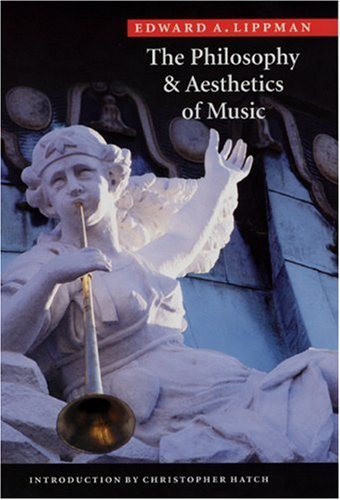

The philosophy & aesthetics of music / Edward A. Lippman ; introduction by Christopher Hatch.
Idioma: Inglés Detalles de publicación: Lincoln : University of Nebraska Press, c1999.Descripción: xi, 249 p. ; ill. 25 cmISBN:- 0803229127 (cloth : alk. paper)
- 9780803229129 (cloth : alk. paper)
- 0803279841 (pbk. : alk. paper)
- 9780803279841 (pbk. : alk. paper)
- Philosophy and aesthetics of music
- 781.17 L766p 21
- ML3845 .L567 1999
| Imagen de cubierta | Tipo de ítem | Biblioteca actual | Biblioteca de origen | Colección | Ubicación en estantería | Signatura topográfica | Materiales especificados | Info Vol | URL | Copia número | Estado | Notas | Fecha de vencimiento | Código de barras | Reserva de ítems | Prioridad de la cola de reserva de ejemplar | Reservas para cursos | |
|---|---|---|---|---|---|---|---|---|---|---|---|---|---|---|---|---|---|---|
| Libro | Biblioteca Encarnación Valdés Colección General bev | 781.17 L766p (Navegar estantería(Abre debajo)) | Disponible | 80000002337593 |
Descripciones mejoradas de Syndetics:
Edward A. Lippman's writings on musical aesthetics comprise a wide variety of areas and employ both systematic and historical approaches, reflecting throughout his unrivaled knowledge of the philosophical literature on music and his deep understanding of the musical repertory. These essays span a broad range of subjects, from the ancients' sense of what music encompasses to the experience of rhythm in Anton Webern's work. Lippman surveys the physical and physiological factors that condition musical perception, and he explores the effect of sung text in vocal music. In the more purely philosophical realm, he argues persuasively that music speaks in its own terms, not in any formalistic sense but through the symbolic meanings it conveys. The historically focused essays include investigations of the aesthetic thinking of Wagner and Schumann, an endeavor that leads Lippman to probe the sources and drives behind musical creativity. Elsewhere he explores the development of particular musical styles. The Philosophy and Aesthetics of Music draws upon both philosophy and musicology in demonstrating how the interpretation of music extends far beyond the scope of conventional theory and analysis.
Includes bibliographical references and index.
Tabla de contenidos provista por Syndetics
- Introduction(p. vii)
- Part 1 Philosophy and Aesthetics(p. 1)
- 1 Symbolism in Music(p. 3)
- Notes(p. 25)
- 2 Spatial Perception and Physical Location as Factors in Music(p. 26)
- Notes(p. 38)
- 3 Progressive Temporality in Music(p. 40)
- 4 Reflections on the Aesthetics of Strophic Song(p. 65)
- Notes(p. 79)
- Part 2 Historical and Critical Studies(p. 81)
- 5 The Place of Music in the System of Liberal Arts(p. 83)
- Notes(p. 97)
- 6 The Place of Aesthetics in Theoretical Treatises on Music(p. 99)
- Notes(p. 113)
- 7 An Interpretation of Bach's "Ich Folge Dir Gleichfalls"(p. 115)
- 8 The Tonal Ideal of Romanticism(p. 123)
- Notes(p. 134)
- 9 Theory and Practice in Schumann's Aesthetics(p. 136)
- Notes(p. 173)
- 10 The Aesthetic Theories of Richard Wagner(p. 179)
- 11 The Formation of Wagner's Style(p. 192)
- Notes(p. 208)
- 12 Wagner's Conception of the Dream(p. 210)
- Notes(p. 237)
- Index(p. 239)