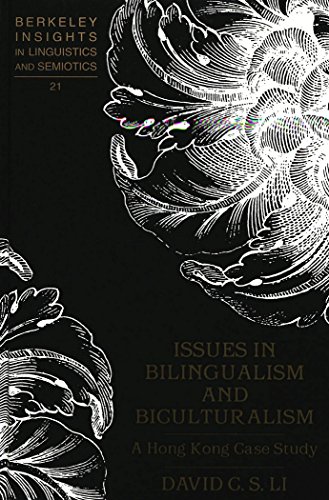

Issues in bilingualism and biculturalism a Hong Kong case study David C.S. Li.
Idioma: Series Berkeley insights in linguistics and semiotics ; vol. 21Detalles de publicación: New York P. Lang c1996.Descripción: xviii, 205 p. ill. 24 cmISBN:- 0820430366 (alk. paper)
- 495.1/04221/095125 20
- P115.5.H85 L5 1996
| Imagen de cubierta | Tipo de ítem | Biblioteca actual | Biblioteca de origen | Colección | Ubicación en estantería | Signatura topográfica | Materiales especificados | Info Vol | URL | Copia número | Estado | Notas | Fecha de vencimiento | Código de barras | Reserva de ítems | Prioridad de la cola de reserva de ejemplar | Reservas para cursos | |
|---|---|---|---|---|---|---|---|---|---|---|---|---|---|---|---|---|---|---|
| Libro | Biblioteca Mons. Iñaki Mallona (Arecibo) Colección General ab | 495.104221 L693i (Navegar estantería(Abre debajo)) | Disponible | 60000002009816 |
Descripciones mejoradas de Syndetics:
Issues in Bilingualism and Biculturalism describes the nature and extent of code-mixing in Hong Kong in the 1990s. It is mainly based on written data obtained from the local Chinese press collected systematically over a period of two years since late 1992. While previous studies on code-mixing between Cantonese and English in Hong Kong tend to emphasize sociolinguistic motivations, this book presents evidence that much of the code-mixing behaviour, be it in print or in speech, may be traced back to linguistic motivations at work resulting from sustained contact between Cantonese, modern standard Chinese and increasingly, English. This study further argues that, largely as a correlate of biculturalism, code-mixing - which is indicative of linguistic convergence in the mind of the average Hong Kong bilingual - is simply unstoppable, given that the norms prescribed for the written standard varieties of Chinese and English deviate considerably from those of the vernacular Cantonese.
Includes bibliographical references (p. [171]-184) and index.