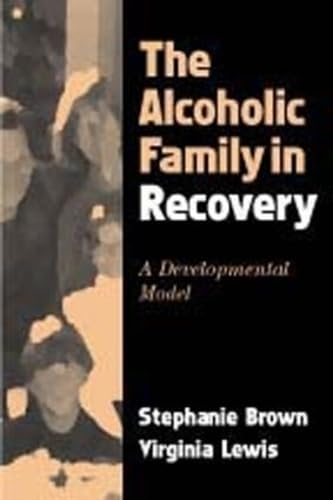

The alcoholic family in recovery a developmental model Stephanie Brown, Virginia Lewis.
Detalles de publicación: New York Guilford Press c1999.Descripción: xviii, 318 p. 24 cmISBN:- 1572304022 (hc.)
- 362.2923 B8771a 21
- HV5132 .B748 1999
- 2000 L-560
- WM 274
| Imagen de cubierta | Tipo de ítem | Biblioteca actual | Biblioteca de origen | Colección | Ubicación en estantería | Signatura topográfica | Materiales especificados | Info Vol | URL | Copia número | Estado | Notas | Fecha de vencimiento | Código de barras | Reserva de ítems | Prioridad de la cola de reserva de ejemplar | Reservas para cursos | |
|---|---|---|---|---|---|---|---|---|---|---|---|---|---|---|---|---|---|---|
| Libro | Biblioteca Mons. Iñaki Mallona (Arecibo) Colección General ab | 362.2923 B8771a (Navegar estantería(Abre debajo)) | Disponible | 60000002995535 |
Descripciones mejoradas de Syndetics:
Most treatments for alcoholism have focused on abstinence as their final goal and emphasize brief interventions with the addicted individual. But family relationships change dramatically when the alcoholic stops drinking--in fact, stress, turmoil, and uncertainty are the norm. This volume details how to help families regroup after abstinence, ride out periods of emotional upheaval, and find their way to establishing a more stable, yet flexible, family system. Using a compelling case-study format to illustrate the process of change, the book presents the moving personal experiences of families at different stages of the recovery process. Expanding the therapist's role to include psychoeducation and supportive counseling, the authors provide pointers for assessment at key stages of recovery and guide clinicians through bringing about lasting change.
Includes bibliographical references (p. 303-308) and index.
pt. 1. Introduction -- [ch]. 1. What happens when the drinking stops? -- [ch]. 2. Developmental process of recovery -- pt. 2. Stories of families in recovery -- [ch]. 3. Transition and early recovery: The Corwins and the Turners -- [ch]. 4. From early recovery to ongoing recovery: the Hendersons and the Warners -- pt. 3. Framework for assessment -- [ch]. 5. Assessing family functioning: domains of experience -- [ch]. 6. Stages of recovery: drinking, transition, early recovery, and ongoing recovery -- [ch]. 7. Factors that influence recovery -- pt. 4. Developmental model of family recovery -- [ch]. 8. Drinking stage -- [ch]. 9. Transition for couples and families -- [ch]. 10. Early recovery for couples and families -- dg [ch]. 11. Ongoing recovery for couples and families.
Tabla de contenidos provista por Syndetics
- Contents
- I Introduction
- 1 What Happens When the Drinking Stops?
- 2 The Developmental Process of Recovery
- II Stories of Families in Recovery
- 3 Transition and Early Recovery: The Corwins and the Turners
- 4 From Early Recovery to Ongoing Recovery: The Hendersons and the Warners
- III A Framework for Assessment
- 5 Assessing Family Functioning: Domains of Experience
- 6 Stages of Recovery: Drinking, Transition, Early Recovery, and Ongoing Recovery
- 7 Factors That Influence Recovery
- IV A Developmental Model of Family Recovery
- 8 The Drinking Stage
- 9 Transition for Couples and Families
- 10 Early Recovery for Couples and Families
- 11 Ongoing Recovery for Couples and Families
- Epilogue
Reseñas proporcionadas por Syndetics
CHOICE Review
Brown and Lewis, both competent clinical researchers, offer a well-written and understandable work. It presents a framework for describing, comprehending, and treating families with an alcoholic member. The material has a limited focus on the two-parent nuclear family but does not deny the existence of alternative family constellations. The philosophy of diagnosis, process, and treatment is strongly biased toward a 12-step approach, since the most successful result for those seeking treatment has come from AA and similar programs. However, the authors fail to recognize that most "alcoholics" who abstain do so without benefit of any formal program. This is a very useful book for clinicians seeking to structure family work and those searching for a helpful practice foundation. Many therapists will find the model of family recovery to be particularly valuable. The bibliography is excellent and the material soundly referenced. Upper-division undergraduates and above. F. J. Peirce emeritus, University of OklahomaNotas de autor provistas por Syndetics
Stephanie Brown, PhD, is a clinician, teacher, researcher, consultant, and author in the field of alcoholism. She founded the Alcohol Clinic at Stanford University Medical Center in 1977 and served as its director for 8 years. A Research Associate at the Mental Research Institute in Palo Alto, California, where she is Co-Director of the Family Recovery Project, Dr. Brown also maintains a private practice and directs the Addictions Institute in Menlo Park, California.Virginia Lewis, PhD, a licensed psychologist, educational psychologist, and marriage, family, and child counselor, is Co-Director of the Family Recovery Project and Senior Research Fellow at the Mental Research Institute. In addition to her full-time private practice, she gives lectures and workshops on the Family Recovery Project and is coordinating and analyzing test data for journal publications. She has coauthored and been awarded several research grants with associates at the Mental Research Institute over the past 20 years, and has lent her skills to a number of research projects.