Reseñas proporcionadas por Syndetics
Library Journal Review
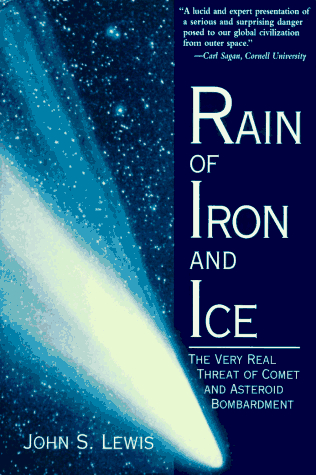
News flash: After 200 years of touting the uniformity principle, scientists have discovered catastrophism. Of course, there has always been evidence of destruction coming from the heavens: The Book of Revelations, Charles Fort, medieval astrologers, Christian Millenialists, and Immanuel Velikovsky have all insisted upon it. But now, after centuries of debunking such theories, science proclaims its official dictum: cataclysm is possible, indeed probable. Rain of Iron and Ice traces the history of religious and scientific beliefs about meteorite falls, cometary eruptions, and asteroid near-misses and reviews eschatology (the literature of such catastrophes). Lewis, a noted planetary scientist and impact crater expert and author of Space Resources (LJ, 9/15/87), follows the fascinating study of bombardment on the Earth, Moon, Mercury, Venus, and Mars. He outlines the results of computer simulations and the implications for the future of life on Earth, offering suggestions as to "what we can do about it." Lewis does a fairly thorough job of reviling experts for scoffing at superstition and ignoring the vast quantities of eyewitness reports, but he stays within the bounds of establishment science (there are no footnotes to Velikovsky). Following Duncan Steel's more lay oriented Rogue Asteroids and Doomsday Comets (LJ 5/1/95), this scholarly history is suitable for academic libraries and informed science readers in public libraries.Valerie Vaughan, Hatfield P.L., Mass. (c) Copyright 2010. Library Journals LLC, a wholly owned subsidiary of Media Source, Inc. No redistribution permitted.
Publishers Weekly Review
This volume informally yet comprehensively surveys meteorites (which reach the surface of the earth) and meteors (which don't)-their origins, types, consequences and prospects for influencing future events. Author Lewis, codirector for science at a NASA/University of Arizona research center, is passionate and upbeat on the topic. Addressing the general reader, he recounts apt anecdotes in historical context while outlining a commonsensical framework for understanding the scientific scope and nature of the matter that comes to earth from space. Early chapters describe legendary meteorite falls. Subsequent chapters consider, for example, new knowledge from studies of nuclear explosions, cratering on Mars and Mercury, atmospheric effects on Venus and biological signatures of impacts in earth fossil records. Very interesting are results of computer simulations based on the accumulated discoveries, which project what we can expect from future encounters. Overall, Lewis presents an impressively readable and informative digest of current knowledge on the subject. (Feb.) (c) Copyright PWxyz, LLC. All rights reserved
CHOICE Review
Only during the second half of this century did it become clear how vulnerable Earth is to damage from collisions with comets and asteroids, especially in the aftermath of the insight that it was most probably the collision of the earth with an asteroid that triggered the extinction of the dinosaurs. Lewis, an expert in these matters, has convincingly analyzed this danger from data (much of it concerning the cratering not only of the Earth but also of other planets and asteroids) gathered from spacecraft as well as on the ground and, in doing so, informs the reader in some detail about small solar-system bodies in general. Unfortunately, the book shows signs of having been thrown together quickly. The text is on occasion conspicuously repetitive, and the author takes considerable liberties with historical facts and the spelling of non-English names. The book also bristles with many conversationally presented hypotheses; it will be interesting to see how many of these will have remained unfalsified after another two or three decades. General; undergraduate. H. K. Eichhorn University of Florida