Descripciones mejoradas de Syndetics:
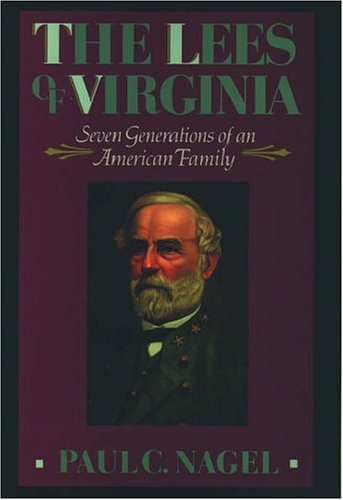
Whether opposing Nathaniel Bacon and his Rebels in 1676, or condemning English colonial policy in 1776, or turning back the Union Army at the Seven Days' battles of 1862, the descendants of Richard and Anne Lee have occupied a preeminent place in American history. They were among the first families of Virginia. Two were signers of the Declaration of Independence and several others distinguished themselves during the Revolutionary War. And one, Robert E. Lee, remains widely admired for his lofty character and military success. In The Lees of Virginia, Paul Nagel chronicles seven generations of Lees, from the family founder Richard to General Robert E. Lee, covering over two hundred years of American history. We meet Thomas Lee, who dreamed of America as a continental empire. His daughter was Hannah Lee Corbin, a non-conformist in lifestyle and religion, while his son, Richard Henry Lee, was a tempestuous figure who wore black silk over a disfigured hand when he made the motion in Congress for Independence. Another of Thomas' sons, Arthur Lee, created a political storm by his accusations against Benjamin Franklin. Arthur's cousin was Light-Horse Harry Lee, a controversial cavalry officer in the Revolutionary War, whose wild real estate speculation led to imprisonment for debt and finally self-exile in the Caribbean. One of Harry's sons, Henry Lee, further disgraced the family by seducing his sister-in-law and frittering away Stratford, the Lees' ancestral home. Another son, however, became the family's redeeming figure--Robert E. Lee, a brilliant tactician whose ruling motto was self-denial and who saw God's hand in all things. In these and numerous other portraits, Nagel discloses how, from 1640 to 1870, a family spirit united the Lees, making them a force in Virginian and American affairs. Paul Nagel is a leading chronicler of families prominent in our history. His Descent from Glory, a masterful narrative account of four generations of Adamses, was a Book-of-the-Month Club main selection and a brilliant critical and popular success. The New Yorker hailed it as "intelligent, tactful, and spiritually generous," and Pulitzer Prize-winning historian W.A. Swanberg, in the Chicago Sun-Times, called it "a magnificent embarrassment of biographical riches." Now, in The Lees of Virginia, Nagel brings his skills to bear on another major American family, taking readers inside the great estates of the Old Dominion and the turbulent lives of the Lee men and women.
Includes bibliographical references (p. 307-317) and index.
Reseñas proporcionadas por Syndetics
Library Journal Review
The Lee family, descended from Richard and Anne Lee, were among Virginia's first families. Two signed the Declaration of Independence, others distinguished themselves during the Revolutionary War, and then there was Gen. Robert E. Lee. While the author gives the general star treatment, he does not gloss over the founders, the ways wealth was accumulated, or the lesser Lees, who feuded with Franklin and Jefferson and were involved in land speculation, adultery, and drug addiction, the Lees who lost their estates or rented out slaves to survive. This recorded version could use a family tree printout for reference since narrator Edward Lewis seems to race through the volume at times. A genealogical history for specialized libraries.--James L. Dudley, Westhampton Beach, NY (c) Copyright 2010. Library Journals LLC, a wholly owned subsidiary of Media Source, Inc. No redistribution permitted.
Publishers Weekly Review
Historian Nagel, chronicler of the presidential Adams family ( Descent from Glory ), here presents another splendidly written, poignant, well-researched portrait of a notable clan through approximately 230 years, starting in 1640 with the arrival in Virginia of Richard Lee from Shropshire, England. We're made aware that the considerable contributions of the Lee family to the public, economic, military and intellectual life of the nation have been overshadowed by its most famous figure, Confederate general Robert E. Lee. From among the myriad (and occasionally confusing in their sheer number) members of this close-knit but usually politically feuding clan, several stand out, along with the general--Richard Henry, whose original motion for independence was incorporated by Jefferson into the Declaration of Independence, and headstrong, self-destructive cavalry leader ``Light-Horse Harry.'' If, as Nagel notes, the Lees, like the Adamses, were often temperamentally estranged from their times, there was a marked difference: unlike the coolly detached Adamses, the Lees were passionate for involvement. (Sept. ) (c) Copyright PWxyz, LLC. All rights reserved
CHOICE Review
In The Lees of Virginia (1935), Burton J. Hendrick wrote a sound history of the public activities of the foremost Lees. In Stratford Hall: The Great House of the Lees (1936), Ethel Ames combined a detailed account of the house with a lengthy history of the family. Casenove Lee, in the Lee Chronicle (1957), wrote biographical sketches of the more notable Lees. In this new work, Nagle, formerly director of the Virginia Historical Society, shows little interest in the family's public experiences, but much interest in their relationships with each other. His main sources are letters of the Lees. He devotes his last four chapters to General Robert E. Lee, but gives a total of about three pages to Lee's military exploits. Characteristically it is Lee as son, brother, husband, father, and cousin that interests the author. By 1870 (the year of Robert E. Lee's death) there were probably 300 descendants in the US of Richard Lee and his wife Anne Constable, who first came to America c. 1640. About 40 of these descendants appear in Nagel's book, some chosen for their prominence in public life, others because of the availability of family letters and documents. Although the book has hundreds of quotations, there are no footnotes. The author does provide a sound essay on his sources. Undergraduate and general readers. -J. Z. Rabun, Emory University
Booklist Review
Genealogical research--the investigation into a family pedigree--is often flawed by poor documentation, unprofessional research methods, and a lack of attention to detail. Nagel's study of the family of Robert E. Lee is an exception. Here is a well-researched, readable treatise that traces the history of the Lee family through the male line from Richard Lee, its early English forebear in Virginia in the early 1600s, through the 1700s to the end of the Civil War. If Nagel seems to focus his study on the more well-known figures of each generation, he does at least provide information on the major connections of this prominent American family, along with some historical background on the times in which the Lees lived. It is clear that the author has made considerable efforts to consult major primary sources necessary for effective research of this sort. Recommended for history buffs and anyone interested in methods of genealogical research. Includes a genealogical chart, portraits of some family members, acknowledgments, and sources. To be indexed. --Jane Jurgens