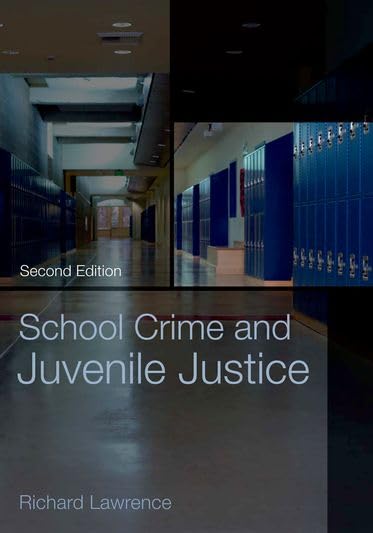

School crime and juvenile justice Richard Lawrence.
Detalles de publicación: New York Oxford University Press 2007.Edición: 2nd edDescripción: xiv, 338 p. 24 cmISBN:- 0195172906 (alk. paper)
- 371.58 L4191s2 22
- LB3013.3 .L38 2006
| Imagen de cubierta | Tipo de ítem | Biblioteca actual | Biblioteca de origen | Colección | Ubicación en estantería | Signatura topográfica | Materiales especificados | Info Vol | URL | Copia número | Estado | Notas | Fecha de vencimiento | Código de barras | Reserva de ítems | Prioridad de la cola de reserva de ejemplar | Reservas para cursos | |
|---|---|---|---|---|---|---|---|---|---|---|---|---|---|---|---|---|---|---|
| Libro | Biblioteca Encarnación Valdés Colección General bev | 371.58 L4191s2 (Navegar estantería(Abre debajo)) | Disponible | 80000002297078 |
Descripciones mejoradas de Syndetics:
School Crime and Juvenile Justice, Second Edition, examines the nature, extent, and causes of school crime and disruptive behavior, offering a comprehensive overview of this significant and growing problem. Drawing on numerous sources and on studies conducted over the past ten years, the second edition reviews the most up-to-date theories on the relationship between school crime and crime in the community, the role of parents and peers, and schools' organization and policies. Lawrence discusses current research findings, laws and school policies, prevention strategies, and alternative schools and special education programs for at-risk and delinquent students. Extensively revised and updated, this edition includes two new chapters: Chapter 6 examines the school environment and how school size, structure, and related factors affect school crime and safety, while Chapter 7 discusses recent research on identifying which students may be at risk of committing school violence. Chapters on the causes of juvenile delinquency and the role of police, courts, and corrections in the administration of juvenile justice have been expanded and updated to reflect the latest available research and resources. Ideal for criminal justice courses and an indispensable resource for scholars and school administrators, School Crime and Juvenile Justice, Second Edition, takes a closer look at the problem of crime and violence in and around schools. It offers a clear understanding of how people can work together to create safer schools and how educators and juvenile justice officials can develop cooperative delinquency prevention programs.
Includes bibliographical references (p. 302-330) and index.
Juvenile crime in society and in schools -- Justice for juveniles -- Explaining delinquency and school crime -- Family, peers, gangs, and delinquency -- Dropout and delinquency -- School environment, crime, and school safety -- Explaining and responding to school violence -- School law and students' rights -- The police and juvenile crime -- The juvenile court -- Juvenile corrections -- School-based programs for delinquency prevention.
Tabla de contenidos provista por Syndetics
- Preface(p. xi)
- Acknowledgments(p. xiii)
- 1 Juvenile Crime in Society and in Schools(p. 1)
- Public Views of Juvenile Crime(p. 2)
- Some Historical Perspective(p. 3)
- Measures of Crime(p. 3)
- Police Measures of Juvenile Crime(p. 4)
- Juvenile Court Cases(p. 6)
- Self-Report Measures(p. 7)
- Victimization Surveys(p. 8)
- Measuring School Crime(p. 8)
- Measures of School Crime and Safety(p. 11)
- Victimization Reports(p. 12)
- The Effects of School Crime and Violence(p. 23)
- International Measures of School Crime and Violence(p. 24)
- Summary(p. 26)
- 2 Justice for Juveniles(p. 28)
- Historical Overview of Juvenile Justice(p. 29)
- Juvenile Justice in America(p. 29)
- The "Child-Saving" Movement(p. 31)
- The First Juvenile Court(p. 31)
- Comparison of Juvenile and Criminal Court(p. 33)
- Legal and Procedural Distinctions: Juvenile Versus Criminal Justice(p. 33)
- Challenges and Changes in Juvenile Justice(p. 34)
- U.S. Supreme Court Decisions(p. 35)
- Federal and State Legislative Changes(p. 37)
- Current Juvenile Justice Trends and Reforms(p. 39)
- Summary(p. 40)
- 3 Explaining Delinquency and School Crime(p. 42)
- Why Study Theories of Crime and Delinquency?(p. 42)
- Types of Crime Theories(p. 43)
- Individual Explanations for Delinquency(p. 45)
- Social Structure Theory(p. 51)
- Social Process Explanations(p. 55)
- Developmental and Life-Course Theories(p. 58)
- General and Integrated Theories(p. 58)
- Social Reaction Theories: Labeling and Conflict(p. 59)
- Female Delinquency(p. 64)
- Applying Theories to School Crime and Justice(p. 67)
- Summary(p. 68)
- 4 Family, Peers, Gangs, and Delinquency(p. 69)
- The Family(p. 69)
- Changes in Family and Parental Roles(p. 70)
- The Family and Delinquency(p. 71)
- Do Parents Cause Delinquency?(p. 74)
- Child Abuse and Neglect(p. 76)
- Parents, School Problems, and Delinquency(p. 79)
- Peer Relationships and Delinquency(p. 82)
- Gangs and Delinquency(p. 86)
- Drugs and Delinquency(p. 91)
- Summary(p. 93)
- 5 Dropout and Delinquency(p. 94)
- Perspectives on Truancy and Dropout(p. 95)
- Defining and Measuring Dropout(p. 97)
- The Extent of Absenteeism and Dropout(p. 97)
- Factors Associated with Dropping Out(p. 100)
- Consequences of Dropping Out(p. 103)
- Truancy, Dropout, and Delinquency(p. 104)
- Policy Implications of Delinquency and Dropout(p. 107)
- Truancy and Dropout-Prevention Programs(p. 113)
- Summary(p. 119)
- 6 School Environment, Crime, and School Safety(p. 120)
- School Crime: Community Problem or School Problem?(p. 121)
- The Challenges Faced by Schools(p. 124)
- School Tracking and Delinquency(p. 128)
- School Funding and Educational Inequality(p. 128)
- School Reform and At-Risk Students(p. 131)
- School Programs and Teaching Strategies(p. 133)
- The Role of Parents in School Achievement(p. 134)
- Do Schools Cause Failure-and Delinquency?(p. 136)
- School Climate and Disorder(p. 138)
- Policy Implications for School Crime Prevention(p. 146)
- Summary(p. 146)
- 7 Explaining and Responding to School Violence(p. 147)
- Explaining and Predicting School Violence(p. 148)
- Identifying Youth at Risk of School Violence(p. 149)
- Criminal Profiling(p. 150)
- Warning Signs(p. 153)
- Threat Assessment(p. 155)
- The Reliability and Validity of Profiles and Warning Signs(p. 158)
- A Theory of School Shootings(p. 160)
- Preventing School Violence(p. 161)
- Summary(p. 163)
- 8 School Law and Students' Rights(p. 165)
- Students' Rights in School(p. 166)
- School Records and Privacy(p. 170)
- Freedom of Speech and Expression(p. 172)
- Constitutional Due Process(p. 173)
- Suspension and Expulsion(p. 174)
- Corporal Punishment(p. 179)
- Search and Seizure(p. 186)
- Rulings on Types of School Searches(p. 188)
- The Exclusionary Rule and School Searches(p. 198)
- Court Decisions on the Exclusionary Rule in Schools(p. 199)
- Safe Schools: Required by Law?(p. 200)
- Summary(p. 203)
- 9 The Police and Juvenile Crime(p. 204)
- Police Roles and Responsibilities(p. 204)
- Police Officers in Schools(p. 207)
- Police and Juvenile Offenders(p. 210)
- Police Decisions and Use of Discretion(p. 211)
- Police Diversion and Status Offenders(p. 214)
- Alternatives to Police Arrest and Custody(p. 215)
- Police and Juveniles' Legal Rights(p. 216)
- Are SROs School Officials or Police Officials?(p. 218)
- Fingerprinting, Photographing, and Records(p. 220)
- Summary(p. 221)
- 10 The Juvenile Court(p. 222)
- History and Development of the Juvenile Court(p. 222)
- Juvenile Court Procedures(p. 223)
- Juvenile Transfers to Adult Court(p. 227)
- Are Juveniles Different from Adults?(p. 228)
- Do Juvenile Transfers Make a Difference?(p. 230)
- "Blended Sentencing": An Alternative to Transfers(p. 232)
- Juvenile Records(p. 233)
- The End of the "Ultimate Punishment" for Juveniles(p. 234)
- Juvenile Court Trends and Reforms(p. 235)
- Summary(p. 239)
- 11 Juvenile Corrections(p. 240)
- Residential Programs and Institutional Corrections(p. 240)
- History and Development of Juvenile Corrections(p. 241)
- Detention Centers(p. 242)
- Correctional Institutions for Juveniles(p. 243)
- Other Community Programs(p. 245)
- Boot Camps(p. 245)
- Wilderness Camps(p. 246)
- Disproportionate Minority Confinement(p. 247)
- From Deinstitutionalization to "Get-Tough" Policies(p. 250)
- Juvenile Probation and Community Corrections(p. 252)
- Intermediate Sanctions in Juvenile Corrections(p. 259)
- Reexamining Community Corrections Models(p. 261)
- Effectiveness of Juvenile Corrections(p. 265)
- Limitations of Juvenile Corrections for Delinquency Prevention(p. 267)
- Juvenile Corrections and Schools(p. 268)
- Summary(p. 271)
- 12 School-Based Programs for Delinquency Prevention(p. 272)
- Crime Control Versus Crime Prevention(p. 272)
- Defining Crime Prevention(p. 273)
- Theoretical Bases for School-Based Delinquency Prevention(p. 274)
- Some Directions for School Crime Prevention(p. 275)
- Federal Government Role in Delinquency Prevention(p. 290)
- School-Based Prevention: Some Model Programs(p. 291)
- Recommendations for Educators, Justice Officials, and Policymakers(p. 299)
- Summary(p. 301)
- References(p. 302)
- Author Index(p. 331)
- Subject Index(p. 336)