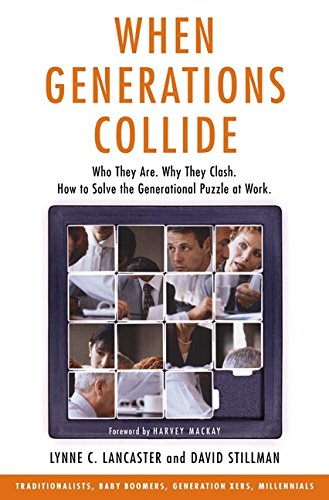
Imagen de Amazon.com

Portada de Syndetics
Imagen de OpenLibrary
When generations collide who they are, why they clash, how to solve the generational puzzle at work Lynne C. Lancaster and David Stillman.
Detalles de publicación: New York HarperCollins 2002.Descripción: xxv, 352 p. 24 cmISBN:- 0066621062 (alk. paper)
- 658.30084 L2442w 21
- HF5549.5.M5 L36 2002
| Imagen de cubierta | Tipo de ítem | Biblioteca actual | Biblioteca de origen | Colección | Ubicación en estantería | Signatura topográfica | Materiales especificados | Info Vol | URL | Copia número | Estado | Notas | Fecha de vencimiento | Código de barras | Reserva de ítems | Prioridad de la cola de reserva de ejemplar | Reservas para cursos | |
|---|---|---|---|---|---|---|---|---|---|---|---|---|---|---|---|---|---|---|
| Libro | Biblioteca Encarnación Valdés Colección General bev | 658.30084 L2442w (Navegar estantería(Abre debajo)) | Overdue(pending) | 80000002258955 |
Total de reservas: 0
Descripciones mejoradas de Syndetics:
BICKERING. BACK BITING. CLASHING. COLLIDING.
JUST ANOTHER DAY AT THE OFFICE... If your workplace sometimes feels like a battlefield and your colleagues sometimes seem like aliens, you are not alone. Today there are four distinct generations of employees glaring at one another from across the conference table, and the potential for conflict and confusion has never been greater.
At head of title: Traditionalists, baby boomers, generation Xers, millennials.
Includes bibliographical references (p. [337]-338) and index.
Tabla de contenidos provista por Syndetics
- Acknowledgments(p. VII)
- Foreword(p. XVII)
- Introduction: How This Book Came to Be(p. XXI)
- Section I Who are the Generations and Why Do They Collide?(p. 1)
- 1 Generational Turbulence: The Widening Generation Gap at Work(p. 3)
- 2 From World War II to the World Wide Web: Traditionalists, Baby Boomers, Generation Xers, and Millennials at Work(p. 10)
- 3 The Tie-Dyed Preppy: On the Cusp Between Two Generations(p. 36)
- 4 Race, Religion, Gender ... What Next? Generational Differences: the Newest Form of Diversity(p. 42)
- Section II Putting the Generations to Work(p. 49)
- 5 What Do You Want to Be When You Grow Up? Mapping the Generations' Career Paths(p. 51)
- 6 From A Gold Clock to Founders' Stock: Rewarding the Generations(p. 70)
- 7 Scoring A Perfect "10" on the Balance Beam: What "Balance" Means to the Generations(p. 97)
- 8 Sitting on a Porch Swing Drinking Metamucil? How the Generations are Redefining Retirement(p. 122)
- 9 Is Fun Really the "F-Word"? the Dirt on "Fun" at Work(p. 141)
- Section III Recruting the Generations(p. 149)
- 10 Finders Keepers: How the Rules of the Recruiting Game have Changed(p. 151)
- 11 Why Would Anyone Want to Work for You? Creating Employee Value Propositions for the Generations(p. 163)
- 12 Ready, Aim, Hire! Putting Value Propositions to Work(p. 180)
- 13 Diamonds in the Rough: Finding New Generations of Employees(p. 199)
- 14 Here's Your Boss and Benefits; There's the Bathroom: Orientation Programs and the Generations(p. 215)
- Section IV Retaining and Managing the Generations(p. 235)
- 15 The Solid Oak Door has Become a Revolving One: Retaining the Generations(p. 237)
- 16 Is no News Really Good News? Giving and Receiving Feedback(p. 253)
- 17 The School Bell is Ringing More Loudly than Ever: Training the Generations(p. 275)
- 18 "I once Diapered Somebody Who's Now My Boss's Age": When Generation X is the Manager(p. 297)
- 19 Minding Your Generational Ps and Qs: Language, Etiquette, and the Generations(p. 308)
- 20 Connecting over the Kung Pao: How the Generations are Reinventing Diversity(p. 319)
- Section V Where do We go From Here?(p. 329)
- 21 Are We There Yet? The Future of the Generations at Work(p. 331)
- Bibliography(p. 337)
- Index(p. 339)
Extracto provisto por Syndetics
Reseñas proporcionadas por Syndetics
Library Journal Review
The concept of workplace diversity has come to embrace ethnicity, disability, sexual orientation, and more. Lancaster and Stillman, founding partners of BridgeWorks consulting firm, ask us to consider yet another category: generational differences. The generations they allude to are "Traditionalists" (1900-45), "Baby Boomers" (1946-64), "Generation Xers" (1965-80), and "Millennials" (1981-99), and they are interested in how members of each group interact in contemporary work settings. According to the authors, employee productivity is the key to success in the new economy, and given the difficulties employers have in recruiting, training, motivating, and managing their workforce, understanding multigenerational differences in the workplace could result in success or failure. The authors fully describe each generation and explore the problems each might encounter in work settings. Combining practical, how-to exercises with examples of companies that have used generational differences to their advantage, this is a book every corporate human resources department would want on the bookshelf. Unfortunately, given how the economy has changed recently, it may be something that is largely expendable at this time. Recommended for management collections. Richard Drezen, Washington Post, New York City Bureau (c) Copyright 2010. Library Journals LLC, a wholly owned subsidiary of Media Source, Inc. No redistribution permitted.Publishers Weekly Review
Lancaster and Stillman, partners in a consulting firm, tackle a potential conflict in the workplace: disparities in age may lead people to see situations differently. The authors divide the workforce into four categories: Traditionalists, born between 1900 and 1945; Baby Boomers, born 1946 to 1964; Gen-Xers, 1965-1980; and Millennials, born after 1980; these temporal and social demarcations show where conflicts may lie. This book, like the consultants' mission statement, "bridge[s] the gap between generations by helping people look beyond their own perspectives." No matter how well intentioned, this approach ensures a few inherent problems. Stereotyping is a danger when characterizing groups this large, and the authors don't always avoid the trap. Is it really accurate, for example, to say that Millennials are unique in wanting their work to have value? But the bigger problem is that an initial premise is questionable. The authors say, "Finding common ground with members of our own generation at work is relativity easy," but if it were, there wouldn't be a need for diversity training. And as any manager can attest, people can be difficult no matter what their age. Acknowledging that people of various ages see things differently is worthwhile. However, Lancaster and Stillman disappoint in failing to supply specifics for what to do about those differences. Agent, Sandy Dijkstra. (Feb.) (c) Copyright PWxyz, LLC. All rights reservedCHOICE Review
When Generations Collide is a good read. Authors Lancaster and Stillman provide an entertaining and informative look at the differences that generational outlook makes in the workplace. Following a quick look at the general characteristics defining four groups--traditionalists, baby boomers, gen-Xers, and millenialists--the authors examine the impact of these general characteristics on such things as career paths, rewards, work and life balance, retirement, and fun at work. More detailed looks at recruiting, retaining, and managing the different generations offer ideas for organizations struggling with these issues. A key point conveyed by the authors is that generational differences are real and matter, even though many, perhaps most, organizations do not recognize or understand those differences. Lancaster and Stillman describe their data as coming from consulting and speaking experiences and surveys. By providing little information on the rigor of their data structure and analysis, the authors leave themselves open to questions of generalizability, though generalize they do. Filled with interesting stories and anecdotes, this book may offer insights and provoke ideas among practitioners and HR professionals. ^BSumming Up: Recommended. Corporate and practitioner collections. B. J. Keinath Metropolitan State UniversityBooklist Review
Diversity is a significant but sensitive issue in today's workplace. Here two experts in the field focus on generational diversity. Specifically, their book addresses the necessary but often difficult ways of attracting and retaining individuals from the four generations that make up the American workforce: traditionalists, baby boomers, generation Xers, and millenials (persons born between 1981 and 1999, who are just beginning to participate in the labor force). If you want the best and brightest working for your company, the authors aver, you need to hire people from all four of these generational groups and ensure that they work together successfully. But clashes are inevitable, admit Lancaster and Stillman, since each generation approaches the concept of balance and cooperation in the workplace from a different direction. Nevertheless, the authors show that "bridging the generation gaps at work can provide huge payoffs when it comes to recruiting, retaining, managing, and motivating others." Their book is a guide for employers and employees on how to take advantage of generational differences rather than allowing those differences to drain productivity. As with all outstanding business books, this wise and personable one will appeal to a wide range of readers by informing and educating them not only about corporate life but also about life in general. --Brad HooperNotas de autor provistas por Syndetics
Baby Boomer Lynne C. Lancaster is a Phi Beta Kappa summa cum laude graduate of the University of Minnesota. She earned her stripes as a corporate communication consultant. Lynne has served as a contributing faculty member at the University of Minnesota's Carlson School of Management, and her writing has appeared in numerous publications, including The Futurist and Nation's Business. Lynne is married and stepmother to two Gen XersGeneration Xer David Stillman is an honors graduate of the University of Wisconsin at Madison with a B.A. degree in communications and sociology. David interned for Prime Time Live, then traveled the world as a roving reporter for CBS radio, covering stories such as the end of apartheid in South Africa and the fall of the former Soviet Union. David's cutting-edge work in communications has won him numerous accolades, including Worldfest-Houston Medals, the New York Festivals Award, and the much-coveted Clio Award. David is married and the proud father of two Millennials