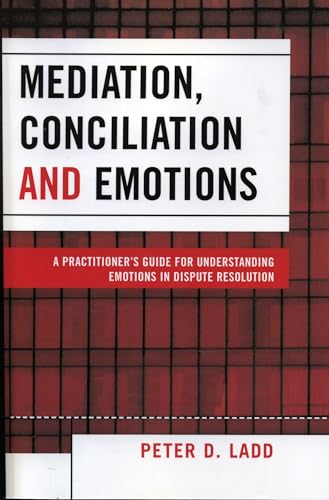

Mediation, conciliation, and emotions a practitioner's guide for understanding emotions in dispute resolution Peter D. Ladd.
Detalles de publicación: Lanham, Md. University Press of America, Inc. c2005.Descripción: xvii, 275 p. ill. 23 cmISBN:- 076183284X (pbk.)
- 9780761832843 (pbk.)
- 303.6/9 22
- HM 1126 .L33 2005
| Imagen de cubierta | Tipo de ítem | Biblioteca actual | Biblioteca de origen | Colección | Ubicación en estantería | Signatura topográfica | Materiales especificados | Info Vol | URL | Copia número | Estado | Notas | Fecha de vencimiento | Código de barras | Reserva de ítems | Prioridad de la cola de reserva de ejemplar | Reservas para cursos | |
|---|---|---|---|---|---|---|---|---|---|---|---|---|---|---|---|---|---|---|
| Libro | Biblioteca de Derecho Mons. Fremiot Torres Oliver Colección General biblioteca derecho | HM 1126 .L33 2005 (Navegar estantería(Abre debajo)) | Disponible | 70000000833397 |
Descripciones mejoradas de Syndetics:
Emotions impact any practitioner of dispute resolution; yet, there are very few programs with courses that explore the emotional side of disputes. In Mediation, Conciliation, and Emotions , Peter Ladd outlines the emotions found in disputes and how these emotions function in dispute resolution. The book is divided into two parts: emotions and mediation, and emotions and conciliation. These parts examine the phenomenon of mediation, how to control emotions during mediation sessions, and how different disputes require different modes of emotional reconciliation. Mediation, Conciliation, and Emotions offers practical advice and information about the role of emotions in dispute resolution. It is an indispensable tool for practitioners of dispute resolution.
Author Peter Ladd has developed a computer program which simplifies scoring of the "Emotional Climate Inventory" offered in the book's Appendix. This program can be accessed via St. Lawrence University Graduate School of Education's website at www.stlawu.edu/education.
Includes bibliographical references (p. [257]-267) and index.
Tabla de contenidos provista por Syndetics
- Introduction(p. 1)
- Behavior and Feelings(p. 1)
- Issues and Emotions(p. 2)
- 1 Issues-Oriented Dispute Resolution(p. 2)
- 2 Blending Issues and Emotions in Dispute Resolution(p. 3)
- 3 Emotions-Oriented Dispute Resolution(p. 3)
- Mediation and Conciliation(p. 5)
- 1 Comparing Mediation and Arbitration(p. 6)
- 2 Comparing Conciliation and Counseling(p. 7)
- 3 The Connection between Mediation and Conciliation(p. 8)
- Brief Summary(p. 9)
- Part I Emotions and Mediation(p. 11)
- Chapter 1 The Phenomenon of Mediation(p. 13)
- Case Study(p. 13)
- Understanding a Climate of Mediation(p. 13)
- Basic Mediation Skills(p. 17)
- 1 Creating Neutrality(p. 22)
- 2 Finding Common Ground(p. 22)
- 3 Isolating Issues(p. 25)
- 4 Choosing Options(p. 26)
- 5 Making Successful Agreements(p. 27)
- Three Styles of Mediation(p. 29)
- 1 Evaluative(p. 30)
- 2 Negotiating(p. 30)
- 3 Transformative(p. 31)
- 4 Emotions and Three Styles of Mediation(p. 32)
- Mediation Exercise(p. 33)
- Mediation Short Notes(p. 34)
- Chapter 2 Emotions and Mediation(p. 35)
- Case Study(p. 35)
- Mediating Anger(p. 36)
- Case Study(p. 38)
- Mediating Resentment(p. 39)
- Case Study(p. 41)
- Mediating Revenge(p. 42)
- Case Study(p. 43)
- Mediating Apathy(p. 44)
- Case Study(p. 46)
- Mediating Guilt(p. 47)
- Case Study(p. 49)
- Mediating Egotism(p. 50)
- Case Study(p. 51)
- Mediating Greed(p. 52)
- Case Study(p. 54)
- Mediating Jealousy(p. 55)
- Case Study(p. 56)
- Mediating Anxiety(p. 57)
- Case Study(p. 59)
- Mediating Hatred(p. 59)
- Part II Emotions and Conciliation(p. 61)
- Chapter 3 Anger and Conciliation(p. 63)
- Case Study(p. 63)
- Understanding an Emotional Climate of Anger(p. 64)
- Conciliating Anger(p. 67)
- 1 Understanding Unreasonable Thinking(p. 68)
- 2 Reducing Stress(p. 69)
- 3 Understanding Angry Explosions(p. 70)
- 4 Spatial Distance and the Window of Opportunity(p. 72)
- 5 The Importance of Closure(p. 73)
- An Alternative: A Climate of Reason(p. 74)
- An Emotional Climate Exercise(p. 78)
- Conciliators Short Notes(p. 79)
- Chapter 4 Resentment and Conciliation(p. 81)
- Case Study(p. 81)
- Understanding an Emotional Climate of Resentment(p. 83)
- Conciliating Resentment(p. 86)
- 1 Problems vs. Predicaments(p. 86)
- 2 A Climate of Choices(p. 88)
- 3 Challenging Buried Emotions(p. 88)
- 4 The Importance of Direct Communication(p. 90)
- 5 Victims of Mediocrity(p. 91)
- An Alternative: A Climate of Empowerment(p. 92)
- An Emotional Climate Exercise(p. 96)
- Concilators Short Notes(p. 97)
- Chapter 5 Revenge and Conciliation(p. 99)
- Case Study(p. 99)
- Understanding an Emotional Climate of Revenge(p. 101)
- Conciliating Revenge(p. 104)
- 1 Revenge as a Solution(p. 105)
- 2 Understanding Boundaries(p. 105)
- 3 A Right to Get Even(p. 106)
- 4 Choosing an Effective Plan(p. 107)
- 5 Rescuing People Frozen in Time(p. 108)
- 6 Physical and Psychological Retaliation(p. 108)
- An Alternative: A Climate of Justice(p. 109)
- An Emotional Climate Exercise(p. 114)
- Conciliators Short Notes(p. 115)
- Chapter 6 Apathy and Conciliation(p. 117)
- Case Study(p. 117)
- Understanding an Emotional Climate of Apathy(p. 119)
- Conciliating Apathy(p. 122)
- 1 The Anger, Resentment, Apathy Connection(p. 123)
- 2 Apathy and it's Relationship to Post-Traumatic Stress(p. 124)
- 3 The Power of Active Listening(p. 124)
- 4 Cynicism-The Language of Apathy(p. 125)
- 5 Regaining a Sense of Purpose(p. 126)
- An Alternative: A Climate of Hope(p. 127)
- An Emotional Climate Exercise(p. 132)
- Conciliators Short Notes(p. 133)
- Chapter 7 Guilt and Conciliation(p. 135)
- Case Study(p. 135)
- Understanding an Emotional Climate of Guilt(p. 137)
- Conciliating Guilt(p. 140)
- 1 "Walking on Egg Shells"(p. 141)
- 2 Social Pressure(p. 141)
- 3 The Problem with Labeling(p. 142)
- 4 Guilt Survives on Generalizations(p. 143)
- 5 The Safe Rut(p. 144)
- 6 Locus of Control(p. 145)
- An Alternative: A Climate of Respect(p. 146)
- An Emotional Climate Exercise(p. 150)
- Conciliators Short Notes(p. 151)
- Chapter 8 Egotism and Conciliation(p. 153)
- Case Study(p. 153)
- Understanding an Emotional Climate of Egotism(p. 155)
- Conciliating Egotism(p. 158)
- 1 The Futility of Arguing with an Egotist(p. 158)
- 2 The Broken Record Technique(p. 159)
- 3 Self-Centered and Self-Serving(p. 160)
- 4 Explaining and Describing a Point of View(p. 161)
- 5 The Insecurity of Being Alone(p. 162)
- An Alternative: A Climate of Humility(p. 163)
- An Emotional Climate Exercise(p. 168)
- Conciliators Short Notes(p. 169)
- Chapter 9 Greed and Conciliation(p. 171)
- Case Study(p. 171)
- Understanding an Emotional Climate of Greed(p. 173)
- Conciliating Greed(p. 175)
- 1 Cultural Implications for Greed(p. 176)
- 2 Connecting the Cognitive with the Emotional(p. 177)
- 3 Obsessed People Do Not Listen(p. 178)
- 4 Anything Goes!(p. 179)
- 5 Hoarding Behavior(p. 180)
- An Alternative: A Climate of Generosity(p. 181)
- An Emotional Climate Exercise(p. 186)
- Conciliators Short Notes(p. 187)
- Chapter 10 Jealousy and Conciliation(p. 189)
- Case Study(p. 189)
- Understanding an Emotional Climate of Jealousy(p. 191)
- Conciliating Jealousy(p. 194)
- 1 Losing Love(p. 194)
- 2 What Else Are People Afraid of Losing?(p. 195)
- 3 Heeding the Warming in Warning Signals(p. 197)
- 4 Claiming/Counter Claiming and Common Ground(p. 198)
- 5 The Irony of Using Force(p. 199)
- An Alternative: A Climate of Trust(p. 199)
- An Emotional Climate Exercise(p. 204)
- Conciliators Short Notes(p. 205)
- Chapter 11 Anxiety and Conciliation(p. 207)
- Case Study(p. 207)
- Understanding an Emotional Climate of Anxiety(p. 209)
- Conciliating Anxiety(p. 212)
- 1 Surviving Expectations(p. 213)
- 2 Expanding the Focus(p. 214)
- 3 The Difference between Worry and Concern(p. 215)
- 4 The Difference between Fear and Anxiety(p. 216)
- 5 The Art of Referral(p. 217)
- An Alternative: A Climate of Security(p. 217)
- An Emotional Climate Exercise(p. 222)
- Conciliators Short Notes(p. 223)
- Chapter 12 Hatred and Conciliation(p. 225)
- Case Study(p. 225)
- Understanding an Emotional Climate of Hatred(p. 228)
- Conciliating Hatred(p. 231)
- 1 Hatred as a Form of Dispute Resolution(p. 231)
- 2 The Revenge/Hatred Difference(p. 231)
- 3 The Trap of Hatred-Oriented Disputes(p. 233)
- 4 Prejudice, Racism and Terrorism(p. 234)
- 5 Psychological Tough Mindedness(p. 236)
- An Alternative: A Climate of Compassion(p. 237)
- An Emotional Climate Inventory(p. 242)
- Conciliator Short Notes(p. 243)
- Appendices(p. 245)
- 1 Understanding the Emotional Climate of a Dispute(p. 245)
- 2 Emotional Climate Inventory(p. 246)
- Bibliography(p. 257)
- Index(p. 269)