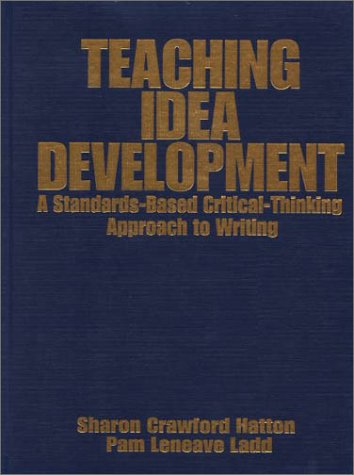

Teaching Idea Development a Standards based critical thinking approach to writing Sharon Crawford.
Detalles de publicación: Thousand Oaks, CA Corwin Press 2002.Descripción: xv, 121 p. 29 cmISBN:- 0761977589
- 808.042 H366t 2001
- LB1590.3 .H39 2002
| Imagen de cubierta | Tipo de ítem | Biblioteca actual | Biblioteca de origen | Colección | Ubicación en estantería | Signatura topográfica | Materiales especificados | Info Vol | URL | Copia número | Estado | Notas | Fecha de vencimiento | Código de barras | Reserva de ítems | Prioridad de la cola de reserva de ejemplar | Reservas para cursos | |
|---|---|---|---|---|---|---|---|---|---|---|---|---|---|---|---|---|---|---|
| Libro | Biblioteca de Mayagüez Colección General mb | LB1590.3 .H39 2002 (Navegar estantería(Abre debajo)) | Disponible | 50000002178191 |
Descripciones mejoradas de Syndetics:
"The most marvelously practical and engaging approach to come along in decades. It goes beyond the basics to take up very practical techniques that are terribly useful but not covered in most textbooks. All of us want our students to think critically and creatively - this book shows us how to teach them to do just that. A superb text." David R. Russell , Professor of English Iowa State University, Ames, IA
"A wealth of practical instruction activities to use in the classroom that can help students at all levels learn to flesh out the bare bones of their ideas. The world of effective writing, meant for authentic audiences and purposes, guides every suggestion made in this book." Jan Isenhour , Executive Director The Carnegie Center for Literacy and Learning Lexington, KY
"An excellent writing resource for teachers interested in helping students develop critical thinking skills. Loaded with specific objectives, student models, and classroom lessons, this book provides a catalog of useful strategies. New teachers, especially, should find this extremely useful." Harry Noden Author of Image Grammar Kent State University, Kent, OH
Turn good ideas into great writing with this hands-on guide!
Idea development is a concrete skill that can be taught in a systematic way, and this step-by-step guide provides educators in all content areas with the tools they need to help students think more critically and write with more fully developed ideas.
Hatton and Ladd, instructors with the esteemed Kentucky Writing Program, offer the reading-writing-thinking sequences that successful writers use when developing ideas. This teacher resource is chock-full of ideas that teachers in intermediate, middle, or secondary schools can implement immediately. Most important, the strategies and tactics offered are designed to work in the current highly rigorous, standards-based school environment, providing results that are both successful and measurable.
Teaching Idea Development explores the theory and practice of implementing idea development in the classroom, from identifying and solving common idea-development problems to strategies for teaching essential writing skills, including:
Description Comparison and contrast Cause and effect Dialogue Anecdotes Vignettes. . . and much more, in a lively, enthusiastic, and highly usable guide for teaching students how to think critically about their ideas as they express them effectively.
Includes bibliographical references (p. 121).
Tabla de contenidos provista por Syndetics
- Part 1 Implementing Idea Development in The Classroom
- Promoting Effective Writing
- Identifying and Solving Common Idea Development Problems
- Part 2 Strategies for Teaching Idea Development
- Purposeful Detail
- Description
- Compare and Contrast
- Cause and Effect
- Dialogue
- Anecdote
- Vignette
- Analysis
Notas de autor provistas por Syndetics
Sharon Crawford Hatton has been a teacher of writing and English for more than twenty years, with most of the last ten years as a consultant and advisor on writing. A long-time member of the Advisory Board of the Carnegie Center for Literacy and Learning, and a member of Advisory Board of the Bluegrass Writing Project since 1994, Hatton is currently a curriculum and assessment coordinator at the elementary school level. Her strengths include written and oral communications, participatory leadership skills, and the design development, and implementation of assessment-driven curriculum.
Pam Leneave Ladd has been active in literacy and writing programs for many years, including work as a P-12 consultant with the esteemed Kentucky Writing Program from 1990 to 1999. Currently a K-6 writing consultant for Cooper-Whiteside Elementary School in Paducah, Kentucky, Ladd is also the owner of Writing Connections, Inc., an educational consulting firm that promotes best practice teaching and curriculum development, especially as it relates to reading and writing integration. Ladd is also an accomplished group leader and presenter of hundreds of professional development workshops and conference sessions since 1986.