Imagen de Amazon.com

Portada de Syndetics
Imagen de OpenLibrary
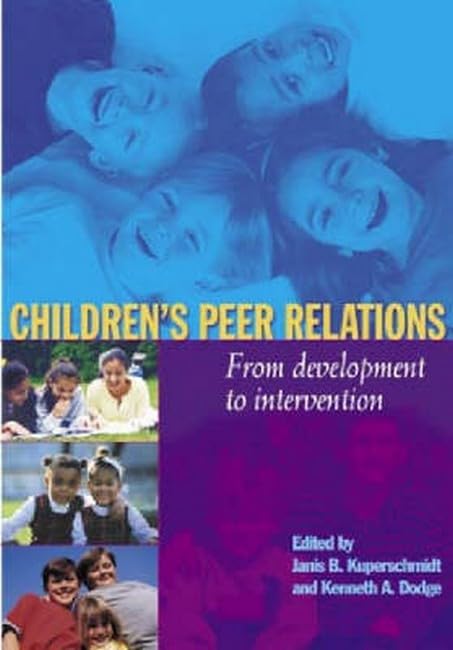
Children's peer relations from development to intervention edited by Janis B. Kupersmidt and Kenneth A. Dodge.
Series Decade of behaviorDetalles de publicación: Washington, DC American Psychological Association c2004.Descripción: xvi, 289 p. ill. 27 cmISBN:- 1591471052 (hardcover : alk. paper)
- 155.418 C5367 22
- BF723.I646 C48 2004
- 2004 H-152
- WS 105.5.I5
Recursos en línea:
| Imagen de cubierta | Tipo de ítem | Biblioteca actual | Biblioteca de origen | Colección | Ubicación en estantería | Signatura topográfica | Materiales especificados | Info Vol | URL | Copia número | Estado | Notas | Fecha de vencimiento | Código de barras | Reserva de ítems | Prioridad de la cola de reserva de ejemplar | Reservas para cursos | |
|---|---|---|---|---|---|---|---|---|---|---|---|---|---|---|---|---|---|---|
| Libro | Biblioteca Encarnación Valdés Colección General bev | 155.418 C5367 (Navegar estantería(Abre debajo)) | Disponible | 80000002274135 |
Total de reservas: 0
Descripciones mejoradas de Syndetics:
Children's Peer Relations is a compilation of virtually everything that is known about the association between children's peer relations and the development of peer rejection, aggression, and antisocial behavior. Looking beyond the peer rejection process, this volume also covers dyadic relationships, cliques, and associations with difference types of peers as well as the effects of family influences. It is comprehensive in covering the last three decades of research that connect the dynamical features of the social and emotional processes associated with peer problems in childhood and mediators of peer experiences.
Includes bibliographical references and indexes.
Tabla de contenidos provista por Syndetics
- Contributors(p. ix)
- Foreword(p. xi)
- Preface(p. xiii)
- Part I. Peer Status in Context(p. 1)
- 1. Sociometric Status and Peer Group Behavior: Previous Findings and Current Directions(p. 3)
- 2. Gender and Peer Relations: Are the Two Gender Cultures Really All That Different?(p. 21)
- 3. Friendships, Peer Networks, and Antisocial Behavior(p. 37)
- Part II. Social-Cognitive and Emotional Processes(p. 59)
- 4. Social Information Processing and Children's Social Adjustment(p. 61)
- 5. Children's Understanding and Regulation of Emotion in the Context of Their Peer Relations(p. 81)
- 6. Understanding the Experience of Peer Rejection(p. 101)
- 7. How Peer Problems Lead to Negative Outcomes: An Integrative Mediational Model(p. 119)
- Part III. Family Influences(p. 139)
- 8. Parents' Relationships With Their Parents and Peers: Influences on Children's Social Development(p. 141)
- 9. From Family Relationships to Peer Rejection to Antisocial Behavior in Middle Childhood(p. 159)
- Part IV. Intervention and Prevention(p. 179)
- 10. The Fast Track Experiment: Translating the Developmental Model Into a Prevention Design(p. 181)
- 11. If You Can't Beat 'em ... Induce Them to Join You: Peer-Based Interventions During Adolescence(p. 209)
- 12. Research Meets the Real World: Lessons Learned in Three Community Implementations of Fast Track(p. 223)
- Part V. Conclusion(p. 241)
- 13. The Impact of Negative Social Experiences on the Development of Antisocial Behavior(p. 243)
- Author Index(p. 269)
- Subject Index(p. 281)
- About the Editors(p. 289)