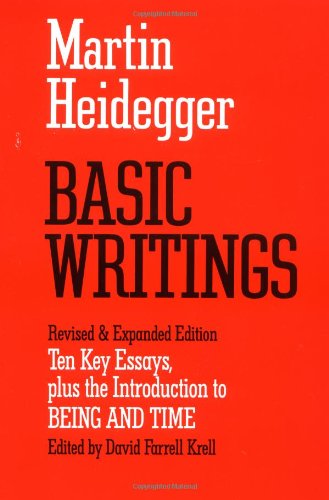

Basic writings from Being and time (1927) to The task of thinking (1964) Martin Heidegger ; edited, with general introduction and introductions to each selection by David Farrell Krell.
Idioma: Inglés Lenguaje original: Alemán Detalles de publicación: [San Francisco, Calif.] HarperSanFrancisco c1993.Edición: Rev. and expanded edDescripción: xii, 452 pISBN:- 0060637633 (acid-free paper)
- 193 20
- B3279.H47 E5 1992
| Imagen de cubierta | Tipo de ítem | Biblioteca actual | Biblioteca de origen | Colección | Ubicación en estantería | Signatura topográfica | Materiales especificados | Info Vol | URL | Copia número | Estado | Notas | Fecha de vencimiento | Código de barras | Reserva de ítems | Prioridad de la cola de reserva de ejemplar | Reservas para cursos | |
|---|---|---|---|---|---|---|---|---|---|---|---|---|---|---|---|---|---|---|
| Libro | Biblioteca Encarnación Valdés Colección General bev | 193 H465b (Navegar estantería(Abre debajo)) | Disponible | 80000001734931 |
Descripciones mejoradas de Syndetics:
Heidegger's most popular collection of essential writings, now revised and expanded -- includes the 10 key essays plus the introduction to Being and Time.
Includes bibliographical references (p. [450]-452).
Being and time : introduction -- What is metaphysics? -- On the essence of truth -- The origin of the work of art -- Letter on humanism -- Modern science, metaphysics, and mathematics -- The question concerning technology -- Building dwelling thinking -- What calls for thinking? -- The way to language -- The end of philosophy and the task of thinking.
Notas de autor provistas por Syndetics
Martin Heidegger was born in Messkirch, Baden, Germany on September 22, 1889. He studied Roman Catholic theology and philosophy at the University of Frieburg before joining the faculty at Frieburg as a teacher in 1915. Eight years later Heidegger took a teaching position at Marburg. He taught there until 1928 and then went back to Frieburg as a professor of philosophy.As a philosopher, Heidegger developed existential phenomenology. He is still widely regarded as one of the most original philosophers of the 20th century. Influenced by other philosophers of his time, Heidegger wrote the book, Being in Time, in 1927. In this work, which is considered one of the most important philosophical works of our time, Heidegger asks and answers the question "What is it, to be?" Other books written by Heidegger include Basic Writings, a collection of Heidegger's most popular writings; Nietzsche, an inquiry into the central issues of Friedrich Nietzsche's philosophy; On the Way to Language, Heidegger's central ideas on the origin, nature and significance of language; and What is Called Thinking, a systematic presentation of Heidegger's later philosophy.
Since the 1960s, Heidegger's influence has spread beyond continental Europe and into a number of English-speaking countries. Heidegger died in Messkirch on May 26, 1976.
(Bowker Author Biography)