Reseñas proporcionadas por Syndetics
Library Journal Review
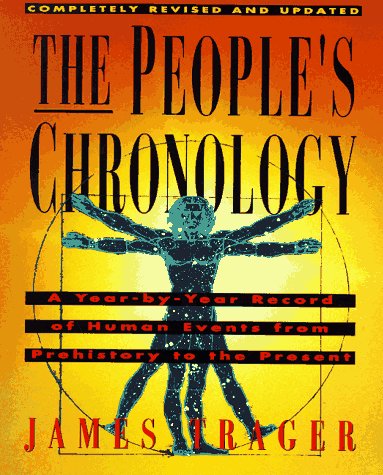
Trager's revised and updated chronology, first issued in 1979 ( LJ 9/1/79), joins a bevy of similar sources, including the recently published Chronicle of the World (Prentice-Hall Pr., 1990), The New York Public Library Book of Chronologies ( LJ 1/91), and a third edition of Bernard Grun's well-known The Timetables of History (Touchstone: S. & S., 1991). Of these works, Trager's packs in the most facts, conveyed via relatively lengthy accounts in two-column pages of more than 30,000 events covering all major areas of human endeavor from three million B.C. through 1990. Although the revised edition contains only about 40 more pages than its predecessor, much new material has been added, most obviously for recent years; likewise, much has been cut from the original, most of which will not be missed. The index--justifiably criticized as inadequate in the first edition--has been greatly expanded but remains an imperfect finding device; the 13-line account of Augustus Deodat Taylor's prefabricated house (the so-called ``balloon-frame'' house), for instance, is not indexed under such logical headings as ``architecture,'' ``buildings,'' ``construction,'' ``housing,'' or ``Taylor.'' Entries in the text are loosely grouped by topic, designated by graphic symbols (dollar sign, artist's palette, mortarboard, etc.), but the symbols tend to be too numerous and ambiguous to serve as effective guides for pinpointing specific information. On balance, Trager's tome succeeds more as a browsing item than as a work for serious reference. Librarians will still prefer the standard, Grun.-- Kenneth F. Kister, author of ``Best Encyclopedias,'' Tampa, Fla. (c) Copyright 2010. Library Journals LLC, a wholly owned subsidiary of Media Source, Inc. No redistribution permitted.
School Library Journal Review
YA-- This chronological desk reference for social and political history covers prehistory through 1991. The concise, although chatty, entries are arranged by category (identified by a symbol in the left margin). A comprehensive index is included. Although one may initially plan to search for a specific bit of information, both the style and content make it difficult to stop reading. Students can locate information for assignments and collect data to bring conventional reports to life. Those working on decade reports will find popular songs, political figures, major events, hit movies, and much more. All will garner a better understanding of politics, daily life, and the arts during any time period, and almost any region of the world. Or, they can simply bone up on trivia through the centuries.-- Barbara Hawkins, West Potomac High School, Fairfax, VA (c) Copyright 2010. Library Journals LLC, a wholly owned subsidiary of Media Source, Inc. No redistribution permitted.
Booklist Review
This chronology, an update of the first edition published in 1979 [RSBR Jl 1 80], contains over 30,000 entries. A "revised" chronology often only has the most recent years tacked on at the end of an otherwise unrevised book. This book, however, has been revised throughout. The publisher claims one-quarter of the material is new; some items have been dropped. Entries typically consist of a brief paragraph describing a particular event. Within a year, events are arranged not by date but by subject. Events are classified with graphic symbols beside them, in 30 different categories, including politics, economics, literature, architecture, crime, music, theater, food, and even tobacco. This system requires that the reader remember what each symbol stands for, or keep referring back to the key located at the beginning. One year may stretch over many pages; the year is noted only in the upper corner of each left-hand page. Until the reader figures this out, it can be difficult to know exactly where one is. The first edition ended with 1973, the last entry being the now famous Roe v. Wade Supreme Court decision. This update goes up through 1991 and covers the events surrounding the Gulf War. The initial section, labeled "Prehistory," begins with three million B.C. and the appearance of Australopithecines. Coverage seems to be heavily weighted toward Western history, and in the twentieth century, toward American. There is a considerable amount of editorial comment. One entry for 1990 points out that it costs more to keep a prisoner incarcerated for a year than it would to send him to Harvard, "but construction of jail cells continues at the expense of education, health care and other budget items." A comprehensive index helps guide users to specific areas of interest. The People's Chronology is more detailed than The Timetables of History (3d ed., Simon & Schuster, 1991). Academic, public, and high school libraries will want to consider purchasing the revised edition of this mammoth chronology. (Reviewed May 15, 1992)