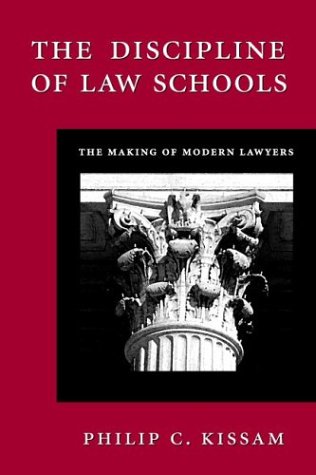

The discipline of law schools the making of modern lawyers Philip C. Kissam.
Detalles de publicación: Durham, N.C. Carolina Academic Press c2003.Descripción: ix, 280 p. 23 cmISBN:- 089089390X
- KF 272 .K 58 2003
| Imagen de cubierta | Tipo de ítem | Biblioteca actual | Biblioteca de origen | Colección | Ubicación en estantería | Signatura topográfica | Materiales especificados | Info Vol | URL | Copia número | Estado | Notas | Fecha de vencimiento | Código de barras | Reserva de ítems | Prioridad de la cola de reserva de ejemplar | Reservas para cursos | |
|---|---|---|---|---|---|---|---|---|---|---|---|---|---|---|---|---|---|---|
| Libro | Biblioteca de Derecho Mons. Fremiot Torres Oliver Colección General biblioteca derecho | KF 272 .K58 2003 (Navegar estantería(Abre debajo)) | Disponible | 70000000756580 |
Descripciones mejoradas de Syndetics:
This book takes a comprehensive look at the basic practices, ideas and habits in American law schools. By examining the many interrelationships between these practices and ideas, Kissam discloses the implicit or tacit knowledge about law and lawyers that is produced in unintended ways by legal education. This knowledge empowers law students and professors, but it also creates tendencies or predispositions among them to think about the law and lawyering in ways that substantially limit the study of law and legal practice. Most importantly, the disciplinary web of interrelationships among practices and ideas helps to create (1) an excessive focus upon acquiring limited technical skills and knowledge, to the detriment of practicing with and acquiring the more complex skills of legal interpretation, legal argument and making difficult legal and ethical judgments; (2) the promotion of useful but superficial reading and writing habits that limit the communicative skills of many lawyers; and (3) the implicit or unintended development of unduly conservative views about the nature of law, legal practices and legal ethics.
The book draws on contemporary political theory and philosophy to develop an original ethical basis for evaluating and possibly altering the discipline of law schools in ways that could promote more effective, more democratic and more humane legal education.
This book may motivate law professors to carefully contemplate or alter their current educational practices, and it may also help lawyers obtain a better understanding of their own legal traits and of the nature of new law graduates with whom they work.
"[T]his book must certainly be read by all future law students as well as legal eductors. In addition, it would be an excellent acquisition for all undergraduate pre-law studies collections." -- Bimonthly Review of Law Books, November/December 2004
Includes bibliographical references and index.
Tabla de contenidos provista por Syndetics
- Acknowledgments(p. ix)
- Introduction(p. 3)
- Chapter 1. Basic Practices(p. 17)
- Elite and Non-Elite Law Schools(p. 19)
- Professional Expectations(p. 23)
- The Core Curriculum(p. 25)
- Casebooks(p. 31)
- The Case Method(p. 37)
- Law School Examinations(p. 50)
- The Institutions of Scholarship(p. 58)
- The Placement Process(p. 66)
- Chapter 2. Space and Time(p. 71)
- Spatial Relationships(p. 71)
- The Buildings(p. 72)
- Amphitheatre Classrooms(p. 73)
- Courtrooms and Clinics(p. 77)
- Other Spaces(p. 78)
- Temporal Relationships(p. 81)
- Student Rhythms(p. 81)
- Faculty Rhythms(p. 85)
- Chapter 3. Disciplinary Techniques(p. 93)
- Invisibilities(p. 93)
- Coolness(p. 96)
- Rituals, Symbols, Myths(p. 99)
- The Examinatorial Regime(p. 105)
- A Confessional Technology(p. 113)
- The Discourse of Law Schools(p. 117)
- Coda: The Pleasures of the Discipline(p. 120)
- Chapter 4. Reform(p. 125)
- The Reform Tradition(p. 127)
- The Professional Reforms(p. 134)
- Legal Writing Programs(p. 138)
- Clinical Education(p. 146)
- Professional Ethics(p. 154)
- Academic/Political Movements(p. 160)
- Law and Economics(p. 164)
- The Law and Society Movement(p. 167)
- Law and Literature(p. 170)
- Critical Legal Studies(p. 172)
- Feminist Jurisprudence(p. 175)
- Critical Race Theory(p. 180)
- Chapter 5. Foreign Relations(p. 185)
- The Diffuse Influence of Legal Practices(p. 185)
- Corporate Law Firms(p. 188)
- The Judicial System(p. 200)
- The Organized Bar(p. 203)
- The Research University(p. 211)
- The State and Culture(p. 220)
- Chapter 6. Ethics(p. 227)
- Major Consequences of the Discipline(p. 228)
- Possible Selves, Possible Ethics(p. 231)
- The Ethics of a Dialogical Self(p. 243)
- The Moral Conversation(p. 245)
- Deconstructing the Discipline(p. 249)
- Reconstructions(p. 260)
- Epilogue: Our Disciplinary Future(p. 269)
- Index(p. 277)